Hello! In our last lesson, we established that the cell membrane is a fantastic barrier, a phospholipid bilayer that keeps the watery, ion-filled environments inside and outside the cell separate. But we ended with a critical question: if the membrane blocks ions, how does a neuron—a cell that runs on electrical signals involving ions—actually work?
Today, we answer that question by turning our attention to proteins. These are the molecules that do the heavy lifting in the cell. You can think of them as the specialized machines, tools, and communicators embedded in and around the cell's structures. Our goal is to define what proteins are and explain their diverse roles, focusing on three functions that are absolutely central to neuroscience: enzymes, receptors, and channels.
An Overview of Proteins: The Cell's Workhorses
Before we dive into the details, let's get a broad overview. Proteins are responsible for almost everything a cell does, from providing structural support to carrying out complex chemical reactions. The short video below from Nucleus Biology provides an excellent introduction to the variety and importance of proteins.
This video, "Proteins," gives a concise summary of what proteins are, what they are made of, and the diverse functions they perform. It also introduces a key concept we'll return to: denaturation.
Please watch the entire video. As you watch, pay close attention to: The different examples of protein functions mentioned at the beginning. The explanation of amino acids as building blocks and how they form polypeptides in the middle section. The critical relationship between a protein's shape and its function, including the concept of denaturation near the end.
As the video highlighted, all proteins, despite their vast differences in function, are constructed from the same set of 20 building blocks called amino acids.
The Structure of a Protein
A protein is a polymer, which is a large molecule made by linking together many smaller, repeating units called monomers. For proteins, the monomer is the amino acid. These amino acids are linked together in a long chain called a polypeptide. A functional protein can be made of one or more of these polypeptide chains, folded into a specific three-dimensional shape.
To understand how this works, let's look more closely at the building blocks and how they connect.
Introduction to proteins and amino acids (article)
This article from Khan Academy will walk you through the structure of amino acids and the way they are linked together to form polypeptides.
Please read the sections titled "Amino acids" and "Peptide bonds." Focus on the basic structure of an amino acid: the central carbon, the amino group, the carboxyl group, and the R group. Note the key idea that the R group is what makes each of the 20 amino acids unique. Then, in the section on peptide bonds, understand how these amino acids are linked head-to-tail to form a polypeptide chain through a peptide bond.
The crucial takeaway from this reading is that a polypeptide is a specific sequence of different amino acids. This sequence is what determines everything else about the protein. The chemical properties of the amino acid R groups (e.g., whether they are charged, polar, or nonpolar) cause the polypeptide chain to twist and fold into a complex, stable, three-dimensional shape.
As the video mentioned, a protein's shape is critical to its function. If that shape is disrupted—a process called denaturation—the protein can no longer do its job. This is why factors like temperature and pH are so tightly controlled in the body.
Three Key Roles of Proteins in Neuroscience
Now that we have a grasp of what a protein is, let's explore the three functions mentioned in our learning goal: enzymes, receptors, and channels.
1. Enzymes: The Cell's Catalysts
An enzyme is a protein that acts as a biological catalyst. It speeds up a chemical reaction without being consumed in the process. In neuroscience, enzymes are vital for countless processes, including the synthesis and breakdown of neurotransmitters (the chemical messengers we will study in detail later).
Protein Function | Learn Science at Scitable - Nature
The article "Protein Function" from Nature Education explains how enzymes work.
Please read the section "How Do Proteins Aid the Biochemical Reactions of a Cell?". Focus on how enzymes lower the activation energy of a reaction and the "lock and key" analogy for how an enzyme binds to its specific starting material, or substrate.
Enzymes are incredibly specific. Each enzyme typically recognizes only one or a few types of substrate molecules, binding to them at a location called the active site. This specificity allows for precise control over the cell's chemistry.
2. Receptors: The Cell's Sensors
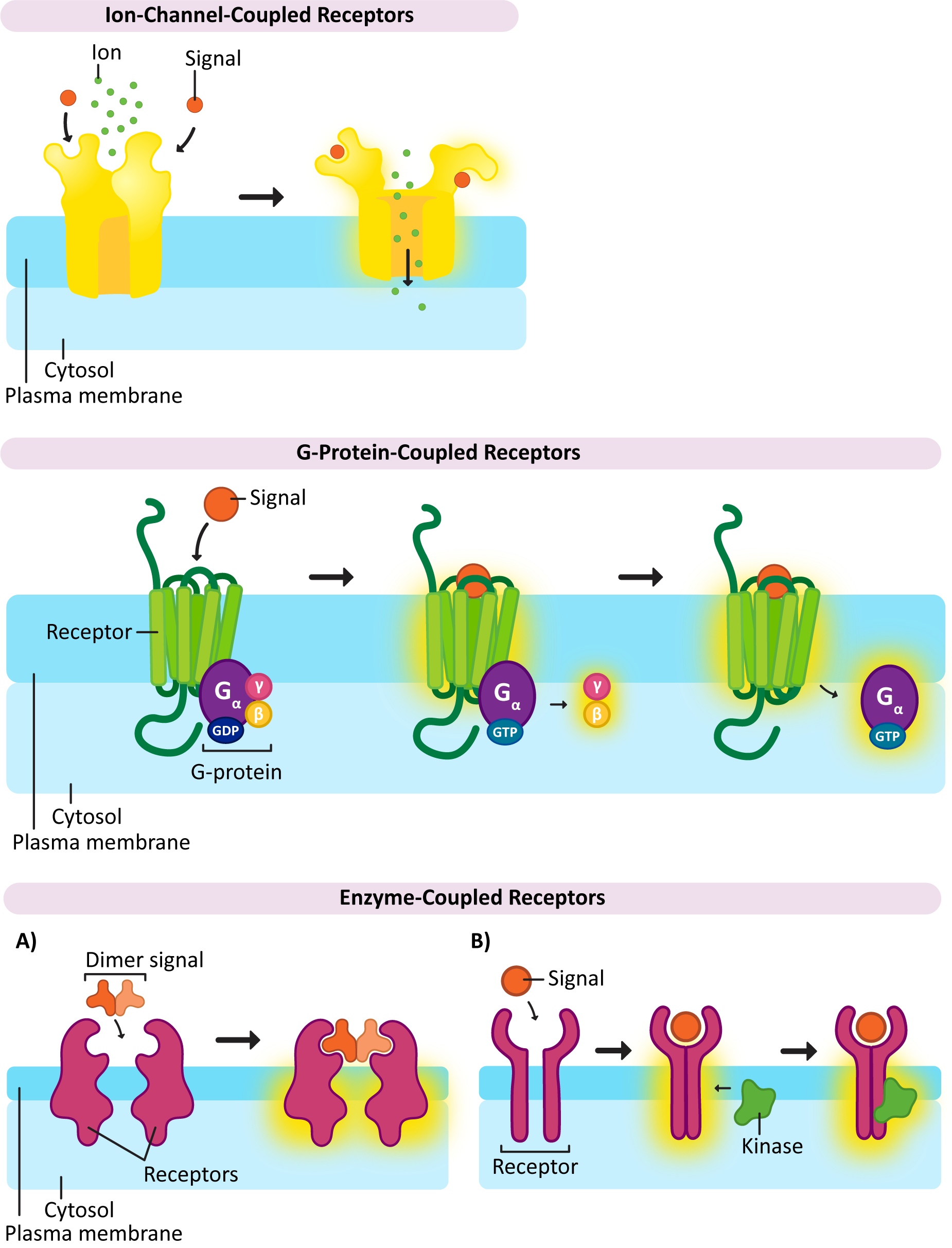
A receptor is a protein that receives signals from outside the cell. When a specific signaling molecule, such as a hormone or a neurotransmitter, binds to its corresponding receptor, it triggers a change inside the cell. This is the primary way that neurons communicate with each other.
The binding of the signal molecule (called a ligand) to the receptor is like a key fitting into a lock. This causes the receptor protein to change its shape, which in turn initiates a cascade of events within the cell.
The image below illustrates three major classes of receptors found on the cell surface. For now, focus on the general principle: a signal arrives, binds to a receptor protein, and causes something to happen.
3. Channels and Transporters: The Cell's Gates and Pumps
This brings us back to where we started. If the lipid bilayer blocks ions, proteins provide the way across. Channel proteins and transporter proteins are embedded in the cell membrane and manage the traffic of substances that cannot cross the lipid bilayer on their own.
- Channels form tiny, hydrophilic pores through the membrane. When open, they allow specific ions (like Na⁺, K⁺, or Cl⁻) to flow through, driven by diffusion and electrical forces. Many of these channels have "gates" that open or close in response to specific signals.
- Transporters (or carriers) bind to the substance they are moving and physically shuttle it across the membrane by changing their shape. Some of these, known as pumps, use energy to move substances against their concentration gradient.
The image below shows several types of ion channels, which are fundamental to a neuron's ability to generate electrical signals.
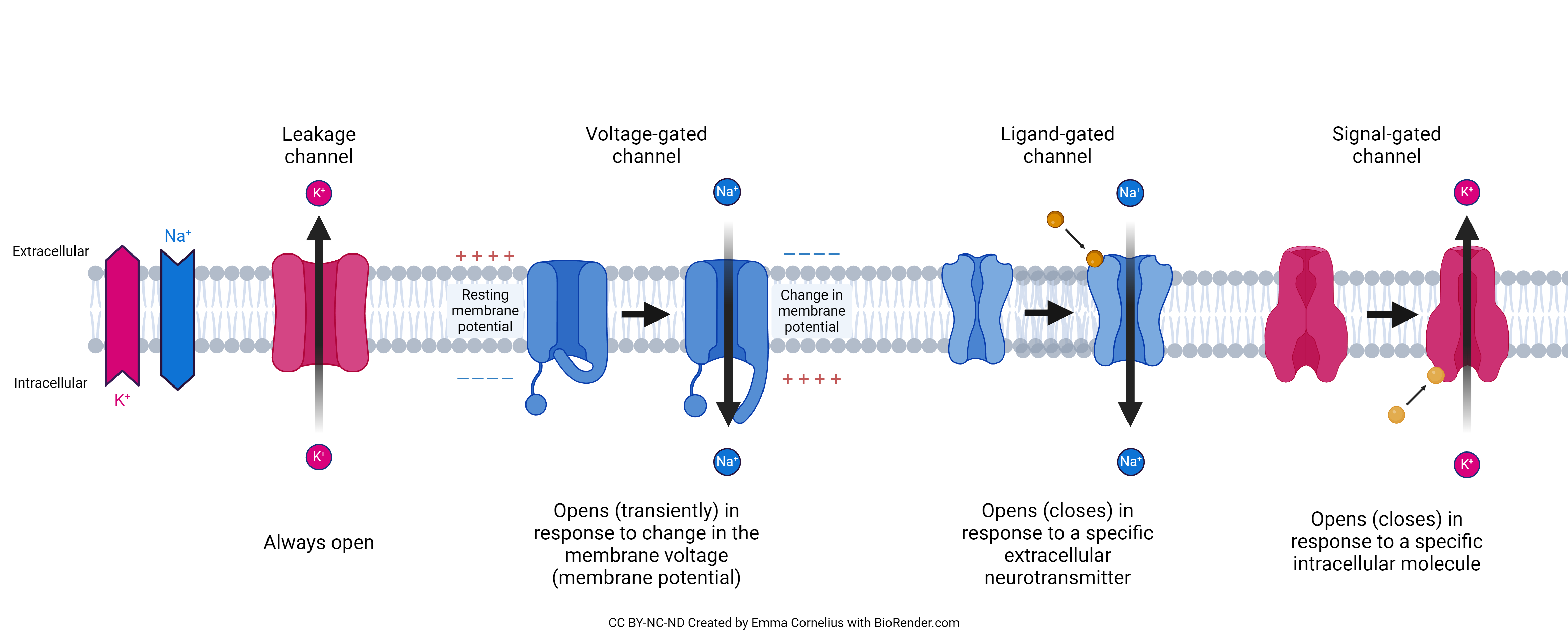
Notice the "Ligand-gated channel" in the diagram. This is a perfect example of how protein functions can overlap: it is both a receptor (it binds a ligand) and a channel (it opens a pore for ions). This type of protein is a cornerstone of communication between neurons.
Conclusion
In this lesson, we have moved from the passive barrier of the lipid membrane to the active, functional world of proteins. You now know that proteins are the "doers" of the cell, whose functions are determined by their intricate, folded shapes.
Here are the key takeaways:
- Proteins are complex macromolecules made from chains of amino acids called polypeptides.
- A protein's specific three-dimensional shape determines its function.
- Three critical roles for proteins in neuroscience are:
- Enzymes, which catalyze biochemical reactions.
- Receptors, which receive signals from other cells.
- Channels and transporters, which control the movement of ions and other molecules across the cell membrane.
We have now set the stage for understanding how a neuron maintains its electrical charge. In the next lesson, we will focus on one of the most important proteins in the entire nervous system: the sodium-potassium pump. We'll see how this specific transporter protein works together with ion channels to establish the foundation of all neural signaling.