Introduction
Welcome to your next lesson on core training. In our previous session, we established the critical importance of creating spinal stability through the bracing maneuver. You learned how to generate intra-abdominal pressure (IAP) by coordinating your diaphragm, transversus abdominis (TVA), and pelvic floor to turn your torso into a rigid, pressurized cylinder. This is the foundation of safe and powerful lifting.
Today, we build directly on that foundation. The learning outcome for this lesson is to select exercises that target the rectus abdominis and obliques through their full contractile range, including anti-movement patterns (e.g., anti-extension).
Now that you know how to stabilize your core, we will explore how to train the "six-pack" muscles (rectus abdominis) and the obliques. We'll examine how to train them through dynamic movements for hypertrophy and, just as importantly, how to challenge your bracing ability by training them to resist movement. This dual approach is the key to building a core that is not only well-developed but also exceptionally functional.
The Two Pillars of Core Training: Movement and Anti-Movement
A comprehensive core training program is built on two complementary principles: training the core to create movement and training it to prevent movement.
-
Movement-Based Training: This involves dynamic, full-range-of-motion exercises where the spine flexes, laterally bends, or rotates. These exercises are excellent for stimulating hypertrophy by taking muscles like the rectus abdominis and obliques through their full contractile range, from a lengthened (stretched) position to a shortened (contracted) position.
-
Anti-Movement Training: This involves resisting external forces that try to pull your spine out of its neutral, braced position. This is a direct application of the IAP and bracing skills you learned in the last lesson. These isometric or quasi-isometric exercises are paramount for building functional strength that transfers directly to your compound lifts and protects your spine from injury.
Let's explore how to apply these principles to the rectus abdominis and obliques.
Rectus Abdominis: Training Spinal Flexion and Anti-Extension
The rectus abdominis, the "six-pack" muscle, runs vertically from your pubic bone up to your sternum and lower ribs. Its primary function is trunk flexion—bringing your ribcage and pelvis closer together, as in a crunch.
Training Through the Full Contractile Range
To train the rectus abdominis for hypertrophy, we need to challenge it through its entire range of motion.
- Lengthened Position: The rectus abdominis is stretched when the spine is neutral or slightly extended.
- Shortened Position: It is fully contracted when the spine is maximally flexed.
To appreciate the difference between a high-quality, full-range movement and a poorly executed one, let's look at the reverse crunch.
Anti-Core Training For Banged Up Meatheads
The article 'Anti-Core Training For Banged Up Meatheads' by Dr. John Rusin provides a fantastic explanation of how to perform a reverse crunch properly. This version maximizes the training stimulus on the rectus abdominis while teaching you to control the eccentric phase.
Read the section titled 'Anti-Extension Core Training'. Pay close attention to the setup with the foam roller and the emphasis on the controlled eccentric (lowering) phase of the movement. This controlled lowering is where you resist extension.
As the article explains, the key is the slow, controlled eccentric lowering. This is where you actively resist gravity's pull, which is trying to arch your lower back. By doing so, you are training the rectus abdominis through its full range while simultaneously practicing anti-extension.

Training Anti-Extension
Anti-extension is the ability to prevent your lumbar spine from arching or hyperextending. This is arguably the most important core function for lifts like the overhead press, squat, and even the bench press, where there's a tendency to flare the ribs and lose spinal position.
The 4 Layers of Your Core—And How to Train Each One
The video 'The 4 Layers of Your Core' offers a great overview of the rectus abdominis and its role in both flexion and anti-extension.
Watch the first segment, from 00:19 to 03:05. Notice how the presenter emphasizes that the rectus abdominis is crucial for resisting spinal extension, providing examples like the plank and ab-wheel rollout.
Exercises that train anti-extension challenge your ability to maintain the braced, neutral-spine position you practiced in the last lesson.
- Key Anti-Extension Exercises: Planks, Ab-wheel Rollouts, Dead Bugs, Hollow-body Holds.
In these movements, the goal is to keep the ribs down and prevent the lower back from lifting off the floor or sagging toward it.
The Obliques: A Multi-Planar Approach
The obliques are a set of two muscles on each side of your torso: the external and internal obliques. Their fibers run diagonally and work together to produce and resist movement in multiple planes.
- External Obliques: Fibers run downward and inward, like putting your "hands in your pockets."
- Internal Obliques: Fibers run upward and inward, perpendicular to the externals.
Let's see how their functions dictate our exercise selection.
The Comprehensive Core Training Guide
To understand how to train the obliques, we need to grasp their functions in rotation and side-bending. The 'Comprehensive Core Training Guide' from Stronger by Science provides a clear, categorized list of exercises for each core function.
Read the sections titled 'Trunk Lateral Flexion' and 'Trunk Rotation'. For each section, note the primary muscles involved and the distinction between dynamic (movement-based) and isometric (anti-movement) exercise examples.
Based on the resource and their anatomy, the obliques have three primary pairs of functions we need to train:
1. Trunk Rotation & Anti-Rotation
- Rotation (Movement): When you rotate your torso to the right, your left external oblique and right internal oblique work together. This "cross-body" action is what allows you to twist.
- Exercises: Cable Wood Chops, Cable Rotations, Russian Twists.
- Anti-Rotation (Anti-Movement): This is the ability to resist a force trying to twist your torso. It is crucial for stabilizing the spine during unilateral movements (like a single-arm row) and for transferring power in athletic activities.
- Exercises: Pallof Press, Unilateral Dumbbell/Cable Presses and Rows. In a Pallof press, the cable is trying to twist you, and your obliques are working isometrically to prevent that rotation.
2. Lateral Flexion & Anti-Lateral Flexion
- Lateral Flexion (Movement): This is side-bending. When you bend to your right, your right internal and external obliques work together.
- Exercises: Dumbbell/Cable Side Bends, Side Crunches on a hyperextension machine.
- Anti-Lateral Flexion (Anti-Movement): This is the ability to resist being pulled into a side-bend. It's essential for carrying uneven loads.
- Exercises: Side Planks, Suitcase Carries, Single-Arm Farmer's Walks, Suitcase Deadlifts. In a suitcase carry, the weight in one hand is trying to pull you into a side-bend, and your opposite-side obliques must fire to keep your torso upright.
This video provides a great summary of training the obliques with both rotational and side-bending movements.
Grow Your Obliques | Learn Biomechanics
Ben Yanes provides clear, practical examples of how to train the obliques for hypertrophy using both rotational and side-bending movements.
Watch from 00:34 to 04:16. Note the anatomical explanation of how the obliques work together for rotation. Then, observe the specific exercise examples for rotation (cable rotation) and side-bending (hyperextension side-bend) and the emphasis on creating a stable base.
A Framework for Complete Core Training
To ensure you're training your core comprehensively, your program should include exercises that address each primary function. Think of it as a checklist.
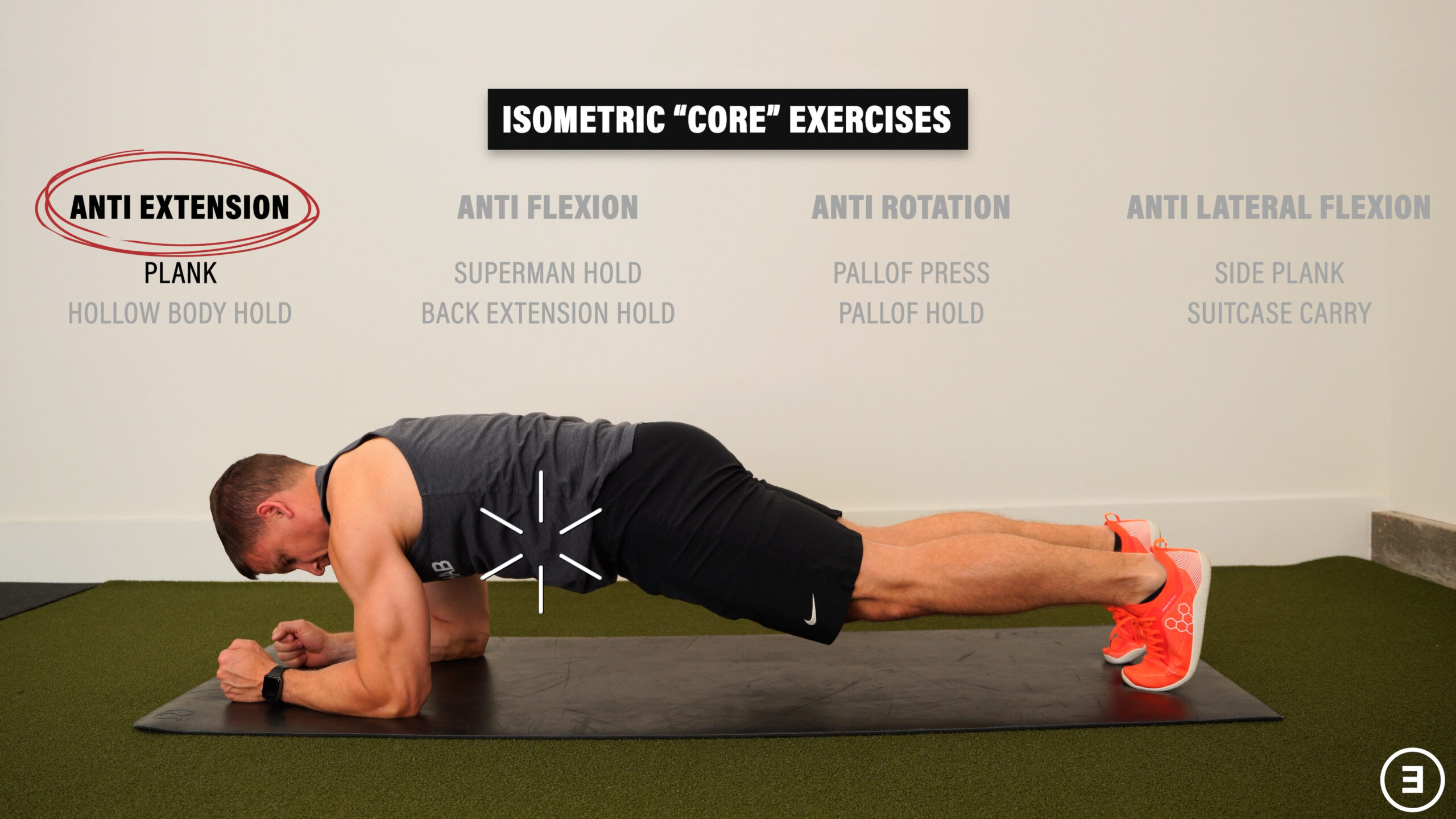
Here's a table to organize your exercise selection:
| Muscle Group | Movement Pattern | Example Movement-Based Exercise | Example Anti-Movement Exercise |
|---|---|---|---|
| Rectus Abdominis | Spinal Flexion | Hanging Leg Raise, Reverse Crunch | Plank, Ab-Wheel Rollout |
| Obliques | Spinal Rotation | Cable Wood Chop, Russian Twist | Pallof Press |
| Obliques | Spinal Lateral Flexion | Side Bend (Cable or Dumbbell) | Side Plank, Suitcase Carry |
Coach's Note: For hypertrophy, dynamic movements (the "Movement-Based" column) performed with controlled tempo in the 10-20 rep range are highly effective. Anti-movement exercises are fantastic as part of a warm-up to activate the core, or as "finishers" at the end of a workout to build isometric endurance and reinforce proper bracing patterns under fatigue.
Conclusion
You now have a complete framework for training the anterior and lateral core. It's not just about doing endless crunches; it's about systematically challenging the muscles through all their functions.
Key Takeaways:
- A complete core program addresses both movement (flexion, rotation, lateral flexion) and anti-movement (anti-extension, anti-rotation, anti-lateral flexion).
- Rectus Abdominis is trained through spinal flexion (e.g., reverse crunches) and by resisting spinal extension (e.g., planks).
- Obliques are trained through spinal rotation (e.g., wood chops) and lateral flexion (e.g., side bends), and by resisting those same forces (e.g., Pallof press, suitcase carries).
- Selecting exercises from each category ensures you build a core that is strong, stable, and well-developed, bridging the gap between aesthetics and performance.
Preview of the Next Lesson
We have now covered the major muscle groups of the torso. In our next lesson, we will move down the kinetic chain to the lower legs. The learning outcome will be to describe the anatomy of the gastrocnemius and soleus, and justify the use of both bent-knee and straight-knee positions for complete calf development. You'll discover why these two muscles, which make up your "calves," require distinct strategies to be trained effectively.