Introduction
Welcome to your next lesson. In our previous session, we built a comprehensive framework for core training, learning how to select exercises that train the rectus abdominis and obliques through their full contractile range using both movement and anti-movement patterns. This established the principle of training a muscle based on all its anatomical functions.
Today, we apply that same detailed approach as we move down the kinetic chain to the lower legs. Our learning outcome is to describe the anatomy of the gastrocnemius and soleus, and justify the use of both bent-knee and straight-knee positions for complete calf development.
The calf muscles are notoriously stubborn to grow for many people. This is often because training programs fail to account for the unique anatomical structure of the two primary muscles involved. By the end of this lesson, you will understand precisely why a one-size-fits-all approach to calf training is ineffective and how to structure your training for complete development.
The Anatomy of the Calves: The Triceps Surae
What we commonly call the "calves" is a muscle group known as the triceps surae, meaning the "three-headed muscle of the calf." This group is composed of two distinct muscles: the gastrocnemius and the soleus.
The Gastrocnemius: The "Diamond" Calf
The gastrocnemius is the most superficial of the calf muscles, forming the visible "diamond" shape on the back of the lower leg. It is composed of two heads: a medial (inner) head and a lateral (outer) head.
- Origin: The medial and lateral heads originate from the back of the femur (your thigh bone), just above the knee joint.
- Insertion: The two heads merge and join with the soleus muscle to form the Achilles tendon, which inserts into the calcaneus (heel bone).
- Key Anatomical Feature: Because it originates above the knee and inserts below the ankle, the gastrocnemius is a biarticular muscle—it crosses two joints (the knee and the ankle).
- Actions:
- Plantar Flexion at the ankle (pointing your toes down).
- Knee Flexion (assists the hamstrings in bending the knee).

The Soleus: The Powerhouse Underneath
Lying beneath the gastrocnemius is the soleus muscle. While less visible, the soleus has a larger physiological cross-sectional area, meaning it is a more powerful plantar flexor and contributes significantly to the overall size and thickness of the calf.
- Origin: The soleus originates on the back of the tibia and fibula (your shin bones), below the knee joint.
- Insertion: It also inserts into the calcaneus via the Achilles tendon.
- Key Anatomical Feature: Because it originates below the knee, the soleus is a uniarticular muscle—it only crosses the ankle joint.
- Action:
- Plantar Flexion at the ankle. It has no action at the knee.
To start, let's watch a short video that provides an excellent overview of this anatomy.
The Most Scientific Way to Train CALVES (Science Explained)
In this video, 'The Most Scientific Way to Train CALVES,' Jeff Nippard provides a clear and concise explanation of the anatomy we've just discussed. Pay close attention to the distinction he makes between the gastrocnemius being biarticular and the soleus being uniarticular.
Watch from the beginning until 01:21. This segment covers the origin, insertion, and actions of both the gastrocnemius and soleus muscles.
The Biomechanical Imperative: Why Knee Position is Everything
The critical difference between the gastrocnemius (biarticular) and the soleus (uniarticular) is the entire basis for effective calf training. This anatomical distinction creates a scenario where we can preferentially target one muscle over the other simply by changing the angle of the knee.
This phenomenon is governed by a principle called active insufficiency.
Active Insufficiency: A biarticular muscle cannot produce maximum force at both joints it crosses simultaneously. When the gastrocnemius is shortened at the knee (i.e., when the knee is bent), its ability to forcefully contract and shorten at the ankle is significantly reduced.
Let's break down how this applies to our two main calf raise variations.
1. Straight-Knee Calf Raises (e.g., Standing Calf Raise)
When you perform a calf raise with a straight or nearly straight leg, the gastrocnemius is at a neutral-to-lengthened position at the knee. In this state, it is not inhibited by active insufficiency and can contribute powerfully to plantar flexion alongside the soleus.
- Position: Knee extended.
- Effect: The gastrocnemius is mechanically advantaged and is a primary mover.
- Primary Target: Gastrocnemius. The soleus is also heavily involved, but this position is superior for gastroc development.
2. Bent-Knee Calf Raises (e.g., Seated Calf Raise)
When you perform a calf raise with your knee bent (typically at 90 degrees), the gastrocnemius is placed in a shortened position at the knee. This puts it into a state of active insufficiency. It can no longer contribute effectively to plantar flexion. The soleus, which does not cross the knee, is unaffected and must take over as the primary plantar flexor.
- Position: Knee flexed.
- Effect: The gastrocnemius is mechanically disadvantaged (active insufficiency).
- Primary Target: Soleus.
This video segment explains the concept of active insufficiency perfectly in the context of calf training.
The Most Scientific Way to Train CALVES (Science Explained)
Let's return to Jeff Nippard's video to see a clear explanation of active insufficiency and how it justifies using both standing and seated calf raise variations.
Watch the segment from 03:01 to 03:41. He explains exactly why bending the knee shifts the focus from the gastrocnemius to the soleus.
The Scientific Evidence
Your preference for a scientific foundation is key, so let's move beyond theory and look at direct evidence. A 2023 study did a head-to-head comparison of standing versus seated calf training.
Triceps surae muscle hypertrophy is greater after standing versus seated calf-raise training
This research article, 'Triceps surae muscle hypertrophy is greater after standing versus seated calf-raise training', provides direct evidence for the principles we're discussing. Reading scientific literature is a crucial skill for an evidence-based coach.
First, read the 'Abstract' to get a high-level summary of the study's purpose, methods, results, and conclusion. Then, jump to the 'Discussion' section. Focus on the first two paragraphs, which interpret why standing raises produced more gastrocnemius growth. This will directly link the research findings back to the anatomy.
The study's findings confirm our anatomical reasoning perfectly:
- Standing (straight-knee) calf raises produced significantly more growth in the gastrocnemius muscles (12.4% vs. 1.7% for the lateral head!).
- Seated (bent-knee) calf raises produced almost no growth in the gastrocnemius.
- The soleus muscle grew similarly in both conditions, but it was effectively stimulated in the seated position where the gastroc was inhibited.
This powerfully demonstrates that to develop the gastrocnemius, you must train with a straight leg. To ensure the soleus receives an optimal stimulus, training with a bent knee is an excellent strategy. Relying on only one position will lead to incomplete development of the triceps surae.
Exercise Selection for Complete Calf Development
Now, let's put this knowledge into a practical framework.
| Muscle Target | Knee Position | Primary Exercises |
|---|---|---|
| Gastrocnemius | Straight | Standing Calf Raise (Machine, Smith, Dumbbell) |
| Leg Press Calf Raise | ||
| Donkey Calf Raise | ||
| Soleus | Bent | Seated Calf Raise (Machine) |
| Seated Calf Raise (Dumbbell/Barbell on knees with deficit) |
This next resource provides excellent visual examples of how to perform these exercises correctly, emphasizing form and full range of motion.
Best Calf Exercises To Force Your Calves To Grow: Soleus, Gastroc & Target Each Head
The 'Best Calf Exercises' video from Citizen Athletics demonstrates several variations for both straight-knee and bent-knee positions.
Watch from 03:09 to 07:45. Pay attention to the form cues for straight-knee variations (like standing raises) and bent-knee variations (like seated raises). Note the emphasis on using a deficit for a greater stretch and pausing at the bottom of the movement.
Coach's Note: The Biomechanical Challenge
Calf training is also mechanically unique. The ankle acts as a second-class lever during a calf raise.
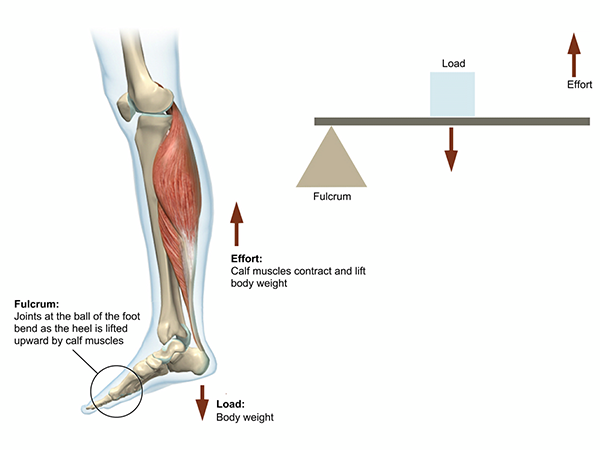
This lever system is extremely efficient, which is great for walking and running but can make it difficult to create enough mechanical tension for hypertrophy. This is why form is paramount:
- Use a full range of motion: Get a deep stretch at the bottom (dorsiflexion).
- Pause in the stretch: Pause for 1-2 seconds at the bottom to dissipate the elastic energy stored in the Achilles tendon, forcing the muscle fibers to do the work.
- Control the eccentric: Lower the weight slowly rather than just dropping.
Conclusion
You now understand the specific anatomical and biomechanical reasons behind a complete calf training strategy. It is not about finding one "best" exercise, but about understanding that two different muscles require two different setups.
Key Takeaways:
- The calves consist of the gastrocnemius (biarticular, crosses knee and ankle) and the soleus (uniarticular, crosses ankle only).
- Due to active insufficiency, the gastrocnemius is inhibited when the knee is bent, making bent-knee exercises soleus-dominant.
- To train the gastrocnemius effectively, you must use straight-knee exercises like standing calf raises, which train the muscle at a longer, more mechanically advantageous length.
- A comprehensive calf program must include both straight-knee and bent-knee variations to target both muscles for complete development.
Preview of the Next Lesson
We have now covered the major muscles from the torso down to the lower leg. In our next lesson, we will address the final major muscle groups relevant to lifting performance: the forearms. The learning outcome will be to briefly describe the anatomy of the primary forearm flexors and extensors and their role in grip strength for compound lifting. This will complete our anatomical survey and set the stage for our module on programming.