Introduction
In our last lesson, we peeled back the first layer of the anterior core, examining the anatomy of the rectus abdominis and the obliques. You learned how their vertical and angled fiber orientations make them prime movers for spinal flexion and rotation. This lesson was about the muscles that create movement.
Today, we go deeper to a muscle you can't see but is arguably one of the most important for strength and safety: the transversus abdominis (TVA). Our learning outcome is to explain the function of the transversus abdominis and its role in spinal stability.
Think of the rectus abdominis and obliques as the applications that run on a computer. The TVA, in contrast, is like a foundational operating system process—it runs constantly in the background, providing the core stability and security the entire system needs to execute demanding tasks safely and efficiently. By the end of this lesson, you'll understand why this deep muscle is the true foundation of a strong, resilient core.
The Transversus Abdominis: Your Body's Natural Weight Belt
While the rectus abdominis runs vertically, the transversus abdominis is unique. As its name suggests, its fibers run transversely, or horizontally, around your abdomen.
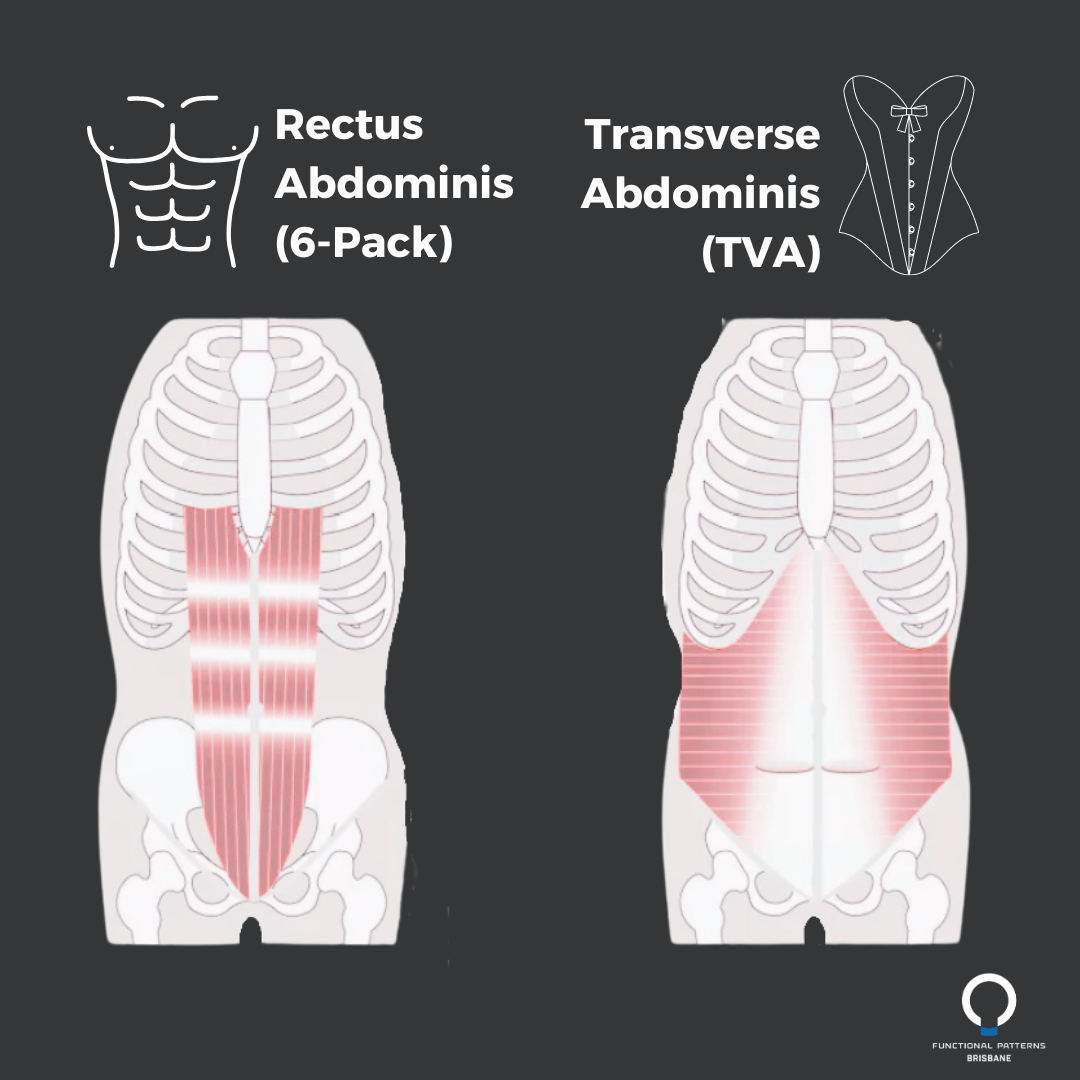
To understand its structure and function, let's start with a formal definition and its attachments.
Transversus Abdominis - Physiopedia
The Physiopedia page on the Transversus Abdominis offers an excellent, concise overview of its anatomy.
Read the introductory paragraph and the 'Origin and Insertion' section. Pay close attention to the description of its fibers running horizontally and its broad attachments, which allow it to encircle the trunk.
As you just read, the TVA is the deepest abdominal muscle. Its attachments are extensive:
- Origin: It arises from the lower ribs, the thoracolumbar fascia (a diamond-shaped sheet of connective tissue on your lower back), the iliac crest (top of the hip bone), and the inguinal ligament.
- Insertion: It wraps around and inserts into the linea alba (the center line of the abdomen) and the pubic crest.
This anatomy—originating from the back and sides and wrapping around to the front—is precisely why it functions as the body's own internal weight belt. When the TVA contracts, it pulls everything inward, cinching the waist.
The Core as a Pressure Canister
So, how does this "cinching" action translate to spinal stability? The key is understanding the core not just as a collection of muscles, but as a sealed, pressurized container.
A simple analogy is a can of soda.
This video from Movement Clinic uses the 'can analogy' to provide a simple yet powerful mental model for core stability.
Watch from 00:23 to 03:53. Focus on how a full, pressurized can is strong, while an empty, depressurized can is easily crushed. Then, see how the diaphragm, pelvic floor, and TVA form the top, bottom, and sides of this 'can'.
This "can" or "cylinder" is formed by a group of deep muscles working in synergy:
- Top: The Diaphragm (your primary breathing muscle).
- Bottom: The Pelvic Floor muscles.
- Back: Deep spinal stabilizers like the Multifidus.
- Front and Sides: The Transversus Abdominis (TVA).

When these muscles contract together, they increase the pressure inside your abdominal cavity. This is called Intra-Abdominal Pressure (IAP).
The TVA is the primary muscle responsible for generating this circumferential tension. Its functions, as listed in the Physiopedia article, are directly related to this:
- Maintains abdominal tension and supports abdominal viscera (organs).
- Increases intra-abdominal pressure.
This pressure acts like an internal airbag, pushing outward on all sides. Vitally, it pushes against the lumbar spine from the inside, providing a rigid column of support that helps resist external forces from a heavy squat or deadlift. This significantly reduces shear and compressive forces on the vertebrae themselves.
Feed-Forward Activation: The Proactive Stabilizer
The most fascinating aspect of the TVA's function is not just what it does, but when it does it. In a healthy, well-functioning nervous system, the TVA has what is known as feed-forward activation.
This means it contracts before you initiate a movement with your arms or legs.
Let's explore this concept further in a research context.
TRANSVERSUS ABDOMINIS ACTIVATION AND TIMING - PMC
This scientific article from the Journal of Performance Health Research discusses the role of TVA activation and timing.
Read the two paragraphs under the heading 'INTRODUCTION'. Focus on the sentence that states the TVA 'is activated prior to extremity movement in order to increase stiffness of the spine for stability'. This is the core concept of feed-forward activation.
This anticipatory contraction is a subconscious neural strategy to "brace for impact." Before your body even attempts to lift a heavy object or perform a powerful movement, your central nervous system tells the TVA to tighten, pre-stabilizing the lumbar spine.
- Analogy for your background: This is like an operating system proactively allocating memory and stabilizing system resources before launching a computationally expensive program. It prepares the hardware (your spine) for the impending load, rather than reacting to it after the fact.
Studies show that individuals with chronic low back pain often have a delayed or absent TVA contraction, meaning their spine is not stabilized before movement, leaving it vulnerable. This highlights the critical link between proper TVA function and spinal health.
Conclusion
In this lesson, we moved past the superficial "mirror muscles" and uncovered the deep, functional architecture of the core. You now understand the TVA's central role not as a mover, but as a master stabilizer.
Key Takeaways:
- The transversus abdominis (TVA) is the deepest abdominal muscle, with horizontal fibers that wrap around the torso like a corset.
- Its primary function is to contract and pull inward, increasing intra-abdominal pressure (IAP).
- The TVA works as part of a "core canister" with the diaphragm (top), pelvic floor (bottom), and multifidus (back) to create 360-degree spinal stability.
- Healthy function involves feed-forward activation, where the TVA contracts proactively before limb movement to prepare the spine for loading.
Preview of the Next Lesson
We have now identified the muscles of the core canister and understand the concept of intra-abdominal pressure. But how do we consciously and effectively use this system for maximum safety and performance in the gym?
In our next lesson, we will cover the next learning outcome: Explain the concept of intra-abdominal pressure (IAP) and the 'bracing' maneuver, detailing the coordinated action of the diaphragm and deep core. You will learn the specific, practical technique for creating a robust brace, why it's superior to simply "sucking in," and how to apply it to your heaviest lifts.