Hello! Welcome to the final lesson in our module on designing narrative-driven campaigns.
In our last session, we focused on maintaining story continuity across different media channels, ensuring a brand's narrative remains cohesive whether it's seen on a blog or on Instagram. You learned to map story beats across platforms to create an immersive, transmedia experience.
Now, we zoom in on the very first spark of that experience: the teaser. Every great story needs a compelling opening, and in marketing, that often takes the form of a teaser ad. Today, we will focus on exactly that. Our goal is to write a short script for a teaser ad that introduces a campaign's central conflict or question. You'll learn how to distill your campaign's core idea into a powerful, attention-grabbing introduction that leaves your audience wanting more.
1. The Art of the Teaser: Ask, Don't Tell
A teaser ad is not a full story. It’s an invitation to a story. Its primary job is to grab an audience's attention and make them curious enough to stick around for the main event. It achieves this by introducing a compelling question, a central conflict, or a profound mystery, but deliberately withholding the resolution.
Think of it as the literary equivalent of a prologue that hints at a dark prophecy or a movie trailer that shows the hero in peril but not their escape. In branding, it sets the stage for a campaign that will ultimately position your product or service as the answer to the question posed.

To understand the core functions of a teaser, let's look at some principles from television writing, which has perfected the art of hooking an audience in the first few minutes.
Teaser and tag | TV Writing Class Notes
The study guide 'Teaser and tag' from Fiveable breaks down the essential purpose and elements of a teaser in a scriptwriting context. Its principles are directly applicable to advertising.
Please read the first three main sections: 'Purpose of teasers': Focus on how teasers engage the audience and set the tone. 'Structure of teasers': Note the typical length and placement. 'Elements of effective teasers': Pay close attention to the subsections on 'Hook and intrigue' and 'Conflict establishment'. These are the heart of what we're learning today.
As the guide explains, an effective teaser accomplishes three things:
- Hooks the Audience: It uses mystery, suspense, or a high-stakes situation to make the viewer curious.
- Sets the Tone: It establishes the emotional feel of the campaign—will it be dramatic, inspiring, funny, or tense?
- Introduces the Conflict: It presents the central problem or challenge that the rest of the campaign will address.
2. Finding Your Campaign's Central Conflict
Before you can write a script, you need to know what conflict you want to introduce. In branding, this conflict is almost always rooted in a problem your customer faces. Your campaign narrative then positions your brand as the key to resolving that conflict.
A powerful way to identify and strengthen this problem is to think like a screenwriter.
Ep 40: 5 Steps For Using Cinematic-Style Conflict in Your ...
In her podcast, 'Write With Influence,' copywriter Amy Harrison adapts screenwriter Erik Bork's checklist for creating cinematic-style conflict. This is a brilliant method for finding the core problem your brand's story will solve.
Please read the section that begins with 'In his book, Eric has what he calls “a five-part punishing checklist”...'. Focus on the five steps of the checklist itself and Amy Harrison's summary at the end, which begins 'So, to summarize, here’s how you can apply this checklist...'.
For a teaser ad, we are primarily concerned with the first two steps of that checklist:
- The One Big Problem: What is the single, most significant challenge your customer is facing that your brand can address? (e.g., "I'm wasting so much time on marketing.")
- Why It Seems Impossible to Solve: What obstacles make this problem feel overwhelming or unsolvable to your customer? (e.g., "There's too much conflicting advice," or "I don't have the budget for a big agency.")
Your teaser should hint at this impossible-seeming problem, creating an immediate sense of relevance and empathy with your target audience.
Another great way to build this initial conflict is by using a simple but powerful narrative device.
How To Become A Master Storyteller
In this video, storyteller Kallaway explains a technique used by the creators of 'South Park' to ensure a story is always moving forward and full of conflict. It's an incredibly practical tool for scripting.
Watch from 00:25 to 03:22. Pay close attention to the 'but and therefore' rule. This simple conjunction is the engine of conflict.
The "But and Therefore" rule is perfect for a teaser. It creates a simple, two-part structure for your conflict:
- "You have this goal, BUT this obstacle is in your way."
- "This is the current situation, BUT something unexpected happened."
This structure immediately creates tension and an open loop that the audience wants to see closed.
3. Structuring Your Teaser Script
Now, let's move from concept to execution. A script for a short ad doesn't need to be complex. A simple three-column format is often enough to align the visual and audio elements.
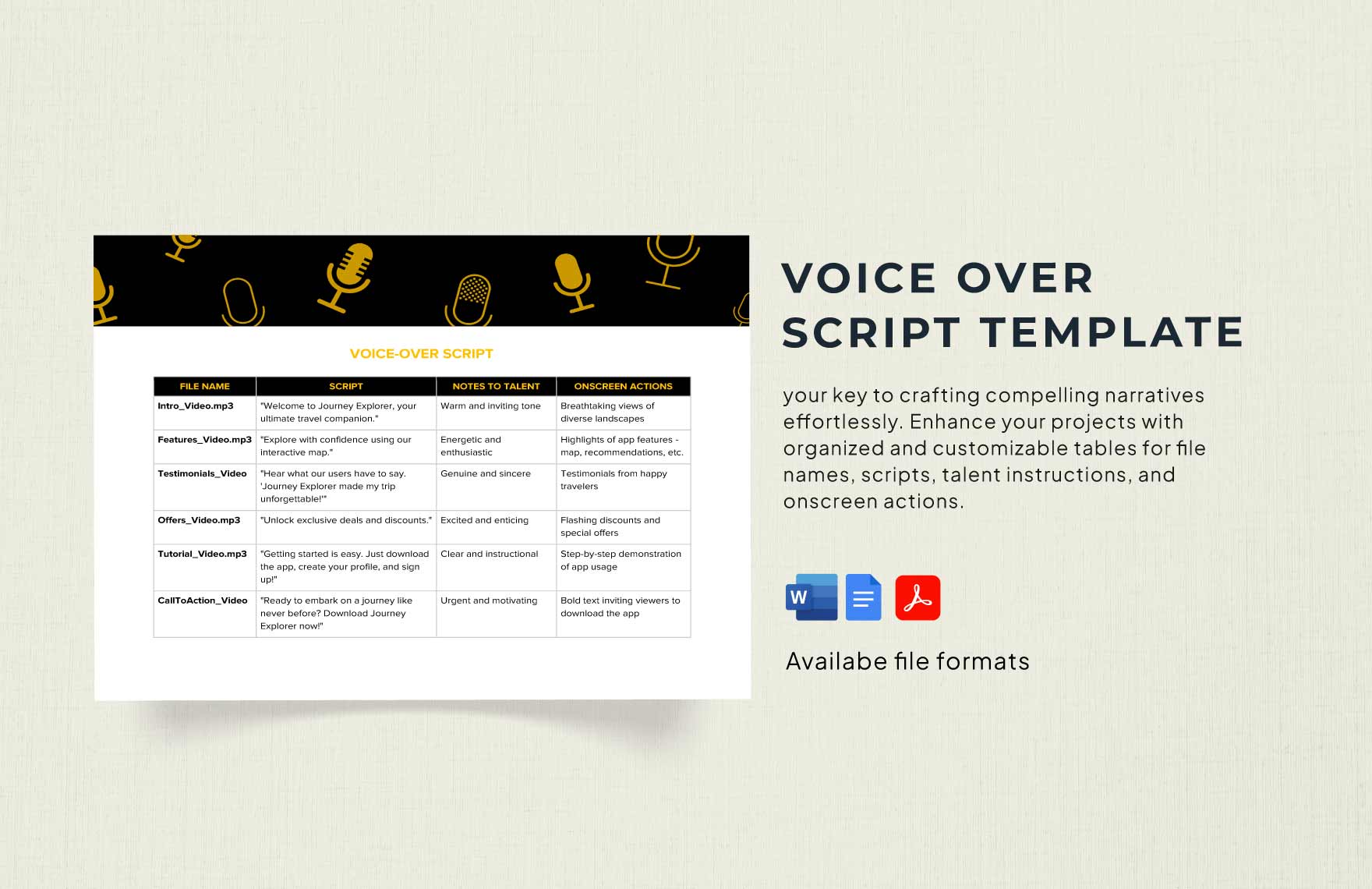
Here is a simple structure you can use:
| SCENE/TIME | VISUALS | AUDIO (Voiceover, Dialogue, SFX) |
|---|---|---|
| 0-5s | Describe the opening shot. This is your visual hook. | The opening line of dialogue or voiceover. This is your audio hook. |
| 5-10s | Describe how the scene develops or changes to introduce the conflict. | The line that reveals the 'BUT'—the problem or the twist. |
| 10-15s | A final, intriguing shot. Often ends on a question or a brand logo. | The concluding question or statement that leaves the audience hanging. A sound effect or musical sting. |
Let's apply this. We'll write a 15-second teaser script for our fictional brand, "The Storysmith's Guild," to launch their new "Pitch Masterclass."
- The One Big Problem: Talented founders with solid data fail to get investment.
- Why It Seems Impossible: They don't know that the story of their data matters more than the data itself.
- The Central Question: "What if the key to your funding isn't in your spreadsheet?"
Here’s the script:
| SCENE/TIME | VISUALS | AUDIO |
|---|---|---|
| 0-5s | A close-up on a laptop screen showing a complex, impressive-looking financial spreadsheet. A founder's face is reflected in the screen, looking tired but proud. | VOICEOVER (Calm, confident): You built the model. You proved the market. Your numbers are perfect. |
| 5-10s | The camera pulls back. The founder is sitting alone in a dark, empty boardroom after a meeting. They slump in their chair, looking dejected. | VOICEOVER (Shifting to a whisper): ...but they still said no. |
| 10-15s | Cut to black. Text appears on screen: "What if the answer isn't in the numbers?" The Storysmith's Guild logo appears below. | (Sound of a page turning, followed by a soft, hopeful musical sting.) |
This script uses the "But and Therefore" structure to create a whiplash effect. It starts with a feeling of confidence ("Your numbers are perfect...") BUT immediately pivots to the painful reality of rejection ("...they still said no."). This introduces the central conflict and ends with a question that the upcoming campaign will promise to answer.
Test your understanding!
Now it's your turn. Let's use the sustainable shoe brand from our previous lesson's exercise, "TerraSole." The campaign is for a new shoe line made from recycled ocean plastic.
Your Task: Based on the script structure above, write a 15-second teaser script that introduces the central conflict (ocean pollution) and a central question for the campaign.
Show answer
Here's one possible script for TerraSole:
- The One Big Problem: Our oceans are filled with plastic waste.
- The Central Question: Can something destructive be turned into something beautiful?
| SCENE/TIME | VISUALS | AUDIO |
|---|---|---|
| 0-5s | A beautiful, slow-motion shot of a pristine ocean wave curling under a blue sky. The shot is serene and majestic. | (Sound of a gentle ocean wave and seagulls.) |
| 5-10s | The wave crashes on the shore, but as the water recedes, it reveals the sand is littered with plastic bottles and debris. The color palette becomes duller. | (The sound morphs into a distorted, unsettling crunching noise.) |
| 10-15s | A single, stylish TerraSole shoe rests on the clean sand. Text appears beside it: "What if the cure is part of the disease?" The TerraSole logo fades in. | VOICEOVER (A hopeful whisper): A new step is coming. |
Conclusion
You've now learned how to craft the crucial first beat of a narrative campaign. By mastering the art of the teaser, you can ensure your brand's story doesn't just get told, but gets heard.
Key Takeaways:
- A teaser ad's purpose is to hook the audience by introducing a compelling conflict or question, not to provide a solution.
- The central conflict should be rooted in a "one big problem" that your customer finds seemingly impossible to solve.
- The "But and Therefore" structure is a powerful tool for creating immediate tension in a script.
- A simple script format (Visuals + Audio) is all you need to plan a short, impactful teaser ad that aligns sight and sound for maximum effect.
Preview of the Next Module:
This lesson concludes our module on designing narrative-driven campaigns. You've gone from outlining a campaign's arc to writing its opening line.
In our next and final module, the Capstone, we will zoom out. Our first lesson will be to define a 'brand story ecosystem' and map its key components. We'll move beyond single campaigns to analyze how all of a brand's stories—from its origin story to its user testimonials to its ad campaigns—work together to build a powerful and enduring narrative identity. This will prepare you for the final project of this course: conducting a full narrative analysis of a real-world brand.