Hello! Welcome back to our journey into brand storytelling.
In our last lesson, we mastered the art of creating narrative hooks and cliffhangers, learning how to build a chain of anticipation that pulls an audience from one piece of content to the next. You practiced this by crafting hooks for an email series, ensuring your audience would be eager to open the next message.
Today, we address a critical question for any modern brand: what happens when that next message isn't in an email, but on Instagram? Or a blog? Or a podcast? This lesson is about extending that narrative thread across different media channels. Our learning outcome is to plan for story continuity across two different media channels (e.g., Instagram and a blog). We'll learn how to create a single, cohesive story that unfolds gracefully no matter where your audience encounters it.
1. From Serialized Content to a Transmedia World
The concept of telling a story in installments is as old as storytelling itself, a technique you're well-acquainted with from your literature background. However, today's media landscape adds a layer of complexity. An audience might see your ad on YouTube, read a customer testimonial on your blog, and then see a behind-the-scenes video on Instagram—all within the same day.
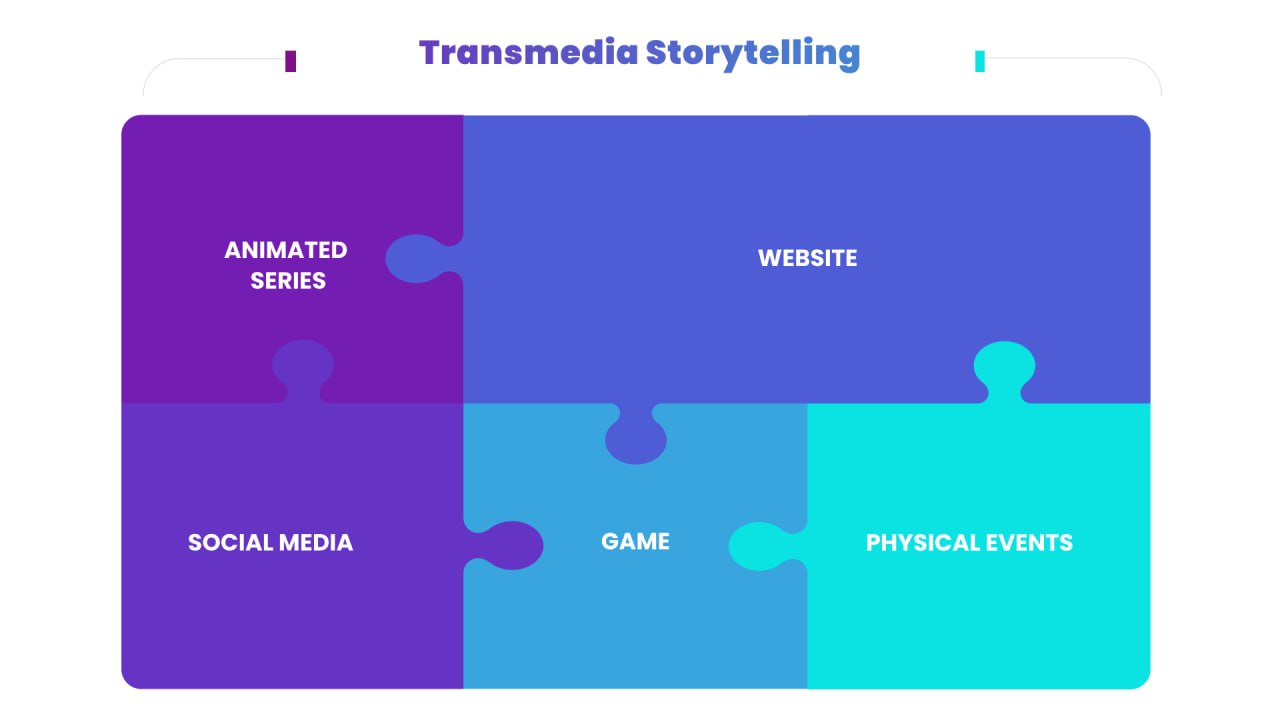
If these encounters feel disconnected, the story falls apart. If they are unified, you create an immersive and persuasive brand world. This is the core idea of transmedia storytelling. It's not about simply repeating the same story on different platforms; it's about telling one cohesive story where each platform contributes a unique and valuable piece to the whole.
To understand the foundations of this concept, let's explore a text on designing these multi-platform narrative experiences.
Principles, practices, and prototypes for designing narrative ...
The thesis 'Transmedia Storytelling' from Carnegie Mellon University provides an excellent introduction to this concept. It explains how digital media has shifted audiences from passive consumers to active participants in a story.
Please read the following sections to grasp the core ideas: Introduction (starts on page 7): Focus on the first and last paragraphs to understand how technology has changed storytelling and introduced a 'participatory' audience. Writer (page 18): Read this short section to see how a 'transmedia writer' specifically plans for stories that move across different formats. Producer (page 30): Read the first paragraph to understand the role of a 'transmedia producer' in choosing the right platform for each piece of the story. Observations, Insights, and Principles (page 65): Skim principle #3, 'Story first, platform/technology dead last.'
As the text highlights, successful multi-channel storytelling requires a new way of thinking:
- The audience is a co-creator: They piece the story together as they move between platforms.
- The story is platform-agnostic: The core narrative must be strong enough to exist independent of any single technology.
- Different roles emerge: The writer defines the overarching storyworld, while the producer decides which part of the story is best told on which platform to maximize its impact.
2. The Golden Rule: Adapt, Don't Just Repeat
The biggest mistake brands make in multi-channel campaigns is simply copy-pasting content. A blog post pasted into an Instagram caption fails because it ignores the context of the platform. The key to story continuity is consistency in message, not uniformity in format.
Let's explore why this consistency is so critical and how to achieve it without being repetitive.
Creating Consistent Content Across Multiple Channels
The article 'Creating Consistent Content Across Multiple Channels' from Postmedia Solutions offers a clear, practical guide for marketers on this exact topic.
Please read the following sections: Start with 'Why content consistency matters more than ever' and 'What happens when messaging isn’t aligned'. These sections explain the high stakes of getting this wrong. Next, read the sections '2. Create a channel-specific content plan' and '4. Repurpose, don’t repeat'. Focus on the distinction between duplicating assets and adapting them to fit their context.
As the article emphasizes, inconsistency leads to customer confusion and erodes trust. To maintain continuity, you must:
- Preserve the Core Narrative: Your central message, theme, and brand voice must remain consistent.
- Adapt to the Channel: Tailor the execution to the strengths of each platform. A blog is for depth, Instagram is for visual impact, and TikTok is for short, attention-grabbing entertainment.
- Repurpose Smartly: A single "flagship" piece of content (like a detailed customer story on your blog) can be the source for many other pieces of content, such as a short video, an image carousel, and a quote graphic.
3. A Practical Plan for Story Continuity
Let's translate this theory into a concrete plan. We'll continue with our fictional brand, "The Storysmith's Guild," and plan a campaign across a blog and Instagram.
Overarching Narrative: We want to tell the story of a founder, "Jane," who was struggling to get investors' attention. After using the Storysmith's Guild framework, she successfully secured funding. This is a classic transformation story.
Here is a step-by-step plan for telling Jane's story across the two channels:
Step 1: Assign Roles to Each Channel
- Blog: This is our "flagship" channel for in-depth storytelling. Its role is to present the full, detailed case study of Jane's journey. It will establish authority and provide tangible proof of our method's success.
- Instagram: This is our "engagement and distribution" channel. Its role is to grab attention, build curiosity, celebrate the success visually, and drive traffic to the blog post.
Step 2: Map the Story Beats Across the Channels
This sequence is designed to guide the audience through the narrative, using each platform for what it does best.
-
Beat 1: The Hook (Instagram Story)
- Content: A simple poll: "Does your pitch have great data but still gets a 'no' from investors?" with "Yes, it's frustrating!" and "Not an issue for me" as options.
- Purpose: To open a loop and identify the audience experiencing the same problem as Jane, making the story instantly relevant to them.
-
Beat 2: The Inciting Incident (Instagram Reel)
- Content: A fast-paced, 15-second Reel. It starts with a clip of a frustrated Jane staring at a spreadsheet. Text overlay: "They said my numbers were great..." It then cuts to a smiling Jane shaking hands with an investor. Text overlay: "...but they didn't invest until I changed ONE thing."
- Purpose: To introduce the central conflict and the promise of a resolution, creating a strong curiosity gap. The caption will say: "Jane's story is incredible. We just published her full journey from 'no' to 'yes'. Link in bio to read it now!"
-
Beat 3: The Climax & Resolution (Blog Post)
- Content: A long-form article titled "How Founder Jane Doe Secured $1M by Ditching Her Spreadsheet and Telling a Story." It details her initial struggles, the specific story framework she learned, and the triumphant outcome. It includes quotes from Jane and a clear call-to-action to download a free pitch template.
- Purpose: To deliver the core value, provide the full narrative, and convert interested readers into leads.
-
Beat 4: Reinforcement (Instagram Carousel)
- Content: A 5-slide carousel post titled "3 Storytelling Lessons from a $1M Pitch." Each slide pulls a key, actionable tip from the blog post. The final slide reminds followers they can read the full story via the link in the bio.
- Purpose: To repurpose the blog's content for a scannable format, reinforcing the key takeaways and giving the story a longer lifespan on the platform.
This structured approach ensures that no matter where the audience enters the story, they encounter a consistent message that is perfectly adapted to the channel they are on.
Test your understanding!
Now, it's your turn to create a plan.
Scenario: A sustainable shoe brand, "TerraSole," wants to tell the story of its new shoe line made from recycled ocean plastic.
Channels: A monthly Email Newsletter and TikTok.
Your Task: Outline a simple, 3-beat plan for how you would tell this story across the two channels. For each beat, specify the channel, the content, and its purpose in the narrative sequence.
Show answer
Here is one possible approach:
-
Beat 1: The Hook (TikTok Video)
- Channel: TikTok
- Content: A video showing a beautiful, clear ocean that quickly transitions to shots of plastic waste washing ashore. A trending, melancholic sound plays. Text overlay: "We're turning THIS..." (points to plastic) "...into THIS." The video ends on a beautiful, cinematic shot of the new shoe.
- Purpose: To grab attention with a strong emotional and visual hook, introducing the core concept of transformation. The caption could tease an upcoming announcement.
-
Beat 2: The Deep Dive (Email Newsletter)
- Channel: Email Newsletter
- Content: The newsletter, with the subject line "From Ocean Waste to Your Wardrobe," tells the full story. It includes sections on the plastic collection process, interviews with the designers, and professional photos of the new shoes. It emphasizes the positive environmental impact.
- Purpose: To provide the detailed narrative and emotional depth that builds a strong connection with the brand's most engaged audience. It includes a button to "Shop the Collection."
-
Beat 3: The Human Element (TikTok Video)
- Channel: TikTok
- Content: A "day in the life" style video featuring one of the partners who helps collect the ocean plastic. It shows their work in a genuine, unpolished way, ending with them wearing the final TerraSole shoes.
- Purpose: To humanize the story, show the real-world impact, and build authenticity. It links back to the product in a way that feels story-driven rather than like a direct ad.
Conclusion
You now have a framework for weaving a single narrative thread through the complex web of modern media. By thinking like a transmedia storyteller, you can create campaigns that are not only consistent but also deeply immersive and engaging.
Key Takeaways:
- Story continuity across channels is achieved through transmedia storytelling, where each platform contributes a unique piece to a unified narrative.
- The fundamental rule is to adapt, not just repeat. The message and theme stay consistent, but the format and execution must fit the platform.
- Inconsistent messaging leads to customer confusion and erodes brand trust, while a cohesive story builds it.
- A practical plan involves defining the overall story, assigning specific roles to each channel, and mapping the story beats sequentially across them.
Preview of the Next Lesson:
We've now outlined a full multi-channel campaign structure. But every great campaign needs a powerful beginning. In our next and final lesson of this module, we will focus on that initial spark. You will learn to write a short script for a teaser ad that introduces a campaign's central conflict or question, crafting the perfect hook to launch your entire narrative.