Welcome back. In our previous module, we meticulously established the analytical frameworks for both of our case studies. We defined the causal questions, specified the outcomes, and identified the relevant units and levels of analysis. With this foundational work complete, we now pivot from framing the puzzle to actively trying to solve it. This begins the next major phase of our study: hypothesis development.
Today, we will focus on Event 1—the successful five-year cuckold/hotwife dynamic of the mid-40s Indian couple. Our specific goal is to map the socio-cultural context and the couple's relational history, distinguishing inert background conditions from potentially active causal factors. This is a crucial first step. Before we can propose why something happened, we must first paint a rich, descriptive picture of the world in which it happened. This act of "mapping the context" is the descriptive bedrock upon which all subsequent causal inference is built.
The Foundation: Careful Description
As we've previously discussed, process tracing begins not with causation, but with description. To analyze a trajectory of change, one must first be able to characterize the key states and situations along that path.
[PDF] Understanding Process Tracing - Political Science at UC Berkeley
This excerpt from David Collier's paper on process tracing reinforces the foundational role of description in any causal analysis.
Please read the short paragraph titled Description. Then, find the section "DESCRIPTIVE INFERENCE" and read the first two paragraphs, from the opening sentence to the end of the second paragraph. This will serve as a quick reminder of why we must begin by describing the world of our case before we can explain it.
For Event 1, this means describing two nested worlds:
- The Couple's Relational History: This is their private, internal world. It includes their communication patterns, trust levels, shared values, and the state of their marital and sexual satisfaction before the cuckold/hotwife dynamic was introduced.
- The Socio-Cultural Context: This is the external world they inhabit. As a mid-40s Indian couple, this context is rich with specific norms, values, and expectations regarding marriage, fidelity, gender roles, and sexuality.
The challenge, of course, is that this descriptive mapping can reveal a nearly infinite number of facts. Which ones matter? Which are simply part of the inert background, and which are potentially active ingredients in our causal recipe? Your background in statistical causal analysis will have familiarized you with the challenge of variable selection; this is the qualitative equivalent. We need a principled way to sort the causally potent from the causally passive.
Distinguishing Causes from Conditions
To address this, we will use a sophisticated philosophical framework that moves beyond a simple, pragmatic distinction between "the cause" and "the background." This framework helps us dissect the function of different factors within a complex causal system. Given your expertise in causal analysis, you'll recognize the starting point: causal interaction. In statistical models, we often include an interaction term (e.g., ) to show that the effect of on depends on the value of . But this mathematical symmetry can hide a functional asymmetry in the real-world mechanism. The following paper provides the tools to unpack that asymmetry.
[PDF] Interactive causes and causal selection | PhilSci-Archive
This paper by Robert Frühstückl offers a powerful framework for distinguishing between different types of causal factors based on how they interact. This will be our primary tool for sorting background conditions from active causes.
Please read the following sections: In the Introduction, read from the start down to the paragraph discussing the classic fire example: striking of a match. This sets up the core problem. Jump to section 3, "Unpacking causal interactions." Read subsection 3.1, "Enabling conditions," in its entirety. Focus on the definition of an enabler. Next, read subsection 3.2, "Modifying conditions," in its entirety. Focus on the definition of a modifier. Finally, read the two "selection principles" at the end of Section 5, which summarize how to use this distinction: Selection principles.
Let's synthesize this framework:
- Enabling Conditions: An enabler is a factor that is necessary for a cause to exert its effect. It acts like an on/off switch for a causal mechanism. The paper's conclusion is that enablers, while indispensable, are often relegated to the inert background. They are part of the stage, but not the actors. For example, the presence of oxygen enables a spark to cause a fire, but we usually identify the spark as "the cause."
- Modifying Conditions: A modifier is a factor that changes the magnitude or even the direction of a cause's effect. It doesn't just turn the mechanism on or off; it tunes it. The paper argues that modifiers are explanatorily salient and should be considered active causal factors. For example, soil pH modifies the effect of fertilizer on plant growth, sometimes even making it harmful. The pH level helps explain the specific outcome.
This enabler/modifier distinction gives us a powerful analytical lens for mapping our case.
Applying the Framework to Event 1
Let's use this lens to begin mapping the context of our couple. As we brainstorm factors from their relational history and socio-cultural environment, we can sort them into these two bins. A useful visual aid for organizing these factors is Bronfenbrenner's Ecological Systems Theory, which depicts how an individual is situated within nested systems of influence, from the immediate to the societal.
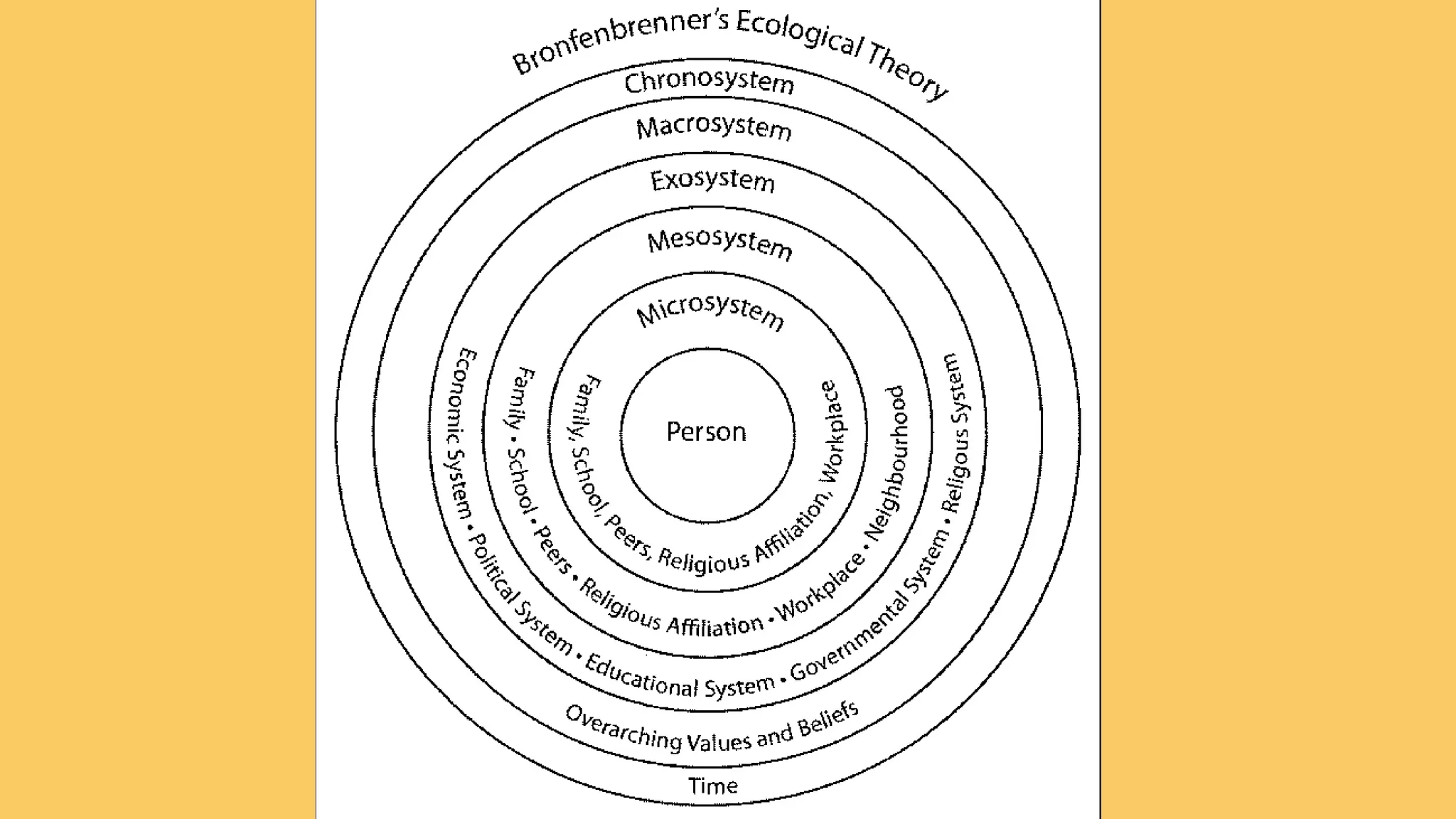
Let's begin sorting potential factors.
The Macrosystem: Socio-Cultural Context
- The Internet and Global Media: Provides access to information about alternative relationship structures like polyamory and cuckolding, which are not prevalent in mainstream Indian culture.
- Classification: This is a classic Enabling Condition. Without access to these ideas, the couple might never have conceived of this path. It switches "on" the possibility of considering the lifestyle. We can classify this as an inert background condition—it's part of the modern stage on which this story plays out, but it doesn't, by itself, push the couple in this direction.
- Traditional Indian Cultural Norms: A strong societal emphasis on monogamy, marital sanctity, and patriarchal gender roles. Public discussion of sexuality is often taboo.
- Classification: This is a likely Modifying Condition. The presence of this strong taboo could act as a powerful force that negatively modifies the likelihood of success (by creating social pressure, guilt, etc.). Alternatively, the act of transgressing such a strong taboo could positively modify the couple's sense of shared identity and excitement. Because it actively shapes the nature and difficulty of their journey, we must treat it as a potentially active causal factor.
- Legal Framework: Adultery was decriminalized in India in 2018.
- Classification: This is an Enabling Condition. By removing the threat of legal sanction, it lowers a significant barrier to entry. It enables the behavior to occur with less risk, but doesn't cause the desire for it. This is a background condition of the specific historical period (the Chronosystem).
The Microsystem: Relational History
- Financial Stability: The couple is assumed to have a stable financial situation, free from major economic stressors.
- Classification: This is likely an Enabling Condition. Significant financial or life instability might have precluded the couple from having the emotional and practical resources to embark on such a complex relational exploration. Its presence enables them to focus on higher-order needs. We'll classify it as an inert background condition for now.
- A History of High Trust: The couple has a long-standing, deep-seated trust in one another built over many years of marriage.
- Classification: This factor is more complex. On one hand, a baseline of trust is surely an enabler; without it, the conversation would be a non-starter. However, it's very likely also a modifier. It's plausible that the degree of trust modifies the degree of success. Higher trust could reduce jealousy (a negative modifier) and increase feelings of security (a positive modifier). Because it likely explains variation in the outcome (i.e., why they were successful and stable), we must provisionally label it a key active causal factor. This points directly toward one of our stated hypotheses.
- Established Communication Patterns: Let's imagine the couple has a history of being able to discuss difficult, emotionally charged topics openly and constructively.
- Classification: Like trust, this appears to be a powerful Modifying Condition. The skill of constructive communication doesn't just enable the process; it actively shapes it, making successful navigation of jealousy, insecurity, and logistical challenges more likely. A couple with poor communication skills attempting the same path would likely have a very different, less successful outcome. This is another prime candidate for an active causal factor.
By applying this framework, we have begun to clear away the background noise and zoom in on the factors that seem most likely to be doing the real causal work.
Conclusion
In this lesson, we initiated the hypothesis development phase for Event 1. We've laid the necessary descriptive groundwork by establishing a method for mapping the couple's context while simultaneously sorting that information into causally relevant categories.
Key Takeaways:
- Causal analysis must begin with rich, "static" description of the conditions and history surrounding an event.
- The distinction between enabling conditions and modifying conditions provides a rigorous way to separate inert background factors from potentially active causal ones.
- Enablers act as on/off switches for a causal process and can be treated as background conditions (e.g., the internet's existence, financial stability).
- Modifiers tune the magnitude or direction of a causal effect and should be treated as active causal factors (e.g., cultural taboos, pre-existing trust, communication skills).
We have now sketched the landscape of our case and identified several factors—particularly trust and cultural context—as promising areas for deeper causal investigation. With this map in hand, we are now prepared to formalize our primary causal claims.
In our next lesson, we will take the next logical step and state our two primary hypotheses for Event 1—the wife's unmet sexual needs and the husband's trust in the bull as his best friend—in precise, testable terms.