Welcome back. In our previous lesson, we meticulously defined the boundaries for our investigation into the boudoir competition, creating a conceptual "container" that runs from the contestant's registration to the final announcement of her win. This step of "binding the case" ensures our analysis remains focused and manageable.
Now that we have established the perimeter of our inquiry, we must identify the key components within those boundaries. An event like a competition is not a monolithic entity; it is a complex system of interacting parts. Today, our goal is to dissect this system by identifying the key units and levels of analysis for Event 2. This involves specifying the 'who' and 'what' we are studying (the units) and the scale at which we will examine their influence (the levels). For a statistician, this process is analogous to defining the entities, variables, and hierarchical structure of a model before fitting data to it.
Distinguishing Units from Levels
To begin, it is crucial to clarify the distinction between a unit of analysis and a level of analysis. These terms are often used interchangeably, but they refer to distinct concepts that are fundamental to rigorous research design.
The following resource from the field of strategy research offers a precise and helpful set of definitions.
[PDF] 1 Units (and Levels) of Analysis in Strategy Research - Cloudfront.net
This paper clarifies the core concepts of units and levels of analysis, which are essential for constructing a robust research design.
Please read the first three subsections under the heading Key elements. Pay close attention to the distinction between the unit of analysis (the entity data is collected about), the level of analysis (the level at which the research question is answered), and the phenomenon of analysis (the overall subject of study).
To summarize for our case:
- Phenomenon of Analysis: The competition win. This is the overarching event we seek to explain.
- Unit of Analysis: The who or what we collect information about. This could be an individual person (the contestant, a judge), a group (the judging panel), or even an artifact (the submitted photograph).
- Level of Analysis: The scale at which we frame our explanation. We might analyze data about individual judges (unit) to make a claim about the judging panel's group dynamics (level).
A Framework for Structuring Analysis
Sociologists and other social scientists often use a three-tiered framework to organize their analysis: micro, meso, and macro. This provides a powerful way to think about how different layers of social reality interact.
The following short video provides a clear, high-level introduction to this concept.
Macrosociology vs microsociology | Society and Culture | MCAT | Khan Academy
This Khan Academy video offers a concise explanation of the distinction between macrosociology and microsociology, which map directly onto the macro and micro levels of analysis.
Please watch the entire video (full video). As you watch, consider how the "big picture" of cultural beauty standards might influence the "small scale" interaction of a judge viewing a photograph.
This framework can be visualized as a set of nested systems, where smaller-scale phenomena are situated within, and influenced by, larger-scale structures.
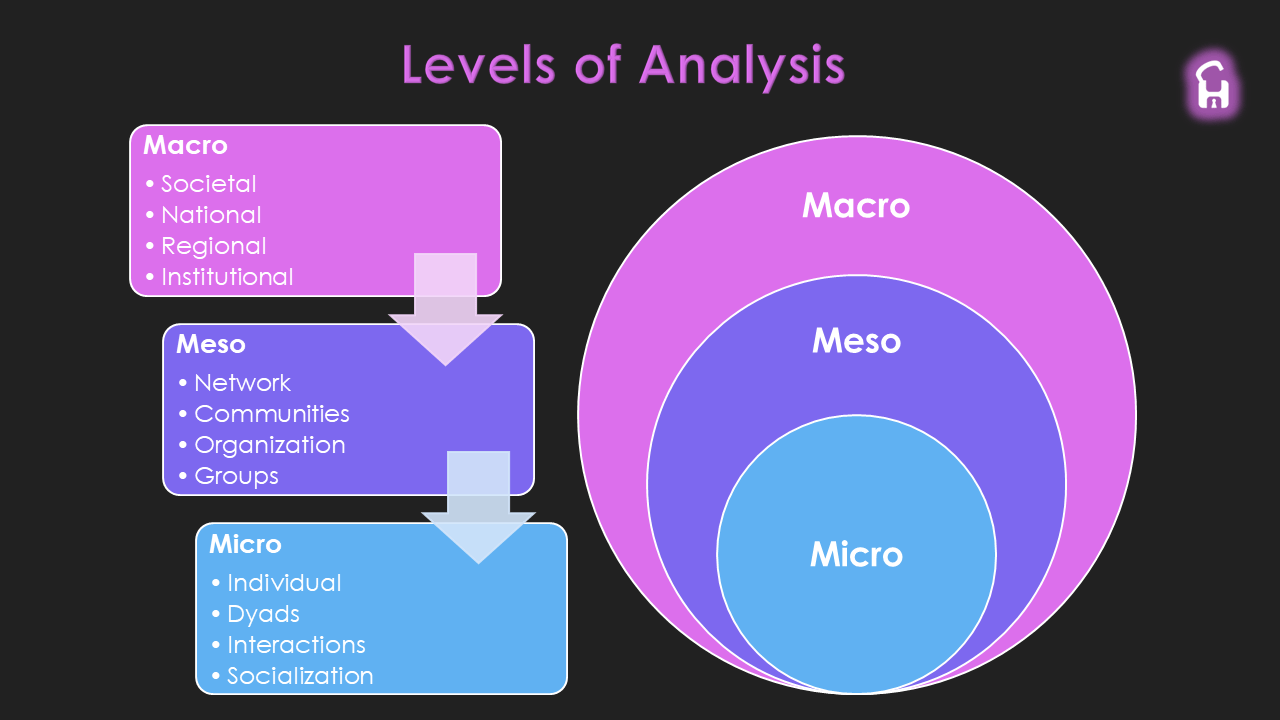
A more formal academic treatment breaks this down further. While the video focused on micro and macro, many researchers include a 'meso' (middle) level and also distinguish between the individual and the 'dyadic' (two-person interaction) at the micro scale.
[PDF] 1 Social functions of emotions at four levels of analysis
This paper by Keltner and Haidt provides a sophisticated breakdown of four distinct levels of analysis used in social science.
Please read the paragraph that defines the four levels, beginning with "We hope that this essay contributes..." and ending with the definition of the cultural level. This will give us a more granular framework for our case.
Now, let's apply this multi-level framework to identify the key analytical components of Event 2.
Levels and Units of Analysis for Event 2
A comprehensive causal explanation for the contestant's win requires us to gather and synthesize evidence from multiple levels.
1. The Micro Level: Individuals and Dyads
This is the most granular level, focusing on individuals and their direct interactions.
- Unit: The Contestant. Here, we analyze her as an individual agent. This includes her choices (attire selection), her actions (posing, expression during the photoshoot), and her attributes (physique, stated persona). This is the focal point of our individual presentation component.
- Unit: The Individual Judge. We also need to consider each judge as an individual decision-maker. What are their personal aesthetic biases? How did they individually score the contestant on criteria like "originality" or "impact"? What was their cognitive and emotional reaction to her submission?
- Unit: The Dyad. This refers to two-person interactions. A key dyad is the contestant-photographer interaction during the shoot. Another crucial one is the conceptual dyad of the judge-photograph, representing the moment of perception where the judge interacts with the submitted image.
2. The Meso Level: Groups and Organizations
This level bridges the gap between individuals and broad societal forces. It concerns the group and competitive dynamics.
- Unit: The Judging Panel. This is more than the sum of its parts. We must analyze the panel as a group. How were individual scores aggregated? Did the judges deliberate together, and if so, how did their group discussion shape the final outcome? This is a core part of the competitive environment.
- Unit: The Audience. The audience acts as a collective entity. We can analyze their aggregate behavior through units like social media comments, likes, and poll results. This constitutes the audience behavior component.
- Unit: The Field of Competitors. The contestant did not win in a vacuum. A crucial unit of analysis is the set of all other finalists. We will need to analyze their presentations (body types, attire choices, personas) to establish the competitive context against which our contestant stood out.
3. The Macro Level: Culture and Society
This is the broadest level, encompassing the societal norms and cultural scripts that provide the context for the entire event.
- Unit: Cultural Beauty Standards. What are the prevailing societal ideals of female beauty at this time and in this place? The hypothesis about her "toned body yet big breasts" being an advantage only makes sense relative to a specific set of cultural standards.
- Unit: Social Norms around Sexuality and Modesty. The power of the "attire/persona contrast" hypothesis rests on a presumed cultural script that associates a "shy background" with modest presentation. The violation of this script generates surprise and impact. This is a macro-level condition that enables a micro-level effect.
- Unit: The "Lingerie Photoshoot Competition" as an Institution. This type of competition has its own rules, history, and implicit values. These institutional factors shape the judging criteria and contestant strategies.
A robust analysis of Event 2 will not remain at a single level. As the authors of "Units and Levels of Analysis in Strategy Research" note, a primary reason for shifting between levels is to identify and isolate theoretical mechanisms. The mechanism behind the "contrast" hypothesis, for example, operates across levels: a macro-level norm (modesty expectations) is strategically violated at the micro-level (attire choice), leading to an effect at the meso-level (higher scores from the judging panel).
Conclusion
Today, we have populated the analytical container we built in the last lesson. We've moved beyond simply defining the case boundaries to identifying the specific, multi-layered components within it.
Key Takeaways:
- A unit of analysis is the 'who' or 'what' we study (e.g., a person, a group), while the level of analysis is the scale at which we frame our explanation (micro, meso, macro).
- For Event 2, the key units and levels span from the micro (the contestant's individual presentation, a judge's perception) to the meso (the dynamics of the judging panel, audience behavior, the competitive field) to the macro (cultural beauty standards and social norms).
- A powerful causal explanation will show how these different levels interact. For instance, how macro-level cultural norms create the conditions for a micro-level action to have a decisive impact at the meso-level of the competition.
With the analytical framework for both of our cases now fully established, we are ready to move into the core of the single-event study methodology. In the next module, we will begin developing and structuring the specific causal hypotheses that we will eventually test. We will start with Event 1, mapping its unique context and formally stating our two primary hypotheses—unmet sexual needs and best friend trust—in precise, testable terms.