Welcome back. In our previous lesson, we mapped the contextual landscape for Event 1, learning to distinguish inert background conditions (enablers) from active causal factors (modifiers). This initial sorting process allowed us to identify promising areas for our causal investigation, such as the couple's pre-existing trust and the socio-cultural pressures they navigated.
Today, we transition from mapping the terrain to drawing the first part of our causal map. Our objective is to take one of the core conclusions of our analysis—that the wife's unmet sexual needs were a key cause—and transform it from an intuitive idea into a rigorous, testable proposition. To do this, we will state Hypothesis 1 in precise, testable terms, operationalizing the specific needs and their fulfillment by the bull. This process of operationalization is central to all empirical research; it's the bridge between abstract theory and observable reality.
From Vague Concept to Testable Hypothesis
A hypothesis is more than just a guess; it's a formal statement that proposes a specific relationship between variables, framed in a way that can be empirically tested. Your background in statistical analysis means you are well-versed in formulating hypotheses for quantitative studies. The logic in qualitative research is parallel, but the execution differs. Instead of defining variables that will be measured numerically, we define concepts that will be identified through observable patterns, actions, and accounts.
A strong research hypothesis must meet three criteria: it must be clear, specific, and testable. Let's watch a brief overview to solidify these requirements.
How To Write An A-Grade Research Hypothesis (+ Examples & Templates)
This video from Grad Coach provides a concise explanation of what makes a research hypothesis robust and ready for testing.
Please watch the following three segments: First, watch the definition of a hypothesis from the beginning. Next, focus on the explanation of specificity and clarity. Note how the vague statement "Sleep impacts academic performance" is refined into something much more precise. Finally, watch the section on testability, which explains that a hypothesis must be provable or disprovable with observable data.
Our starting point, "the wife had unmet sexual needs," is currently like the vague statement "sleep impacts academic performance." To make it a testable hypothesis, we must specify exactly what "unmet sexual needs" means and how we would recognize their "fulfillment" in the real world. This is accomplished through two linked processes: conceptualization and operationalization.
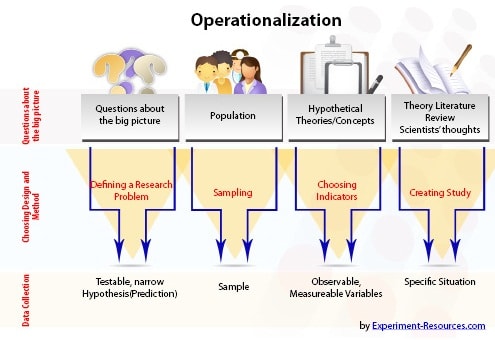
Conceptualization and Operationalization
Conceptualization is the process of defining our abstract idea—in this case, "unmet sexual needs"—with greater precision. Operationalization is the process of specifying the exact real-world evidence, or "fingerprints," we would look for to see if our concept is present.
The following video explains these two critical steps.
Operationalization and Conceptualization in qualitative research (clearly explained)
This video from Survivingresearch provides clear definitions of conceptualization and operationalization, which are the core tasks of this lesson.
Please watch these clips: First, the definition of conceptualization. Then, an example of why precise definitions are needed, using the concept of being educated. Next, the definition of operationalization. Finally, an example of how "being educated" is operationalized into a specific question.
As you can see, we need to move from the abstract concept of "unmet needs" to concrete questions we could, in principle, ask or observations we could make.
1. Conceptualizing "Unmet Sexual Needs"
What does "unmet sexual needs" mean in the context of a long-term, mid-40s couple? Is it about frequency, variety, or specific acts? To build a robust concept, we can draw on domain knowledge.
Cuckolding From a Woman's Perspective - Evolving Your Man
This article, written from the perspective of a woman in a cuckold relationship, provides rich, first-hand details that help us conceptualize the nature of "unmet needs" in this specific context.
Please read the following excerpts to add texture to our concept: In the section "What is Cuckolding?", read the paragraph explaining why cuckolding might happen. It mentions a key factor in long-term relationships. In the section "Cucking vs Swinging," read the sentences that define what the bull provides: fulfilling unmet needs. Under "What I Personally Enjoy About Cuckolding," read about the craving for "fresh sex" and the problem of sexual overfamiliarity. Finally, read the passage describing how a bull is chosen based on specific traits: the ideal partner.
Drawing from this resource and general relationship psychology, we can define our core concept, Erotic Dissatisfaction, as having several dimensions:
- Need for Novelty: A desire to counteract the "erotic dissatisfaction" and "sexual overfamiliarity" that can arise in long-term relationships. It’s a craving for "fresh sex" with a new partner.
- Need for Different Sexual Dynamics: A desire for experiences that are qualitatively different from the marital dynamic. The resources point to specific examples like increased dominance, a focus on purely physical attributes (muscles, physique, stamina), and a sense of being chosen on purely sexual grounds.
- Need for Sexual Agency and Power: The desire for the woman to "take an active and dominant role in their sex life," feeling "overtly powerful, liberated." The act of choosing and directing an external sexual relationship becomes an expression of this agency.
With this multi-dimensional concept, we move beyond a vague "unmet need" to a specific profile of Erotic Dissatisfaction characterized by a desire for novelty, different dynamics, and personal agency.
2. Operationalizing the Hypothesis
Now we must operationalize this concept. How would we observe these needs and their fulfillment? This is where we define the "empirical observables" or "fingerprints" that our hypothesis predicts we will find. This step is crucial for making our claim testable. Just as in operations research, an abstract goal like "improving efficiency" must be defined by concrete Key Performance Indicators (KPIs); our abstract concept must be defined by observable evidence.
[PDF] Process-Tracing Methods in Program Evaluation
This guide from the World Bank's Independent Evaluation Group details how to move from a theory to testable evidence in a process-tracing context. It provides the language and logic we need to operationalize our hypothesis.
Please focus on these key ideas: First, read the paragraph that begins Step 3: Disaggregation of the Process Theory of Change. Focus on the description of how to break down an episode into a step-by-step process. This is what we are doing with our hypothesis. Now, jump to Chapter 2 and read the introduction. It explains that operationalizing a theory involves asking what empirical traces or "fingerprints" it would leave behind. Finally, read the section Step 1: Operationalization of Expected Observables, including Box 2.1. Pay close attention to the distinction between "need-to-find" evidence (which, if absent, weakens our hypothesis) and "love-to-find" evidence (which, if present, strongly confirms it).
Using this framework, we can now state our formal hypothesis and list the observable evidence—the "fingerprints"—we would expect to find if it were true.
Hypothesis 1: The Erotic Dissatisfaction Hypothesis
The primary causal driver for the couple establishing a cuckold/hotwife dynamic was the wife's multi-faceted Erotic Dissatisfaction within the marriage, which was subsequently resolved through the specific actions of the bull, thereby sustaining the arrangement.
This hypothesis predicts we will find the following observable evidence:
A. Evidence for the Cause (The Wife's Pre-existing Erotic Dissatisfaction):
- "Need-to-find" Evidence:
- In interviews, the wife describes her pre-arrangement sex life with her husband using terms like "routine," "maintenance sex," "monotonous," or explicitly states feeling bored or unfulfilled.
- Logs of communication (texts, emails) or journal entries from before the arrangement contain discussions about a lack of "spark" or a desire to "spice things up."
- The husband, in his interview, independently corroborates his wife's feelings of sexual dissatisfaction or boredom in the period leading up to the decision.
B. Evidence for the Mechanism (The Bull's Fulfillment of Specific Needs):
-
"Need-to-find" Evidence:
- The wife's description of her sexual encounters with the bull focuses on the very dimensions identified in our concept: novelty, a different power dynamic (e.g., his dominance), and specific physical attributes or acts she found exciting.
- The wife reports a significant increase in her overall sexual satisfaction and sense of liberation after the arrangement with the bull began.
-
"Love-to-find" Evidence:
- The wife explicitly draws a contrast, stating something like, "The bull provides X, Y, and Z, which were the things I felt were missing with my husband." This would be a "smoking gun" connecting the specific need to the specific fulfillment.
- We find evidence that the couple had considered and rejected other solutions for sexual boredom (e.g., swinging, open relationship with strangers) specifically because those options did not meet the unique need for a particular type of dynamic that the cuckold/hotwife structure provided. This would help rule out rival explanations.
By completing this exercise, we have transformed a simple premise into a structured, testable hypothesis with a clear set of evidentiary requirements. We now know exactly what we are looking for in the case data.
Conclusion
In this lesson, we took the first major step in hypothesis development for Event 1. We moved beyond a vague notion of "unmet needs" and developed a formal, testable causal claim.
Key Takeaways:
- A research hypothesis must be specific, clear, and testable.
- Conceptualization is the process of defining an abstract concept (like Erotic Dissatisfaction) by breaking it down into its core dimensions (e.g., need for novelty, different dynamics, agency).
- Operationalization is the process of identifying the concrete, observable "fingerprints" or "empirical traces" that would confirm or disconfirm the presence of your concept in the real world.
- We can categorize evidence as "need-to-find" (its absence is disconfirmatory) and "love-to-find" (its presence is highly confirmatory).
We have now formally stated Hypothesis 1 for our cuckold/hotwife case. This provides a clear target for our evidence-gathering and testing phases later on.
In our next lesson, we will apply the same rigorous process to our second key explanation: Hypothesis 2 (best friend trust). We will operationalize what "trust" means in this unique context and specify how its presence enabled the stability and success of the arrangement.