Hello! Welcome to the second module of our course, "Introduction to Employee Stock Options."
In our first module, we built a strong foundation. We learned what a company share is, how a company's value grows, and we saw powerful examples of how early employees created life-changing wealth through equity. We ended on the important idea that equity, while powerful, is like a "lottery ticket"—high risk, but with the potential for a high reward.
Now, it's time to move from the big picture to the specific details. We'll start with the most fundamental question. This lesson is dedicated to achieving a single, clear goal: to define what an Employee Stock Option Plan (ESOP) is in simple terms. We'll break down exactly what an "option" is and why it's different from owning a share directly. Understanding this is the first crucial step in mastering the rules of the game.
What is an ESOP? The Right to Buy
At its core, an Employee Stock Option Plan (ESOP) is a benefit that a company offers which gives you a special right. It's not a direct gift of shares, but something more nuanced.
Let's get a formal but simple definition.
What is ESOP? - Benefits and Detailed Explanation with ...
The article 'What is ESOP?' from Dezerv provides a very clear and direct definition. It highlights the most important distinction you need to understand right away.
Please read the section titled 'What are ESOPs?'. Focus on the sentence that explains the difference between an 'option' and an 'obligation'.
As the article explained, the key idea is that an ESOP gives you the right, but not the obligation, to buy company shares at a future date, for a price that is fixed today.
Think of it this way:
- The Right: You have a special privilege that others don't. You can buy the shares if you want to.
- Not the Obligation: You are not forced to buy them. If it's not a good deal, you can simply walk away without any penalty.
This means when you receive an ESOP grant, you don't own any shares yet. You own a promise from the company, or a special "coupon," that lets you buy shares later at a locked-in price.
Where Do These Shares Come From? The ESOP Pool
You might be wondering, if the company is giving employees the right to buy shares, where do these shares come from? Do they just create them out of thin air?
Not quite. A company proactively sets aside a certain percentage of its total ownership for employees. This reserved portion is called the ESOP Pool or Employee Stock Option Pool.
The following video uses a great analogy to make this concept very easy to understand.
Everything you need to know about ESOPs
In this video from Zerodha's 'Zero1' channel, the host uses a pizza to represent the company's total ownership and explains how a slice is set aside for the ESOP pool.
Watch from 03:44 to 06:07. Pay close attention to how the pizza is divided between founders and how one slice is kept aside as the 'employee stock option pool'.
Just like in the video, founders decide to give up a part of their ownership to create this pool. They do this to attract and retain talented employees like you, making you feel like a part-owner who will benefit if the company does well. When you are "granted" ESOPs, you are being promised a certain number of shares from this specific pool.
Test your understanding!
A startup founder tells a new employee, "I'm giving you 1,000 ESOPs from our company's ESOP pool." At that exact moment, does the employee own 1,000 shares of the company?
Show answer
No. The employee owns the option (the right) to buy 1,000 shares at a later date for a predetermined price. They are not a shareholder yet.
The ESOP Lifecycle: A Simple Roadmap
So far, we know an ESOP is a right to buy shares from a pool. But how does this process unfold over time? There is a clear lifecycle, which involves a few key steps.
The article below outlines these steps clearly, and the image provides a great visual summary.
RSU vs ESOP – Differences, Taxation, Which is Better?
This article from Treelife Consulting provides a step-by-step breakdown of the ESOP journey. It's a great way to build a mental map of the process.
Read the section 'How ESOPs Work – Step by Step'. Focus on understanding the four stages: Grant, Vesting, Exercise, and Sale.
To reinforce this, let's look at a visual diagram of the same process.
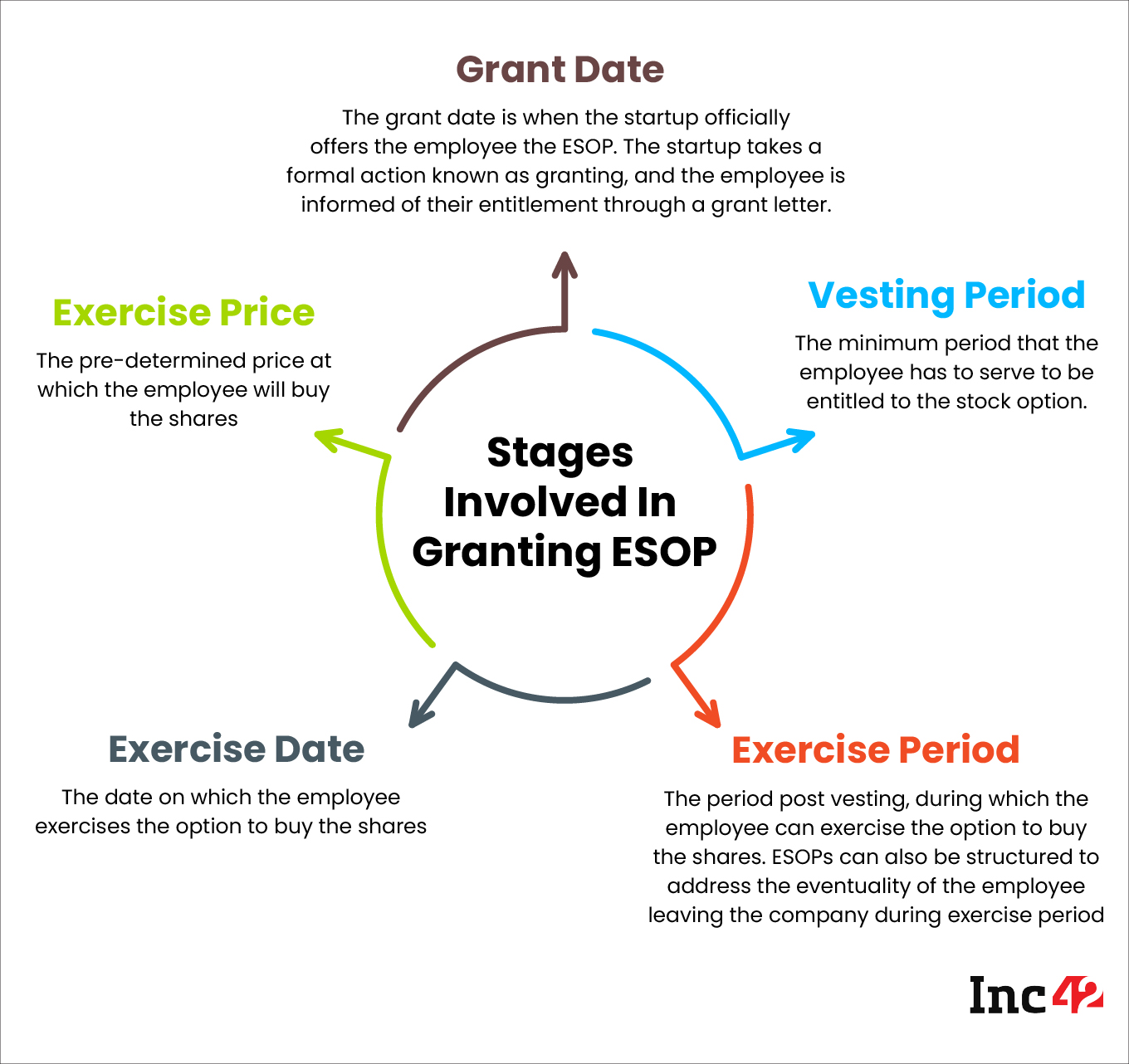
Let's quickly define these key terms from the diagram and article:
- Grant: This is the beginning. The company officially gives you the stock options. The number of options and the purchase price (called the Exercise Price or Strike Price) are documented in a grant letter.
- Vesting: You don't get the right to buy all your options at once. You have to earn them over time by working at the company. This earning period is called vesting. (We will cover this in detail in the next module).
- Exercise: Once your options have vested, you can choose to "exercise" them—this is the act of paying the agreed-upon Exercise Price to officially buy the shares and become a shareholder.
- Sale: After you own the shares, you can sell them (usually during a specific event like an IPO or acquisition) to hopefully make a profit.
This Grant → Vesting → Exercise → Sale sequence is the fundamental journey of an ESOP holder.
Conclusion
In this lesson, we moved from the abstract idea of "getting equity" to a concrete definition of how it often works. We now have a clear and simple definition of an Employee Stock Option Plan.
Key Takeaways:
- An ESOP gives you the right, but not the obligation, to buy a specific number of company shares.
- The price you will pay for these shares, the Exercise Price, is fixed and determined on your grant date.
- You do not become a shareholder when you are granted ESOPs. You only become a shareholder after you exercise your options by paying for the shares.
- Companies create an ESOP Pool, which is a reserved portion of their total shares, to grant options to employees.
Preview of the Next Lesson:
Now that we've defined ESOPs as an "option to buy," you might wonder: why don't companies just give shares away directly? Well, sometimes they do! This other method involves something called Restricted Stock Units (RSUs). In our next lesson, we will explain the difference between being granted shares directly (RSUs) versus being given the option to buy shares (ESOPs) to understand why a company might choose one over the other.