Hello! Welcome to your next lesson.
In our last session, we established a crucial foundation: an Employee Stock Option Plan (ESOP) gives you the right, but not the obligation, to buy company shares at a price that is fixed today. You don't own the shares yet; you own an "option."
But what if a company just gave you the shares directly, without asking you to buy them? This is another common way to grant equity, and understanding this distinction is fundamental. Today's lesson focuses on exactly that. Our goal is to explain the difference between being granted shares directly, using Restricted Stock Units (RSUs), versus being given the option to buy shares through ESOPs.
By the end of this lesson, you'll understand why a startup might offer you ESOPs while a large multinational corporation (MNC) might offer you RSUs, and what that means for your wallet and your risk.
Method 1: The Option to Buy (ESOPs - A Quick Recap)
As we learned, with an ESOP, you receive an option.
- You are given a right to buy shares.
- You must pay money (the "exercise price") to acquire them.
- You only make a profit if the share's market value is higher than your exercise price.
Method 2: The Promise of Free Shares (RSUs)
The second primary method is through Restricted Stock Units (RSUs). An RSU is a promise from your employer to give you company shares at a future date, for free. You don't buy them; they are transferred to you once you meet certain conditions (which we'll later learn is called "vesting").
The word "Restricted" simply means there are rules attached. You can't have the shares right away. You must typically work for the company for a certain period. Once those restrictions are lifted (e.g., you complete one year of service), the "units" convert into actual shares that you own.
To start, let's watch a video that explains RSUs in a very simple way, specifically within the Indian context.
RSU ESOP ESPP explained || Taxation rules in India || #finvestomate
This video from Finvestomate gives a clear, straightforward explanation of what RSUs are and how they work. It uses a simple example that's easy to follow.
Watch the segment from 00:51 to 02:47. Focus on how the employee receives the shares without paying anything out of pocket once the vesting period is complete.
As the video explained, with RSUs, the shares simply become yours after you meet the time requirement. There's no buying decision to make and no exercise price to pay.
The Two Most Important Differences
The choice between ESOPs and RSUs boils down to two critical factors for an employee: cost and risk.
1. Cost: Paying vs. Getting for Free
This is the most fundamental difference.
- ESOPs require you to pay. To turn your options into shares, you must have enough cash to pay the exercise price for all the shares you want to buy.
- RSUs are free. The shares are granted to you as part of your compensation. You don't pay anything to receive them (though, as we'll see in a later module, you will have to pay taxes).
2. Risk: Potential for Value vs. Potential to be Worthless
This difference in cost leads to a major difference in risk.
- RSUs always have some value (as long as the company's stock is worth more than zero). If you are granted 100 RSUs and the share price is ₹50 when they vest, you have received assets worth ₹5,000 (100 * ₹50). If the share price drops to ₹10, you still receive assets worth ₹1,000. You've lost potential value, but you haven't lost any of your own money.
- ESOPs can become worthless. Imagine you have options with an exercise price of ₹100. If the company struggles and its share price drops to ₹80, your options are "underwater." It would make no sense to pay ₹100 to buy a share that's only worth ₹80. In this case, your ESOPs have zero value.
The following video does an excellent job of breaking down this concept of "intrinsic value" and other key differences.
Restricted Stock vs. Stock Options (Everything You Need to Know)
In this video, Jennifer Brick clearly contrasts RSUs and Stock Options. She provides great insights into their differing value propositions.
Please watch from 01:24 to 04:15. Pay close attention to her explanation of why RSUs always have some 'intrinsic value' while options do not.
RSU vs. ESOP: A Head-to-Head Comparison
Now that we have the core concepts, let's put it all together. The following table provides a fantastic visual summary of the key differences, especially relevant for the Indian context.
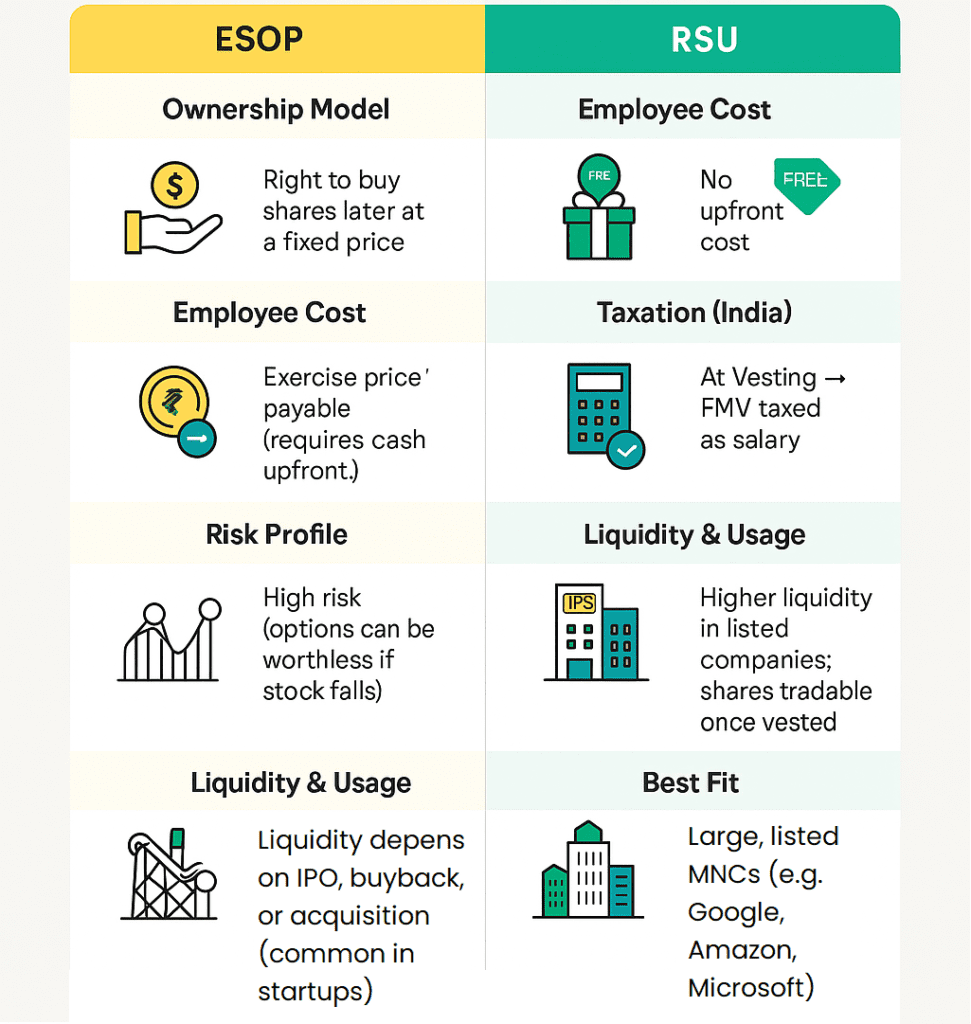
To dive deeper into these points, the article where this table comes from provides one of the best comparisons available.
RSU vs ESOP – Differences, Taxation, Which is Better?
The article 'RSU vs ESOP – Differences, Taxation, Which is Better?' from Treelife is an excellent resource. We will focus on its detailed comparison table, which summarizes everything we've discussed.
Please read the section titled 'RSU vs ESOP – Key Differences (Comparison Table) 2025'. Study each row of the table carefully to contrast the two types of equity on every major feature.
Why Companies Choose One Over the Other
So, why would a company offer one and not the other? It usually comes down to the company's stage of development.
- Startups prefer ESOPs. They are often short on cash but have huge growth potential. By offering ESOPs, they give employees the chance for a massive reward if the company succeeds, motivating them to work hard to increase the company's value. It’s a high-risk, high-reward system that aligns with the startup mentality.
- MNCs and Public Companies prefer RSUs. These companies are more stable, and their stock often has a clear market price. RSUs offer a more predictable and lower-risk form of compensation, making them a powerful tool for retaining employees without the "all or nothing" nature of startup options.
To see these concepts play out in a story format, the following article uses the journey of two different employees, Raj (with RSUs) and Sita (with ESOPs), to illustrate the differences.
Understanding RSUs and ESOPs in India: A Tale of Two ...
This LinkedIn article, 'Understanding RSUs and ESOPs in India: A Tale of Two Employees', provides a narrative-driven explanation that makes the concepts easy to remember.
Read about 'Raj's Story' with RSUs and 'Sita's Story' with ESOPs. Then, review the section 'The Key Differences 🔍' which summarizes their different experiences.
Test your understanding!
Imagine you receive two job offers:
- Startup A offers you 1,000 ESOPs with an exercise price of ₹20 per share.
- MNC B offers you 100 RSUs.
A year later, you vest some of your equity. At that time, the share price for both companies is ₹500.
Question 1: To acquire your shares, how much money do you need to pay out-of-pocket for each offer?
Question 2: Now, imagine a different scenario where both companies face difficulties, and their share price at vesting is only ₹15. What is the value of your equity grant in each case?
Show answer
Answer 1:
- Startup A (ESOPs): To buy the 1,000 shares, you would need to pay the exercise price: 1,000 shares * ₹20/share = ₹20,000.
- MNC B (RSUs): You pay ₹0. The 100 shares are granted to you for free.
Answer 2:
- Startup A (ESOPs): Your exercise price is ₹20, but the shares are only worth ₹15. Your options are "underwater." You would not exercise them, so their practical value is ₹0.
- MNC B (RSUs): You are granted 100 shares worth ₹15 each. The total value is 100 * ₹15 = ₹1,500. Even though the price fell, your RSUs still have value.
Conclusion
You've now grasped the fundamental difference between the two main types of equity compensation. This is a critical piece of knowledge when evaluating a job offer.
Key Takeaways:
- ESOPs are an option to buy shares. You must pay an exercise price, and they carry the risk of becoming worthless if the stock price falls below that price. They are common in startups.
- RSUs are a promise of a direct grant of shares. You pay nothing to receive them, so they almost always have some value upon vesting. They are common in large, stable companies (MNCs).
- The choice between them reflects a trade-off: ESOPs offer a higher potential reward in exchange for higher risk, while RSUs offer a more predictable, lower-risk reward.
Preview of the Next Lesson:
We've repeatedly used the term "vesting" to describe the process of earning your equity over time. But how does this actually work? What is a "vesting schedule"? What is a "cliff"? In our next lesson, we will dive into the mechanics of vesting, explaining how companies use it to ensure you stick around to earn your shares.