Hello! Welcome to the final lesson in our module on the mechanics of vesting.
In our previous lessons, we've broken down what vesting is, how to calculate the number of options you earn over time, and what happens to your vested and unvested options when you leave a company. You learned the crucial rules: unvested options are forfeited, and you have a limited time—the exercise window—to purchase your vested options.
Today, we'll bring all these concepts together. The goal of this lesson is to see how these rules play out in the real world by analyzing a case study. We will compare the outcomes for two employees who are granted the exact same ESOPs but leave their company at different times. This will make it crystal clear how vesting directly impacts your financial outcome.
Setting the Scene: Two New Hires
Imagine a startup called "GrowthUp Inc." a few years ago. Two talented developers, Anya and Ben, join the company on the same day. As part of their compensation package, they each receive an identical ESOP grant.
Here are the key details of their grant:
- Total Options Granted: 4,800 ESOPs
- Vesting Schedule: A standard 4-year vesting schedule with a 1-year cliff.
Let's quickly recap what this schedule means, as it's the foundation for everything that follows.
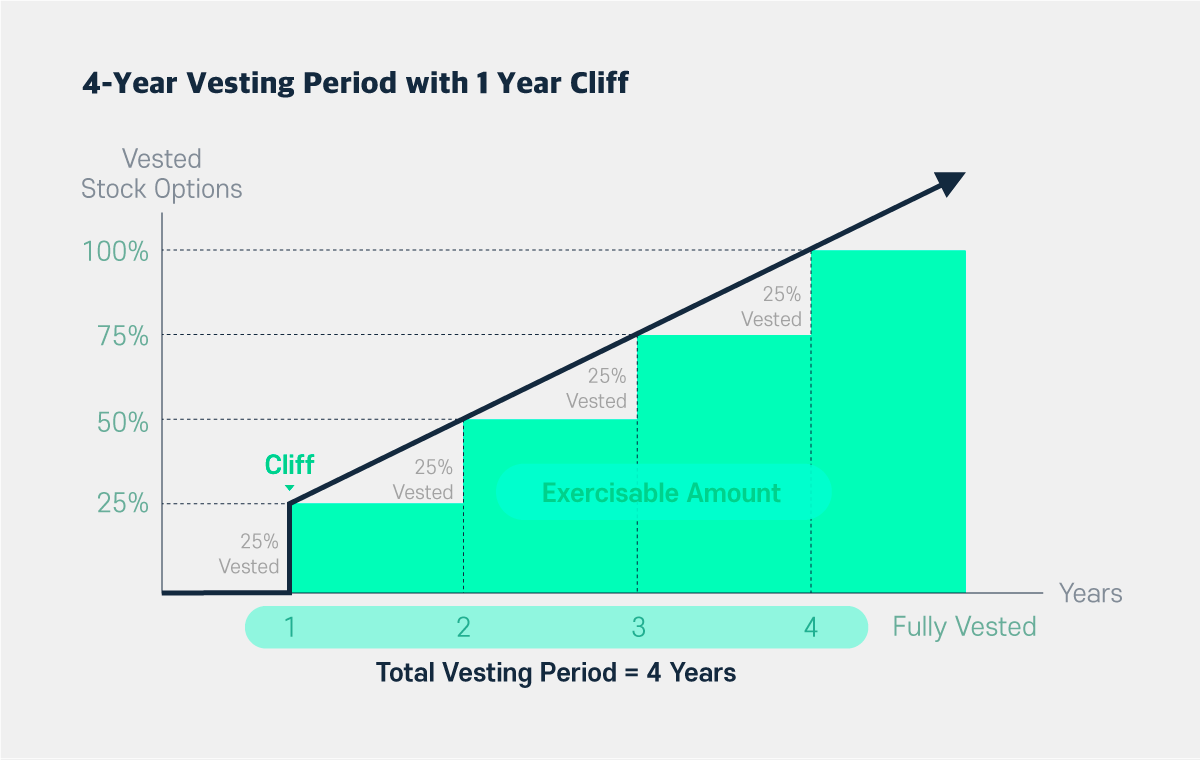
For Anya and Ben's 4,800 options, this translates to:
- The Cliff (Months 1-12): If they leave during this time, they get 0 options.
- At 12 Months: 25% of 4,800 options = 1,200 options vest immediately.
- After 12 Months (Months 13-48): The remaining 3,600 options vest over the next 36 months. This works out to 100 options per month (3,600 options / 36 months).
Now, let's see what happens when their career paths at GrowthUp Inc. take different turns.
Case Study Part 1: Ben, The Early Leaver
Ben works at GrowthUp Inc. for 10 months. He gets a great opportunity at another company and decides to resign.
What happens to his 4,800 options?
- Analysis: Ben left before completing a full year of service. He did not reach the 1-year cliff.
- Outcome: According to the vesting schedule, an employee must stay for at least 12 months to earn any of their options. Because Ben left at month 10, all 4,800 of his granted options are forfeited. They go back into the company's option pool.
Ben walks away with zero shares.
This might seem harsh, but it's the entire point of a cliff. It's a protection mechanism for the company and its long-term employees. It ensures that equity is only shared with those who have committed a minimum amount of time to helping the company grow.
To see why this is so important, let's look at another resource that shows what can happen when there's no vesting.
Vesting Schedules & Cliff Periods: Protecting Equity ... - Startup
The article 'Vesting Schedules & Cliff Periods' from GLS Startup Law provides a powerful, short case study about what happens when founders don't use a vesting schedule.
Please read the section titled 'Case Study: The Founder Who Left With 25%'. Notice how, without vesting, the founder who left early kept a huge stake in the company, causing problems for the founder who stayed.
Ben's situation is the direct result of applying the lesson from that case study. The cliff prevented a situation where someone who stayed for less than a year could walk away with valuable ownership.
Case Study Part 2: Anya, The Mid-Term Leaver
Anya enjoys her work at GrowthUp Inc. and stays with the company for 2.5 years (30 months). She then decides to move to a new city and resigns.
What happens to her 4,800 options?
Let's break it down step-by-step:
- Total Months Worked: 30 months.
- Did she pass the cliff? Yes. 30 months is more than 12 months.
- How many options has she vested?
- She vests 100 options per month for the entire duration of her employment.
- 30 months × 100 options/month = 3,000 vested options.
- How many options were unvested?
- Total Grant - Vested Options = Unvested Options
- 4,800 - 3,000 = 1,800 unvested options.
Outcome:
- The 1,800 unvested options are immediately forfeited the day she resigns. They go back to the company.
- She now has the right to purchase her 3,000 vested options. As we learned in the last lesson, she must do this within her post-termination exercise window (e.g., 90 days), or she will lose these as well.
Anya walks away with the ability to own a significant piece of the company she helped build for 2.5 years.
Comparing the Outcomes
Let's put their results side-by-side. Both started with the exact same grant, but their decision of when to leave led to vastly different results.
| Employee | Time at Company | Vested Options | Unvested Options (Forfeited) | Final Outcome |
|---|---|---|---|---|
| Ben | 10 months | 0 | 4,800 | Gets 0 shares |
| Anya | 30 months (2.5 years) | 3,000 | 1,800 | Can purchase 3,000 shares |
This comparison is the core of understanding vesting: Time is equity. The longer you stay, the more ownership you earn.
To reinforce this, let's look at one more example from another resource that uses a similar scenario.
Joining a tech start-up? Understand your ESOP and stock- ...
The article 'Joining a tech start-up? Understand your ESOP' from Endowus provides another excellent case study with a character named 'Greg'. It shows how his vested shares are calculated at different departure dates.
Please read the section 'How does vesting work, and what happens if I resign?'. Pay close attention to the bullet points that calculate the vested ESOPs if Greg leaves after 28 months, 12 months, and 11 months. You'll see it follows the exact same logic we used for Anya and Ben.
Test your understanding!
Let's imagine a third employee, Chris, who also started with Anya and Ben and was granted 4,800 options. Chris stays for the full 4 years (48 months) and then decides to leave.
What is the status of his options upon his resignation?
Show answer
- Vested Options: Chris has vested 100% of his grant. 48 months × 100 options/month = 4,800 vested options.
- Unvested Options: 0.
- Outcome: Chris has earned the right to purchase all 4,800 shares granted to him. He will still need to exercise them within the post-termination exercise window to become a shareholder.
Conclusion
This case study demonstrates the power and purpose of vesting schedules. They are designed to align your interests with the company's long-term success. By tying ownership to time, companies incentivize employees to stick around and contribute to growth, while employees are rewarded for their loyalty and hard work.
Key Takeaways:
- Vesting creates a direct link between the time you work and the equity you earn.
- The 1-year cliff is a powerful filter. Leaving before the cliff means you walk away with nothing, no matter how close you were.
- After the cliff, every additional month you stay adds to your vested options and your potential future wealth.
- Your departure date is one of the most significant factors determining the final value you get from your ESOPs.
Preview of the Next Module:
Anya has the right to buy 3,000 shares, and Chris can buy 4,800. But what are those shares actually worth? The answer depends entirely on the company's success and its valuation. In our next module, we will shift our focus from the mechanics of earning options to the value of those options. We'll start by exploring the typical lifecycle of a startup—from a small idea in a garage to a massive company on the stock market—and see how its growth directly impacts the paper value of your equity.