Hello! Welcome to the first lesson of our new module on company growth and ESOP valuation.
In the last module, we focused on the mechanics of earning your options through vesting. We ended with a key question: once you've vested your options, what are they actually worth? Anya, from our case study, could buy 3,000 shares, but is that a life-changing amount of money or just pocket change?
The answer depends entirely on the company's journey and growth. The value of your shares is directly tied to the success of the business.
In this lesson, we will explore the typical path a startup takes. Our goal is to identify the typical stages of a startup's lifecycle, from the initial idea all the way to becoming a large public company. Think of it like learning the different levels of a video game; each stage has its own goals, challenges, and rewards. Understanding this journey is the first step to understanding how your ESOPs can grow in value.
A Bird's-Eye View: The Startup Lifecycle
A startup's life is often a journey from a simple idea to a thriving business. This journey is marked by distinct stages of growth, each typically funded by different types of investors.
This graph gives a great overview of the entire process:
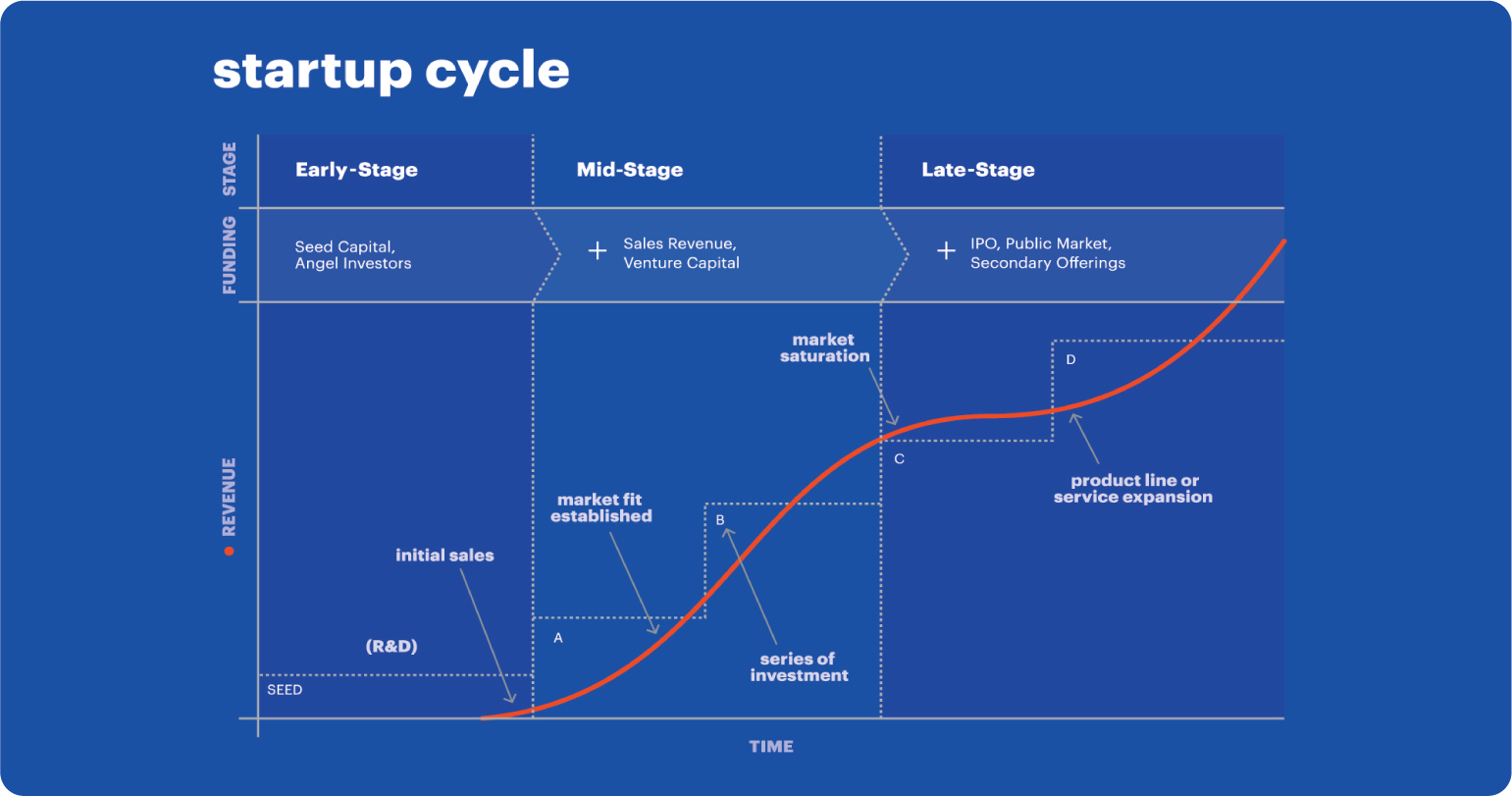
As you can see, the goal is for revenue to go up and to the right! Now, let's break down these stages into the specific names you'll often hear in the startup world.
The Stages of a Startup's Journey
To understand these stages in detail, we'll use a guide that lays them out very clearly.
Get to know the startup stages: A complete guide
The article 'Get to know the startup stages: A complete guide' from Embroker provides a fantastic, easy-to-follow breakdown of a startup's entire lifecycle. We'll refer to it throughout this lesson.
First, please read the introduction of the article, up to the start of section 1 ('Pre-seed stage'). It sets the scene for why understanding these stages is so important for a startup's success.
Now let's dive into each stage one by one.
1. Pre-seed and Seed Stage: The Beginning
This is where it all starts.
- Pre-seed: This is the "lightbulb moment" stage. The founders have an idea but need to prove it's a good one. They do market research, talk to potential customers, and build a founding team. Funding at this stage is usually from the founders' own savings or from "friends and family."
- Seed Stage: The goal here is to "plant a seed" that will grow into a real business. The team builds the first version of the product, often called a Minimum Viable Product (MVP). They try to get their first real customers and gather feedback. The money raised in this stage, called "seed funding," typically comes from Angel Investors (wealthy individuals) or early-stage Venture Capital (VC) firms.
This short video gives a simple, animated explanation of how a seed investment works.
Startup Funding Explained: Everything You Need to Know
The video 'Startup Funding Explained' by The Rest Of Us clearly illustrates the very first step of getting funding for an idea.
Watch the segment from 00:48 to 01:47. It shows how founders give up a piece of their company (equity) to a friend in exchange for the first bit of cash, called a 'seed investment'.
2. Series A: The First Big Step-Up
Reaching the Series A stage is a major milestone. A company gets here only after it has:
- A working product.
- A steady stream of customers and revenue.
- Proof that its business model works (this is called "product-market fit").
The money raised in Series A is used for scaling—hiring more people, expanding marketing and sales efforts, and capturing a larger piece of the market. The investors at this stage are almost always professional Venture Capital firms.
Startup Funding Explained: Everything You Need to Know
Let's continue with the 'Startup Funding Explained' video to see how a Series A round is different.
Watch the section from 02:00 to 02:55. Notice how the founders are no longer talking to friends, but to professional investors (Angel Investors and VCs) and are asking for a much larger amount of money ($1 million).
3. Series B, C, and Beyond: Scaling to Dominate
If Series A is about proving the model, Series B, C, D, etc., are all about massive growth.
- Series B: The company is now a well-oiled machine. It has proven its business model and is looking to expand aggressively, often into new markets or product areas.
- Series C and beyond: These are later-stage rounds. The company is often a market leader and might be looking to acquire other smaller companies, expand globally, or prepare to go public.
With each round, the company's valuation (what the company is worth) hopefully increases, and it raises more money from even larger investors.
4. The Exit: Cashing Out
The "Exit" is the moment everyone—founders, investors, and employees with ESOPs—has been waiting for. It’s the event that turns the "paper value" of your shares into actual cash. This is also called a liquidity event. There are two main types of exits:
- Acquisition (or M&A - Mergers & Acquisitions): A larger company buys the startup. For example, when Walmart bought Flipkart, it was an acquisition. This was a massive exit event for Flipkart's employees and investors.
- Initial Public Offering (IPO): The company lists itself on a public stock exchange (like the Bombay Stock Exchange or NASDAQ). After an IPO, anyone from the general public can buy and sell the company's shares. This allows employees to eventually sell their shares on the open market.
This final clip explains these two exit paths very well.
Startup Funding Explained: Everything You Need to Know
The 'Startup Funding Explained' video concludes by explaining the two primary ways investors (and employees) can finally make money from their shares.
Watch the part from 07:01 to 09:22. It covers both an acquisition and an IPO in a very easy-to-understand way.
A Real-World Example: Zomato's Journey
These stages can feel abstract, so let's look at a real company from India that you probably know: Zomato. This table shows its incredible journey through many of these funding rounds.

Notice how Zomato went through many rounds (all the way to "Series J"!). With each stage, new investors came in, and the company's valuation grew, ultimately leading to its IPO in 2021.
Test your understanding!
Imagine you read a news headline about a startup. Based on the description, try to identify which stage it's most likely in.
Scenario: "QuickCart, a grocery delivery startup with thousands of customers and proven monthly revenue, has just raised $15 million from a leading Venture Capital firm to expand its operations to three new cities."
Which funding stage does this most likely represent?
a) Seed Stage
b) Series A
c) IPO
Show answer
The correct answer is b) Series A.
Here's why: The company already has customers and revenue (it's past the seed stage) and is raising a significant amount from a VC firm specifically to scale its operations. This is the classic definition of a Series A round.
Why Does This Matter for Your ESOPs?
Understanding this lifecycle is crucial because your ESOPs gain value as the company successfully moves through these stages.
Here’s the simple logic:
- You are granted options with a fixed strike price (e.g., ₹10 per share).
- The company raises a Seed round. Its valuation increases, and the fair market value of a share might now be ₹25.
- It grows and raises a Series A round. The company is more valuable now. The share price might jump to ₹100.
- It continues to succeed, raises a Series B round, and the share price climbs to ₹500.
Your cost to buy the share remains fixed at ₹10, but the market value of that share keeps increasing. The difference between the market value and your strike price is your "paper" profit. The "Exit" (IPO or acquisition) is the event that finally lets you turn that paper profit into real money.
Conclusion
Today we've mapped out the exciting, challenging, and rewarding journey of a startup.
Key Takeaways:
- A startup typically grows through distinct stages: Pre-seed/Seed, Series A/B/C, and a final Exit.
- Each stage is funded by different types of investors, from friends and family to large VCs.
- The goal of each stage is to hit new milestones, grow the business, and increase its value.
- The "Exit" (an IPO or acquisition) is the key event that allows employees and investors to realize the financial gains from their equity.
Preview of the Next Lesson:
We've mentioned the terms "valuation" and "share price" a lot in this lesson. But what do they actually mean? How does a company decide it's worth ₹10 crores or ₹1000 crores? In our next lesson, we will dive deep into the concept of company valuation and see exactly how it's calculated and how it directly impacts the paper value of your ESOPs.