Hello! Welcome to our seventh and final lesson in the "Quantum Foundations of Chemical Bonding" module.
In our last lesson, we unified VSEPR theory with our mathematical model of hybridization. This provided a powerful workflow to predict the three-dimensional geometry of molecules—the -framework that defines their shape. You learned how to determine the hybridization of a central atom and predict the resulting molecular geometry and bond angles, even accounting for the influence of lone pairs.
Today, we shift our focus from the geometry of the bonds to the energetics within the bonds. Our learning outcome is to relate orbital overlap to bond strength and explain why bonds are generally weaker than bonds. This lesson will bridge the gap between the quantum mechanical description of orbital interaction and the tangible energetic properties of chemical bonds, providing a crucial foundation for understanding chemical reactivity.
1. Defining Bond Strength: A Potential Energy Perspective
Before comparing bond strengths, we must first define what "strength" means in a quantum mechanical context. When two atoms approach each other from a distance, their atomic orbitals begin to overlap. This overlap allows each atom's electrons to be attracted by both nuclei, a stabilizing interaction that lowers the system's potential energy. However, if the atoms get too close, internuclear and inter-electron repulsion dominate, and the potential energy rises sharply.
The result is a potential energy curve where the minimum energy corresponds to the most stable arrangement: the equilibrium bond length. Bond strength is the energy required to break this bond and separate the atoms to an infinite distance. This is more formally known as the Bond Dissociation Energy (BDE). A stronger bond corresponds to a deeper potential energy well.
Covalent Bond Energy and Length
To visualize this fundamental concept, let's watch a segment from a video by Professor Dave Explains. It provides an excellent illustration of the potential energy curve for the formation of a hydrogen molecule, connecting the concepts of orbital overlap, bond length, and bond energy.
Please watch from 00:56 to 02:35. Focus on how the potential energy of the two-hydrogen system changes as a function of internuclear distance and how this curve defines both the optimal bond length and the bond energy.
2. The Principle of Maximum Overlap
The key takeaway from that video is that orbital overlap leads to a decrease in potential energy. It follows that the extent of this overlap should directly correlate with the magnitude of this energy decrease. This gives us a core guiding principle in both Valence Bond (VB) and Molecular Orbital (MO) theories:
The Principle of Maximum Overlap: The strength of a covalent bond is directly proportional to the extent of overlap between the atomic orbitals forming it. Greater overlap results in a lower-energy, more stable, and thus stronger bond.
In MO theory terms, greater overlap leads to a larger energy difference between the resulting bonding and antibonding molecular orbitals. The electrons in the bonding MO are therefore more stabilized, creating a stronger bond.
3. Sigma () vs. Pi () Bonds: A Geometric Distinction
In previous lessons, we encountered both and bonds. Their fundamental difference lies in the geometry of their overlap relative to the internuclear axis (the imaginary line connecting the two nuclei).
- Sigma () Bonds: Formed by the direct, end-on overlap of orbitals. The electron density is concentrated and cylindrically symmetrical along the internuclear axis. This can occur between s-s, s-p, p-p, or hybridized orbitals.
- Pi () Bonds: Formed by the parallel, side-on overlap of unhybridized p-orbitals. The electron density is concentrated in two lobes, one above and one below the internuclear axis. This means there is a nodal plane that contains the internuclear axis.
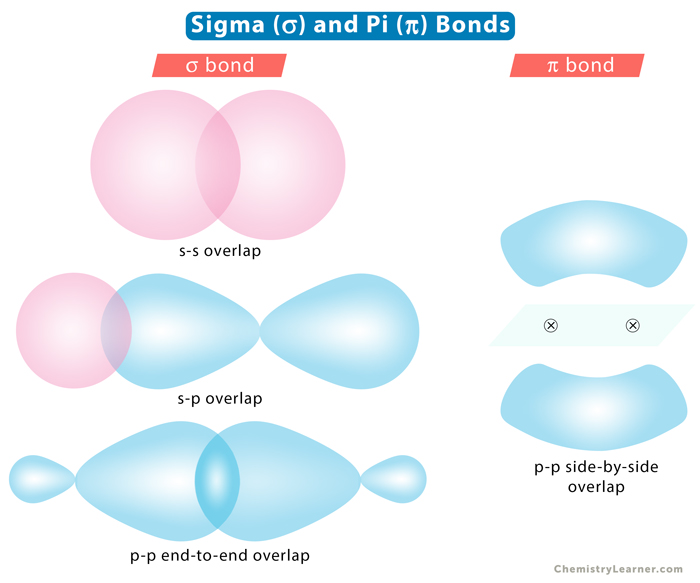
This geometric difference is the root cause of their differing strengths.
4. The "Why": Analyzing the Effectiveness of Overlap
Why is end-on overlap more effective than side-on overlap? To answer this rigorously, we turn to a more formal analysis of the criteria for covalent interaction. A highly useful resource from Chem LibreTexts breaks this down into three criteria: Symmetry, Energy, and Overlap. We will focus on the Overlap Criterion.
Let's read a section from the Chem LibreTexts article 'Orbital Overlap'. This text provides the deep, quantitative reason why \sigma overlap is inherently stronger than \pi overlap.
Please read the subsection titled 'The Overlap Criterion'. Focus specifically on 'Rule 3: Orientation'. The text and the accompanying figure (Figure \PageIndex{8}) in that section are the most critical parts for our current learning outcome.
As the reading explains, for two p-orbitals at the same internuclear distance, the volume of space where the orbitals constructively interfere is significantly larger for a (end-on) orientation than for a (side-on) orientation. The orbitals in a bond point directly at each other, maximizing their interaction. In a bond, they are parallel and overlap more diffusely off-axis.
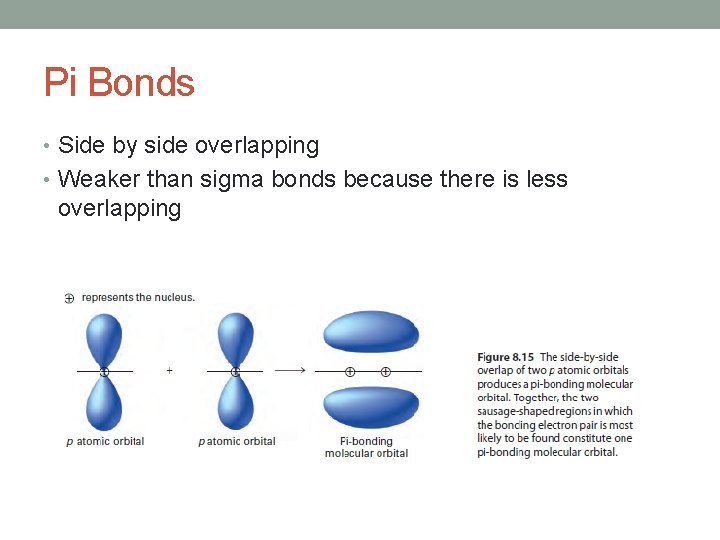
In summary:
- Bond strength is proportional to orbital overlap.
- The geometry of overlap is inherently more effective and leads to a greater degree of overlap than overlap.
- Therefore, bonds are generally stronger than bonds.
5. Application: The Energetics of Multiple Bonds
This principle has direct consequences for the structure of double and triple bonds.
- A double bond consists of one bond and one bond.
- A triple bond consists of one bond and two bonds.
This explains a well-known experimental observation: a carbon-carbon double bond is stronger than a single bond, but it is not twice as strong. Let's look at the approximate bond dissociation energies:
- C-C single bond (): ~350 kJ/mol
- C=C double bond (): ~610 kJ/mol
From this data, we can infer the strength of the bond component:
As predicted by the principle of maximum overlap, the bond (~260 kJ/mol) is significantly weaker than the bond (~350 kJ/mol). The relative weakness of the bond makes it more reactive and is the reason alkenes and alkynes undergo addition reactions, a topic we will explore in great detail later in the course.
Test your understanding!
A nitrogen-nitrogen triple bond (N≡N) in N₂ is exceptionally strong, with a bond dissociation energy of 945 kJ/mol. A nitrogen-nitrogen single bond (N-N) in hydrazine (H₂N-NH₂) is relatively weak, at about 160 kJ/mol.
- Describe the composition of the N≡N triple bond in terms of and bonds.
- Why is simply subtracting the N-N single bond energy from the N≡N triple bond energy a poor way to estimate the bond strength in this case? (Hint: Consider the structure of hydrazine and the concepts from the previous lesson.)
Show answer
- The N≡N triple bond is composed of one bond and two bonds.
- This is a poor method because the N-N single bond in hydrazine is not a good baseline for the bond in N₂. In hydrazine, each nitrogen is sp³ hybridized and has a lone pair. These lone pairs are in close proximity and exert strong electrostatic repulsion (LP-LP repulsion), which significantly weakens the N-N single bond. The component of the N≡N triple bond, formed from sp-hybridized orbitals (50% s-character) and without lone pair repulsion in the same way, is expected to be much stronger than 160 kJ/mol. Therefore, subtracting this artificially weak value would lead to a gross overestimation of the bonds' strength.
Conclusion
This lesson concludes our journey through the quantum foundations of chemical bonding. We have moved from the wavefunctions of individual atoms to a sophisticated understanding of molecular geometry and bond energetics.
Key Takeaways:
- Bond strength is measured by bond dissociation energy, which is the depth of the potential energy well created by orbital overlap.
- The Principle of Maximum Overlap is the central idea: greater overlap leads to a stronger, more stable bond.
- bonds, formed by direct, end-on overlap, have greater overlap and are therefore stronger than bonds, which are formed by less effective side-on overlap.
- A double bond () is stronger than a single bond but not twice as strong, because the component is weaker than the component. This weaker bond is the site of reactivity in molecules with multiple bonds.
Preview of the Next Module:
You have now mastered the fundamental building blocks: orbitals, hybridization, geometry, and bond strength. With this foundation, we are ready to explore how electron density is distributed within the and frameworks of larger molecules and how this distribution governs their properties and reactivity. In our next lesson, the first of the "Electronic Effects and Aromaticity" module, we will investigate the inductive effect, a phenomenon where electronegativity differences cause a polarization of the electron cloud through the -bond framework.