Hello! Welcome to the first lesson of our second module, "Electronic Effects and Aromaticity."
In the previous module, we built a robust quantum mechanical model of chemical bonds. We concluded by examining the -bond framework that defines a molecule's shape and understanding why the direct, end-on overlap of bonds makes them stronger than the side-on overlap of bonds.
Today, we will see that this -framework is not just a static scaffold. The electron density within it is dynamic and can be permanently polarized. This brings us to our learning outcome: to explain the origin of the inductive effect in terms of electronegativity differences and sigma bond polarization. This is the first of several crucial "electronic effects" we will study, which are fundamental to explaining the reactivity and properties of organic molecules. Understanding this will be our first step in answering the "why" behind molecular behavior beyond simple bond structures.
1. What is the Inductive Effect?
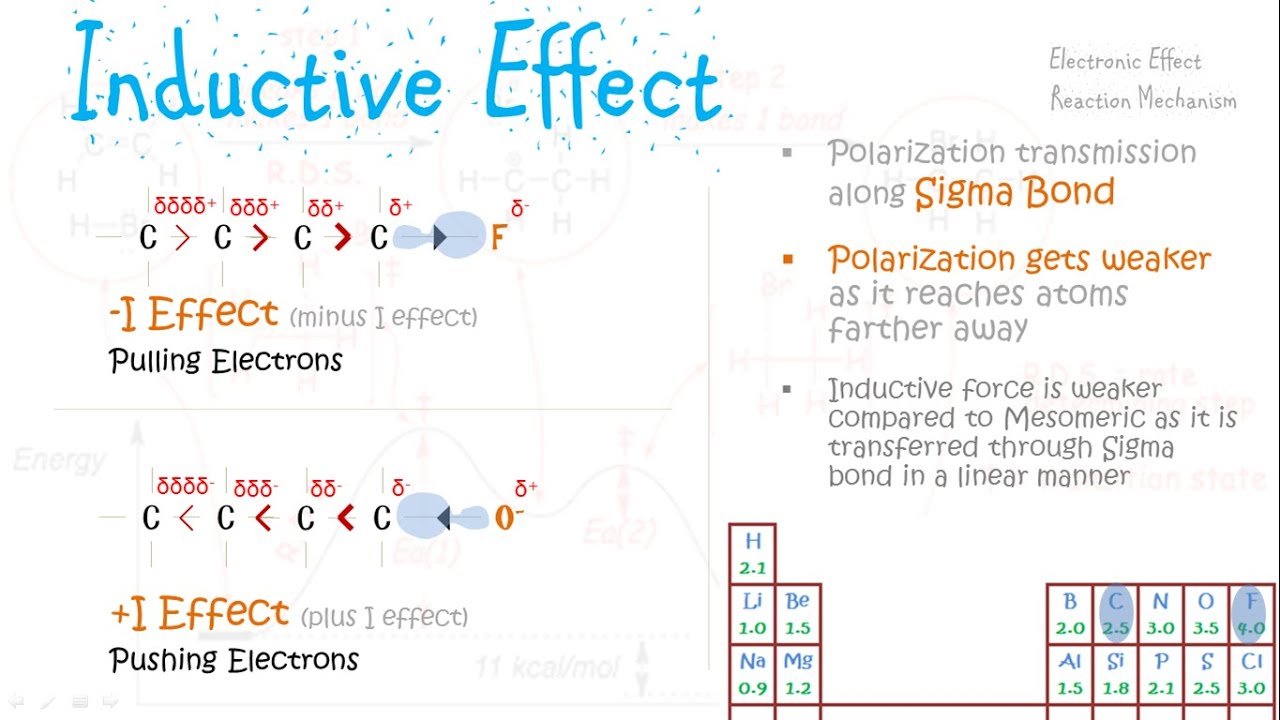
The inductive effect is the permanent displacement of shared electron pairs in a sigma () bond towards the more electronegative atom or group. This creates a permanent dipole in the bond and induces smaller dipoles in adjacent bonds.
Let's visualize this. Imagine a simple carbon chain. If we attach an atom with high electronegativity, like fluorine, it will pull the electron density from the bond towards itself.
- The C-F bond becomes polarized, with the carbon atom gaining a partial positive charge () and the fluorine atom a partial negative charge ().
- This now-electron-deficient carbon () in turn pulls electron density from the next carbon atom in the chain, inducing a smaller partial positive charge () on it.
- This effect continues down the chain, but its magnitude diminishes rapidly with distance. It is generally considered negligible beyond the third carbon atom.
To see a practical application of this, let's watch a short video.
Induction vs Resonance (Rules of Organic Chemistry #4)
This video from the Science Simplified channel provides a clear, conceptual explanation of how the inductive effect stabilizes charge by spreading it out through the sigma bond framework.
Please watch from 00:56 to 02:37 and then from 05:19 to 06:19. Focus on how the presence of electronegative fluorine atoms pulls negative charge density, effectively delocalizing it and increasing stability. Note how the effect's strength depends on the distance from the charge.
2. The Quantum Mechanical Origin of Polarization
Why does an electronegative atom pull electron density? You've learned it's due to a higher effective nuclear charge. Let's connect this to the orbital energy concepts from our first module.
An atom is electronegative because its valence atomic orbitals are at a relatively low energy level; they hold onto electrons tightly. When a covalent bond forms between two atoms of different electronegativity (e.g., Carbon and Fluorine), their atomic orbitals combine to form molecular orbitals.
- The atomic orbital of the more electronegative atom (F) is lower in energy than that of the less electronegative atom (C).
- When they combine to form a bonding molecular orbital, this MO is closer in energy to the fluorine atomic orbital.
- As a result, the electron density in the bonding molecular orbital is not shared equally. It is skewed, or polarized, towards the fluorine atom.
This unequal contribution of atomic orbitals to the molecular orbital is the quantum mechanical basis of the inductive effect.
Stereoelectronic Effects in Organic Chemistry, Prof. Oliver Reiser, Uni Regensburg, Lecture 1
For a deeper dive, let's watch a segment from a lecture by Prof. Oliver Reiser. He explains precisely how electronegativity dictates the energy levels of bonding and antibonding orbitals. This is the rigorous 'why' you are looking for.
Watch from 29:41 to 34:52. Pay close attention to the rules he establishes for the energy of different orbitals. The key rule for us is: 'the more electron withdrawing atoms are which compose the orbitals, the lower they are in energy'. This directly links electronegativity to the orbital energy diagrams that underpin bonding.
3. Classifying Inductive Effects: -I and +I Groups
Based on their ability to pull or push electrons relative to hydrogen, we classify substituents into two types:
-
Electron-Withdrawing Groups (-I Effect): These groups are more electronegative than hydrogen and pull electron density away from the carbon chain.
- Examples:
- These groups create a partial positive charge on the carbon atom they are attached to.
-
Electron-Donating Groups (+I Effect): These groups are less electronegative than hydrogen and effectively "push" electron density towards the carbon chain.
- Examples: Alkyl groups (), negatively charged groups ().
- Alkyl groups are considered weak electron donors. While a simple electronegativity argument is complex, they are more polarizable than a hydrogen atom and thus better at stabilizing an adjacent positive charge, which manifests as a weak donating effect.
The following resource provides a detailed look at these concepts, using the acidity of carboxylic acids as a framework to understand them.
Chapter 14 Substituent Effects
The document 'Chapter 14 Substituent Effects' provides an excellent, detailed analysis of the inductive effect. It formalizes the concepts we've just discussed and shows how they apply in practice.
Please read section 14.2, starting from 'Origin of the Substituent Effect' and continuing through 'Inductive Effects for Other S Groups (14.2B)'. This will cover: When the Substituent is F: A clear explanation of how the C-F bond polarization arises from electronegativity differences. Electron Withdrawing Groups & Electron Donating Groups: Formal definitions of -I and +I groups with clear examples.
4. Measurable Consequences: The Effect on Acidity
The inductive effect is not just a theoretical construct; it has real, measurable consequences. One of the clearest demonstrations is its influence on the acidity of carboxylic acids.
Recall that the strength of an acid () is determined by the stability of its conjugate base ().
Anything that stabilizes the conjugate base () makes it form more readily, thus increasing the strength of the acid ().
Consider chloroacetic acid () compared to acetic acid ().
- When chloroacetic acid loses a proton, it forms the chloroacetate anion ().
- The highly electronegative chlorine atom exerts a strong -I effect.
- It withdraws electron density from the carboxylate group (), effectively spreading the negative charge over a larger area.
- Dispersal of charge leads to stabilization.
- Because the chloroacetate anion is more stable than the acetate anion (where the group has a weak +I effect, slightly destabilizing the anion), chloroacetic acid is a much stronger acid than acetic acid.
This principle has two important corollaries, which define the key characteristics of the inductive effect:
1. Additivity: The more -I groups you add, the stronger the effect.
2. Distance Dependence: The closer the -I group is to the negative charge, the stronger the stabilizing effect.

Test your understanding!
Rank the following compounds in order of increasing acidity (from weakest acid to strongest acid):
A. 3-chlorobutanoic acid
B. 2-fluorobutanoic acid
C. 2-chlorobutanoic acid
D. Butanoic acid
Show answer
The correct order of increasing acidity is D < A < C < B.
Reasoning:
- Butanoic acid (D) is the weakest acid because it has no electron-withdrawing groups. The alkyl chain has a very weak +I effect, slightly destabilizing the conjugate base.
- 3-chlorobutanoic acid (A) is next. The chlorine atom exerts a -I effect, stabilizing the conjugate base, making it more acidic than butanoic acid. However, the Cl is at position 3, so the effect is attenuated by distance.
- 2-chlorobutanoic acid (C) is stronger than (A). The chlorine atom is at position 2, closer to the carboxyl group. The inductive effect is stronger at a shorter distance, leading to greater stabilization of the conjugate base.
- 2-fluorobutanoic acid (B) is the strongest acid. Both F and Cl are at position 2, but fluorine is more electronegative than chlorine. Therefore, it exerts a stronger -I effect, leading to the greatest stabilization of the conjugate base.
5. A Subtle Distinction: Inductive vs. Field Effects
For a truly deep understanding, it's important to know that the term "inductive effect" is often used as a catch-all for two related phenomena:
- Inductive Effect (Through-bond): The polarization transmitted strictly through the chain of sigma bonds, as we have discussed.
- Field Effect (Through-space): The direct electrostatic interaction between a dipole in one part of a molecule and a charge or another dipole elsewhere in the molecule, occurring through the space (or solvent) that separates them, rather than through the bonds.
In most flexible molecules, these two effects are difficult to distinguish experimentally and act in the same direction. Therefore, chemists often refer to their combined influence simply as the inductive effect. Acknowledging this distinction, however, adds a layer of precision to your understanding.
Conclusion
In this lesson, we have dissected the inductive effect, a fundamental principle governing electron distribution in organic molecules.
Key Takeaways:
- The inductive effect is the permanent polarization of bonds caused by differences in the electronegativity of bonded atoms.
- Its quantum mechanical origin lies in the unequal energy levels of the atomic orbitals that combine to form a molecular orbital, causing the electron density in the resulting -MO to be skewed.
- Substituents are classified as electron-withdrawing (-I) or electron-donating (+I).
- The effect is permanent, additive, and weakens significantly with distance.
- The inductive effect has measurable consequences, such as altering the acidity of carboxylic acids by stabilizing or destabilizing their conjugate bases.
Preview of the Next Lesson:
We have now seen how electron density can be polarized in the -framework. What about the -system? In our next lesson, we will explore resonance, a far more powerful electronic effect that describes the delocalization of electrons within conjugated -systems. This concept, also known as the mesomeric effect, is absolutely critical for understanding stability and reactivity in a vast number of organic compounds.