Hello! Welcome to your second lesson in the "Electronic Effects and Aromaticity" module.
In our last session, we explored the inductive effect, seeing how differences in electronegativity cause a permanent polarization of electrons within the sigma () bond framework. We established that this is a relatively weak effect that diminishes rapidly with distance.
Today, we move to a much more powerful and pervasive electronic effect: resonance, also known as the mesomeric effect. While the inductive effect operates through bonds, resonance describes the delocalization of electrons through a system of overlapping p-orbitals (the -system). Many molecules cannot be described by a single Lewis structure, and resonance provides the framework to understand their true nature. Your goal for this lesson is to be able to draw and evaluate the relative importance of resonance structures using rules of stability and formal charge. This skill is absolutely fundamental to predicting the stability, reactivity, and properties of a vast range of organic molecules.
1. The Breakdown of a Single Lewis Structure
Let's start with a simple ion you've encountered: the nitrate ion, . If we draw a valid Lewis structure, we might come up with this:
This structure satisfies the octet rule for all atoms and accounts for the overall charge. However, experimental evidence tells a different story. All three N-O bonds in the nitrate ion are identical in length (125 pm), which is somewhere between a typical N-O single bond (~140 pm) and N=O double bond (~120 pm).
A single Lewis structure implies one double bond and two single bonds, which is inconsistent with experimental fact. So, how do we represent this reality? This is where resonance comes in.
2. Resonance Theory: A More Accurate Picture
Resonance is a core concept of Valence Bond (VB) theory. It states that when a molecule or ion can be represented by two or more valid Lewis structures that differ only in the placement of electrons, its true electronic structure is none of the individual structures but a resonance hybrid of them all.
For the nitrate ion, we can draw three equivalent Lewis structures:
The key principles are:
- The individual drawings are called resonance structures or resonance contributors.
- The actual molecule is the resonance hybrid, which is a weighted average of all the contributors. The double-headed arrow is used to indicate that these structures are related by resonance.
- Resonance is not an equilibrium. The molecule does not flip back and forth between these forms. It exists permanently as the hybrid, with its electrons delocalized over the entire system.
You expressed a desire to connect these ideas to quantum mechanics. The concept of resonance is the VB theory's method for approximating what Molecular Orbital (MO) theory describes more directly. In MO theory, the p-orbitals on the nitrogen and three oxygen atoms combine to form delocalized molecular orbitals that span all four atoms. The electrons occupy these delocalized orbitals, leading to the observed identical bond lengths. Resonance is a powerful conceptual tool that allows us to visualize this delocalization using familiar Lewis structures.
Comparison of the Resonance and Molecular-Orbital Methods
For a deeper dive into the relationship between Valence Bond (resonance) theory and Molecular Orbital theory, please read the following section from Chem LibreTexts.
Please read section '21.3: Comparison of the Resonance and Molecular-Orbital Methods'. This will clarify how these two major theories in chemical bonding approach the concept of electron-pair bonds and delocalization.
3. Drawing Resonance Structures: The Rules of Electron Pushing
To generate valid resonance structures, we use curved arrows to show the movement of electron pairs. It is crucial to remember these rules:
- Arrows show the movement of electrons, not atoms. The positions of all nuclei must remain the same.
- Only electrons and lone-pair electrons can be moved. You can never break a single () bond.
- The total charge of the molecule must be conserved across all resonance structures.
- Never violate the octet rule for second-period elements (B, C, N, O, F). A carbon atom, for example, can never have 5 bonds (10 electrons).
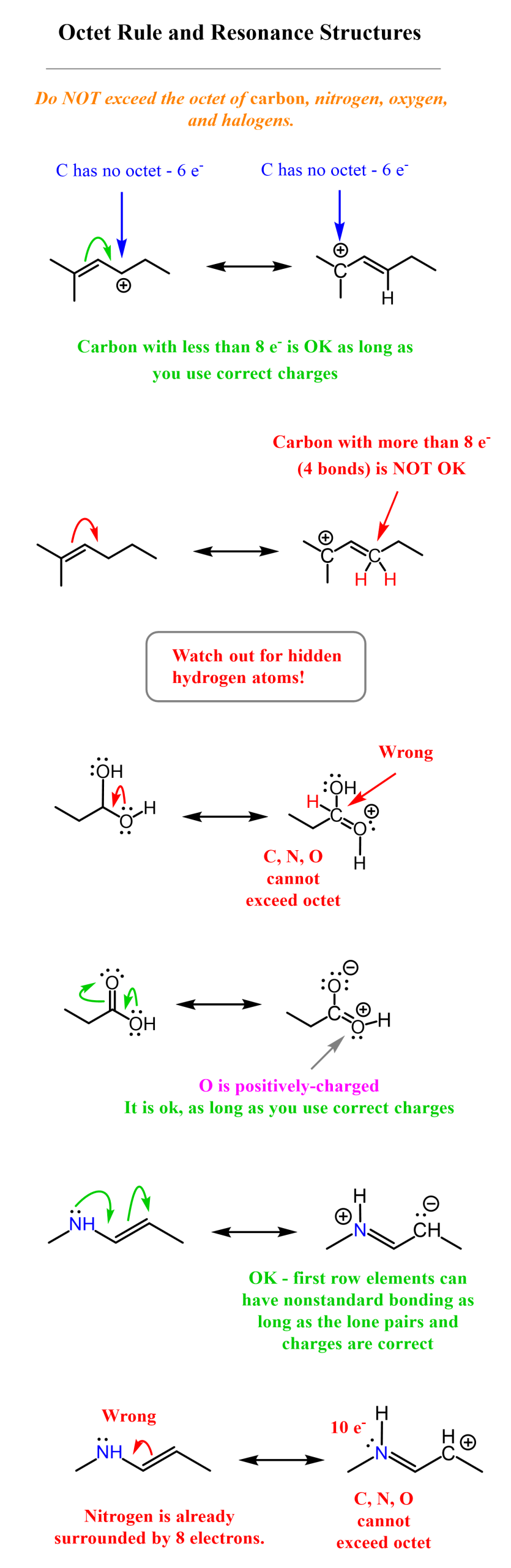
Now, let's see how this is done in practice.
This video from The Organic Chemistry Tutor provides clear, step-by-step demonstrations of how to draw resonance structures for different types of molecules.
Please watch these two segments: 00:00 - 01:57: This part shows how to draw resonance structures for an allylic carbocation, a classic pattern of moving a \pi bond towards a positive charge. 06:57 - 08:06: This part demonstrates resonance in a carboxylate ion, showing a lone pair forming a \pi bond, which in turn displaces another \pi bond into a lone pair. Focus on how the curved arrows originate from a source of electrons (a bond or lone pair) and point to where the electrons are going.
4. Evaluating Resonance Contributors
Not all resonance structures contribute equally to the resonance hybrid. The most stable structures contribute more, and the hybrid will most closely resemble them. We can rank the stability of resonance contributors using a hierarchy of rules.
To systematically evaluate resonance structures, you can consult this excellent guide.
Resonance Structures: 4 Rules On How To Evaluate Them
This article from Master Organic Chemistry provides a superb summary of the rules for evaluating the relative importance of resonance structures.
Read the sections that cover the four main rules, starting from 'Rule #1: Minimize charges' up to the end of 'Rule #4'. This will give you a solid framework for the analysis we're about to do.
Let's break down these rules, in order of importance.
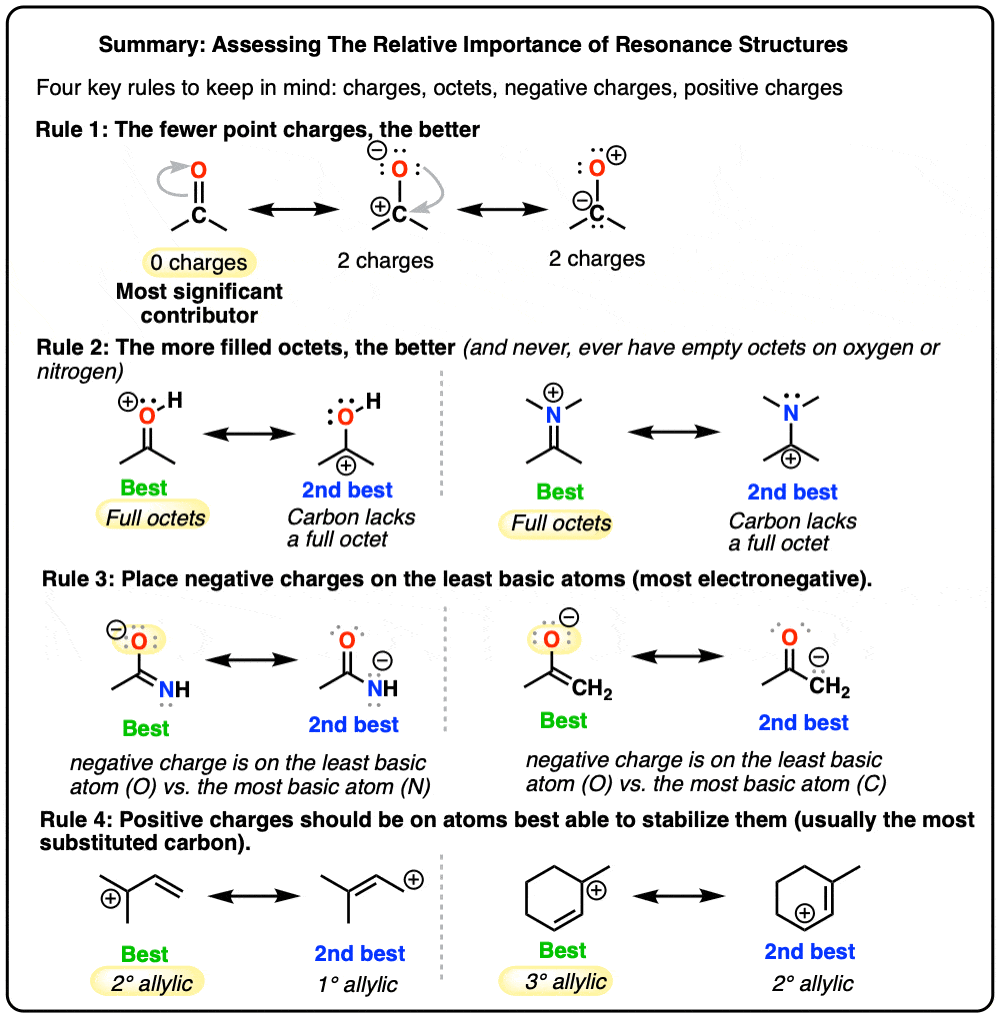
Rule 1: Maximize Full Octets
This is the most important rule. A resonance structure where every second-period atom has a complete octet of electrons is significantly more stable than one with an incomplete octet.
This rule is so powerful it can even override electronegativity considerations. Let's see an example of this.
Let's return to The Organic Chemistry Tutor video to see a case where the octet rule is decisive.
Watch from 10:07 to 13:16. Notice how the structure with a positive charge on the highly electronegative oxygen atom is paradoxically the major contributor. Why? Because in that structure, every atom has a full octet, whereas the other structure has a carbon atom with only 6 electrons.
Rule 2: Minimize Formal Charges
Structures with fewer formal charges are more stable than those with more. A neutral resonance structure is almost always the major contributor compared to one with separated charges.
Calculating formal charge is the bookkeeping tool we use to assess this. If you need a refresher, the MIT OpenCourseWare video on formal charge from the previous lesson is a good resource (resource ID LINK). When drawing the resonance structures for acetone, for example, the neutral structure is far more important than the one with a + on carbon and a - on oxygen.
Rule 3: Place Negative Charge on the Most Electronegative Atom
If a resonance structure must have a negative charge, it is most stable when that charge resides on the most electronegative atom. For example, in the enolate of acetone, the contributor with the negative charge on oxygen is more significant than the one with the negative charge on carbon, because oxygen is more electronegative than carbon.
Rule 4: Place Positive Charge on the Least Electronegative Atom / Most Substituted Carbon
Conversely, if a positive charge is present, it's best stabilized on the least electronegative atom. In the context of carbocations, this means more substituted carbocations are more stable (tertiary > secondary > primary), a concept we will revisit in detail later.
The video segment on the allylic carbocation (resource LINK, section 1) from 01:57 to 04:42 demonstrates this principle well, showing how a tertiary allylic carbocation contributor is more stable than a primary one.
Here is a summary of these crucial rules in a visual format.
Test your understanding!
Draw the two most significant resonance structures for an amide molecule (e.g., ethanamide, CH₃CONH₂). Then, using the rules we've learned, determine which is the major contributor and which is the minor contributor. Explain your reasoning.
Show answer
The two most significant resonance structures are:
- Structure I is neutral. It has no formal charges.
- Structure II is created by moving the lone pair from the nitrogen to form a C=N double bond, and moving the C=O pi electrons onto the oxygen. This creates a formal charge of +1 on nitrogen and -1 on oxygen.
Evaluation:
Based on Rule 2 (Minimize Formal Charges), one might assume Structure I is the major contributor because it is neutral.
However, we must consider Rule 1 (Maximize Full Octets) first. Both structures I and II provide a full octet for all C, O, and N atoms. So, the octet rule doesn't help us decide here.
Now we go back to Rule 2. Structure I is neutral, while Structure II has charge separation. This favors Structure I as the major contributor.
Structure II is still a very significant minor contributor, though. Why? Because the negative charge is on the highly electronegative oxygen atom (Rule 3), and although the positive charge is on nitrogen, all atoms still have a full octet. The significant contribution of Structure II explains why the C-N bond in amides has considerable double-bond character and restricted rotation.
Conclusion
Today, we've unpacked the vital concept of resonance, moving beyond the limitations of single Lewis structures to a more accurate, delocalized picture of electron distribution.
Key Takeaways:
- Resonance is a Valence Bond theory model used when a single Lewis structure is inadequate. The true structure is a resonance hybrid of all contributing structures.
- Electrons in these systems are delocalized, which leads to increased stability.
- Resonance structures are drawn by moving or lone-pair electrons, represented by curved arrows.
- The relative importance of resonance contributors can be evaluated using a clear hierarchy of rules:
- Maximize full octets.
- Minimize formal charges.
- Place negative charges on the most electronegative atoms.
- Place positive charges on the least electronegative atoms.
Preview of the Next Lesson:
We have defined what resonance is. Now, it's crucial to understand what it is not. A common point of confusion is the difference between resonance and tautomerism. In the next lesson, we will distinguish between resonance (electron delocalization) and tautomerism (a rapid chemical equilibrium involving atom migration), solidifying your understanding by contrasting these two distinct phenomena.