Hello! Welcome to our fifth lesson.
In our previous session, we constructed molecular orbital diagrams for ethene and ethyne. We made a simplifying assumption: we treated the carbon atoms as being pre-hybridized (sp² or sp). This allowed us to separate the framework from the system, which we then analyzed using Hückel theory. Today, we will rigorously examine that very assumption.
This lesson directly addresses your interest in the quantum and mathematical underpinnings of chemical concepts. We will dissect the idea of hybridization not as a set of rules, but as a mathematical procedure. Our learning outcome is to analyze hybridization as the mathematical mixing of atomic orbitals to form sp, sp², and sp³ hybrids. We will derive the wavefunctions for these hybrid orbitals from first principles, connecting the abstract mathematics of linear algebra to the concrete, observable geometries of molecules.
1. The Need for Hybridization: Beyond Simple Atomic Orbitals
Let's begin with a fundamental puzzle: methane, CH₄. We know from experiment that methane is tetrahedral, with four identical C-H bonds and H-C-H bond angles of 109.5°.
Now, consider the valence orbitals of a ground-state carbon atom: one spherical 2s orbital and three dumbbell-shaped 2p orbitals () oriented at 90° to each other. How could these orbitals form four identical, tetrahedrally arranged bonds?
- If we used the p-orbitals for bonding, we would expect three bonds at 90° to each other and a fourth bond of a different character using the s-orbital. This contradicts experimental reality.
This is the problem that led Linus Pauling to propose the concept of hybridization. The idea is that we can create a new set of equivalent orbitals on the central atom by taking linear combinations of its native atomic orbitals. These new orbitals, called hybrid orbitals, have the correct directional properties to form the observed molecular geometry.
Before we dive into the math, it's crucial to understand the nature of this concept.
Hybrid Orbitals Account for Molecular Shape
This text provides an excellent introduction to why hybridization is necessary and, importantly, discusses the physical reality of hybrid orbitals. Please read the introductory sections and pay special attention to the discussion on whether hybrid orbitals are 'real'. This aligns with our goal of seeking a deeper, more fundamental understanding.
Please read the initial text leading up to the 'sp Hybrid Orbitals' section. Then, skip to and read the subsection titled 'Are hybrid orbitals Real?'. Focus on the idea that hybridization is a mathematical model—a choice of basis functions—to conveniently explain bonding within the Valence Bond framework.
In essence, hybridization is a mathematical transformation. We are not describing a physical process where orbitals "morph" into each other. Instead, we are choosing a more convenient set of basis orbitals on the central atom that are adapted to the molecule's final geometry.
2. The Mathematical Framework: sp Hybridization
Let's derive the sp hybrid orbitals mathematically. We will mix one 2s orbital and one 2p orbital (let's choose for a linear molecule oriented along the z-axis). Our goal is to create two equivalent, oppositely directed hybrid orbitals, and .
These hybrids are linear combinations of the atomic orbitals (AOs):
To find the coefficients (), we apply two fundamental principles of quantum mechanics that you've seen before:
- Normalization: Each hybrid orbital must be normalized. . This means the total probability of finding an electron described by that orbital is 1.
- Orthogonality: The hybrid orbitals must be orthogonal to each other. for . This ensures they are independent solutions.
Assuming the basis AOs ( and ) are themselves an orthonormal set, these conditions lead to a set of equations for the coefficients.
sp hybridization in terms of wave function & calculation of coefficient | eg. beryllium chloride
This video walks through the complete derivation of the coefficients for sp hybridization. It methodically applies the normalization and orthogonality conditions to solve for the coefficients.
Watch from the beginning to 06:35. Follow the application of the normalization and orthogonality conditions. The goal is to see how these fundamental principles lead directly to the final wavefunctions for the two sp hybrid orbitals.
As the video and the derivation in the Hybrid Orbitals Account for Molecular Shape textbook show, applying these rules yields the following wavefunctions:
Notice the signs. In , the positive lobe of the orbital adds constructively with the s orbital, creating a large lobe pointing in the +z direction. In , the negative lobe of the orbital adds with the s orbital, creating a large lobe in the -z direction. This is how the mathematics produces two oppositely directed orbitals.
3. Deriving sp² Hybrid Orbitals
Now let's tackle the more complex sp² case, relevant for trigonal planar molecules like BH₃ or the carbons in ethene. We mix one 2s orbital with two 2p orbitals (say, and ) to form three equivalent hybrid orbitals in the xy-plane, separated by 120°.
The general forms are:
We have 9 unknown coefficients. We can solve for them using:
- 3 Normalization conditions:
- 3 Orthogonality conditions: , ,
- Symmetry and orientation constraints: We can simplify the problem by orienting one hybrid orbital along the x-axis, which implies it has no character (). We also know the total contribution from the s orbital is 1, so . For equivalent hybrids, .
The full derivation is algebraically intensive, but it's a fantastic exercise in applying the core principles.
sp2 hybridization in terms of wave function | coefficient of wave function in 3 sp2 hybrid orbitals
This video provides a complete, step-by-step derivation of all nine coefficients for the three sp² hybrid orbitals. This is a rigorous mathematical treatment that perfectly matches your interest in the 'why'.
Watch the entire video (approx. 10 minutes and 43 seconds). Don't worry about memorizing every step, but focus on the strategy: how normalization, orthogonality, and orientational choices are systematically used to find every coefficient.
After the lengthy but logical derivation, we arrive at one common representation of the sp² hybrid orbitals:
4. sp³ Hybridization and Visual Summary
The procedure for sp³ hybridization is a direct extension. We mix one 2s and all three 2p orbitals to form four equivalent orbitals pointing towards the vertices of a tetrahedron. The derivation is even more tedious, but follows the exact same principles of normalization and orthogonality. The resulting wavefunctions are given in the Hybrid Orbitals Account for Molecular Shape text (section sp3 Hybrid Orbitals) and have the form:
where the signs are chosen to ensure orthogonality.
Let's visualize the results of our mathematical work.
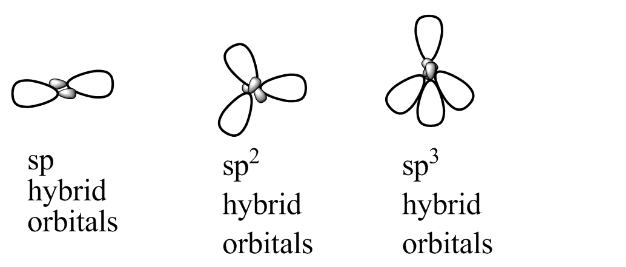
5. The Connection Between s-character and Bond Angle
We can now establish a beautiful, quantitative relationship between the mathematical composition of the hybrid orbitals and their geometry. The angle between any two equivalent hybrid orbitals is directly determined by their s-character.
Let and be two equivalent, normalized hybrid orbitals. We can write them in a simplified form:
Here, is the s-character (e.g., 1/2 for sp, 1/3 for sp², 1/4 for sp³), and and are normalized p-orbitals pointing in the direction of their respective hybrids.
The orthogonality condition is . Expanding this gives:
Since , the cross terms vanish. The term is simply the cosine of the angle between the two p-orbital vectors, which is the bond angle .
Rearranging gives the powerful Coulson's Theorem:
Let's test this formula:
- sp: .
- sp²: .
- sp³: .
This confirms that the geometry is a direct mathematical consequence of creating an orthonormal set of equivalent orbitals.
Test your understanding!
In the water molecule (H₂O), the H-O-H bond angle is approximately 104.5°, not the perfect 109.5° of a tetrahedron. This implies the two hybrid orbitals forming the O-H bonds are not perfectly equivalent to the two hybrid orbitals containing the lone pairs.
Using the formula , calculate the approximate s-character () of the oxygen hybrid orbitals used for bonding to the hydrogen atoms. Is it more or less than the 25% s-character found in a perfect sp³ orbital?
Show answer
Given , we have .
The s-character of the bonding orbitals is approximately 20%. This is less than the 25% in a perfect sp³ orbital. This makes sense: by putting less s-character into the bonding orbitals, the oxygen atom conserves more s-character for the lone pair orbitals. Since s-orbitals are lower in energy than p-orbitals, this stabilizes the lone pair electrons, a concept known as Bent's rule.
Conclusion
Today, we have demystified hybridization, transforming it from a qualitative rule into a rigorous mathematical construction. You have seen how the familiar shapes and geometries of organic molecules emerge directly from the quantum mechanical principles of linear algebra applied to atomic orbitals.
Key Takeaways:
- Hybridization is a mathematical model within Valence Bond theory that combines atomic orbitals on a single atom to form a new set of basis orbitals suitable for describing the observed molecular geometry.
- The wavefunctions of hybrid orbitals are derived by applying normalization and orthogonality conditions to linear combinations of atomic orbitals.
- Mixing one s and one p orbital yields two linear sp hybrids.
- Mixing one s and two p orbitals yields three trigonal planar sp² hybrids.
- Mixing one s and three p orbitals yields four tetrahedral sp³ hybrids.
- There is a direct mathematical relationship, Coulson's Theorem, that connects the s-character of a hybrid orbital to the angle between it and an equivalent hybrid: .
Preview of the Next Lesson:
Now that we have derived the standard hybrid orbitals and understand their intrinsic geometries, we are equipped to predict molecular shapes. In the next lesson, we will combine the hybridization model with the more intuitive VSEPR theory to create a powerful, practical framework for predicting the 3D structure of complex organic molecules.