Hello! Welcome to our eleventh lesson.
In our last two lessons, we explored methods for hydrating alkenes to form alcohols. We saw that acid-catalyzed hydration yields the Markovnikov product but is plagued by carbocation rearrangements. We then learned that oxymercuration-demercuration provides a reliable way to get the Markovnikov product without rearrangements, thanks to its bridged mercurinium ion intermediate.
This leaves a critical question unanswered: how do we synthesize an alcohol where the hydroxyl group is on the less substituted carbon? Today, we will answer that question by studying hydroboration-oxidation, a two-step reaction that provides access to these "anti-Markovnikov" alcohols. Your learning outcome for this lesson is to explain the mechanism, regiochemistry (anti-Markovnikov), and stereochemistry (syn-addition) of hydroboration-oxidation.
This reaction is a cornerstone of synthetic organic chemistry, not just for its unique regioselectivity, but also for its beautiful and subtle mechanism, which perfectly aligns with your goal of understanding the fundamental "why" behind chemical transformations.
The Overall Reaction: A Two-Step, Anti-Markovnikov Hydration
Like oxymercuration, hydroboration-oxidation is a two-step process where reagents are added sequentially.
- Hydroboration: The alkene is treated with borane (BH₃), typically complexed with a solvent like tetrahydrofuran (THF) to stabilize it.
- Oxidation: The intermediate alkylborane is then oxidized using hydrogen peroxide (H₂O₂) in the presence of a base, such as sodium hydroxide (NaOH).
The net result is the addition of H and OH across the double bond, but with a regiochemical outcome opposite to what we've seen so far. The hydroxyl group adds to the less substituted carbon.
Hydroboration Oxidation Mechanism of Alkenes - BH3, THF, H2O2, OH- Organic Chemistry
To begin, let's get a clear overview of the overall transformation, the reagents involved, and the key terms we'll be using.
Please watch the first 2 minutes and 26 seconds of this video from The Organic Chemistry Tutor. Focus on the overall change, the definition of anti-Markovnikov regiochemistry, and the introduction of syn-addition stereochemistry.
The Mechanism Part 1: Hydroboration
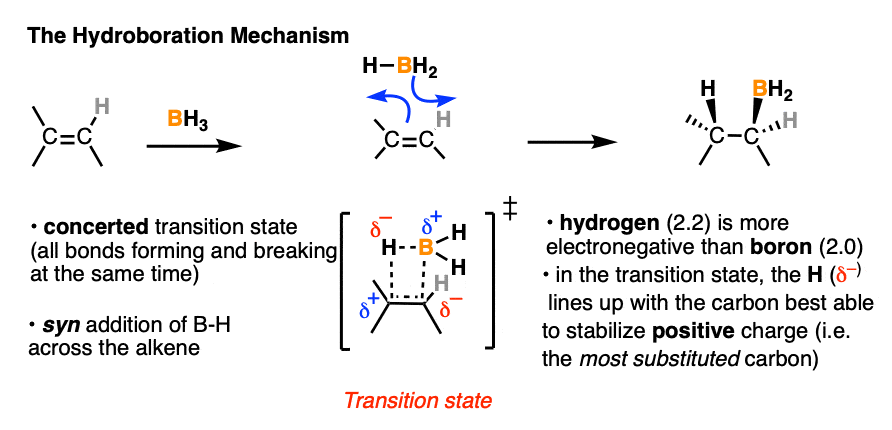
The first step, the addition of the B-H bond across the alkene, is where the reaction's unique selectivity is established. It is a concerted reaction, meaning all bond-forming and bond-breaking occurs in a single step through a four-membered ring transition state.
Stereochemistry: A Concerted Syn-Addition
Because the boron and hydrogen atoms add to the double bond simultaneously from the same BH₃ molecule, they must approach and bond to the same face of the planar alkene. This is known as a syn-addition. This is a critical stereochemical feature and stands in direct contrast to the anti-addition we observed in halogenation and oxymercuration, which proceeded through three-membered bridged intermediates.
Regiochemistry: The "Why" of Anti-Markovnikov Addition
Why does the boron add to the less substituted carbon? The answer lies in a combination of steric and electronic factors, which is exactly the kind of deep dive you're interested in.
1. The Steric Argument (The Simple Answer):
Boron, bonded to two other hydrogens (and the rest of the molecule), is significantly larger than a single hydrogen atom. To minimize steric repulsion, the bulky boron group preferentially adds to the less sterically hindered carbon of the double bond.
2. The Electronic Argument (The Deeper Reason):
This is the more rigorous explanation. It relates to the electronic properties of the B-H bond and the stability of the transition state.
- Electronegativity: Unlike C-H or C-O bonds, the B-H bond is polarized towards hydrogen. Boron has an electronegativity of ~2.04, while hydrogen is ~2.20. This makes boron partially positive (δ+) and hydrogen partially negative (δ-). The hydrogen in borane behaves as a hydride (H⁻).
- Transition State Stabilization: As the nucleophilic π-bond of the alkene attacks the electrophilic boron atom (δ+), a partial positive charge begins to build on the other carbon of the double bond. This positive charge is better stabilized on the more substituted carbon due to hyperconjugation and inductive effects. The partially negative hydride (Hδ-) from the borane is then delivered to this developing positive center.
Therefore, the boron (δ+) ends up on the less substituted carbon, and the hydrogen (δ-) ends up on the more substituted carbon. Since the oxidation step (which we'll see next) replaces boron with the -OH group, the alcohol appears at the less substituted position.
Hydroboration-oxidation: Mechanism | Alkenes and Alkynes | Organic chemistry | Khan Academy
The Khan Academy video on this topic provides an excellent animation and explanation of this concerted mechanism, emphasizing both the steric and electronic factors.
Please watch from 00:22 to 04:53. Pay close attention to the discussion of borane's empty p-orbital, the concerted mechanism, the development of partial charge in the transition state, and how this leads to both syn-addition and anti-Markovnikov regiochemistry.
A Deeper Mechanistic Perspective
Here's a subtle but important point that gets to the heart of your interest in the "why". While we label the overall reaction as anti-Markovnikov, the mechanism itself can be seen as following the spirit of Markovnikov's rule: the reaction proceeds through a transition state that stabilizes positive charge on the more substituted carbon. This is a more sophisticated understanding than simple rote memorization of the "anti-Markovnikov" label.
The blog post "The hydroboration-oxidation mechanism: An updated look" by computational chemist Henry Rzepa discusses this exact point. He argues that calling the reaction anti-Markovnikov is confusing because the mechanism behaves in a Markovnikov-like fashion. This highlights a crucial distinction between the description of an overall outcome and the principles governing the underlying mechanism.
Formation of the Trialkylborane
The reaction doesn't stop after one addition. The product, a monoalkylborane (RBH₂), still has two B-H bonds and can react with two more alkene molecules. This process repeats until all three hydrogens are replaced, yielding a trialkylborane (R₃B). This is the substrate for the next step.

The Mechanism Part 2: Oxidation
The second step transforms the C-B bond into a C-O bond, yielding the final alcohol product. The key feature of this step is that it occurs with retention of configuration.
The Key Steps:
- Nucleophile Formation: Hydroxide (⁻OH) from NaOH deprotonates hydrogen peroxide (H₂O₂) to form the hydroperoxide anion (HOO⁻), a strong nucleophile.
- Nucleophilic Attack: The hydroperoxide anion attacks the electrophilic boron atom of the trialkylborane.
- Rearrangement/Migration: This is the crucial step. One of the alkyl groups (R) migrates from the boron to the adjacent oxygen atom. This breaks the weak O-O bond and expels a hydroxide ion (⁻OH) as a leaving group.
- Retention of Configuration: Critically, this migration step proceeds with retention of stereochemistry. The carbon atom detaches from boron and attaches to oxygen on the exact same face. The stereocenter's configuration is preserved.
- Repeat and Hydrolyze: This process repeats for the other two alkyl groups, forming a trialkoxyborane, B(OR)₃. Finally, hydroxide and water hydrolyze this borate ester to release the three alcohol molecules and form a borate salt (like Na₃BO₃).
Hydroboration-oxidation: Mechanism | Alkenes and Alkynes | Organic chemistry | Khan Academy
The oxidation step, particularly the alkyl migration, can be tricky to visualize. Let's return to the Khan Academy video for a detailed walkthrough.
Watch from 04:53 to 11:17. Follow the process of forming the trialkylborane, the attack by the hydroperoxide ion, and the crucial alkyl migration step that occurs with retention of configuration.
The combination of syn-addition in the first step and retention of configuration in the second step ensures that the H and OH atoms end up on the same side of the original double bond in the final product.
Test your understanding!
Predict the major organic product(s) of the hydroboration-oxidation of 1-methylcyclohexene. Be sure to consider both regiochemistry and stereochemistry.
Show answer
- Reagents: 1. BH₃, THF / 2. H₂O₂, NaOH. This is hydroboration-oxidation.
- Regiochemistry: Anti-Markovnikov. The -OH group will add to the less substituted carbon of the double bond. In 1-methylcyclohexene, this is the secondary carbon (C2), while the hydrogen adds to the more substituted tertiary carbon (C1).
- Stereochemistry: Syn-addition. The H and BH₂ group add to the same face of the cyclohexene ring. To minimize steric hindrance from the methyl group, the borane will preferentially approach from the face opposite to the methyl group. Let's assume the methyl group is "up". The H (at C1) and the BH₂ (at C2) will both add from the "down" face.
- Oxidation: The oxidation of the C-B bond to a C-O bond occurs with retention of configuration. So, the -OH group at C2 will also be "down".
- Product: The final product has the methyl group at C1 "up" and the hydroxyl group at C2 "down". This is a trans relationship between the methyl and hydroxyl groups. The product is trans-2-methylcyclohexan-1-ol.
- Enantiomers: Since the starting material and reagents are achiral, the attack can happen with equal probability from the top face (if the methyl group is considered "down") or the bottom face (if the methyl group is considered "up"). This will produce an equal mixture of both enantiomers of trans-2-methylcyclohexan-1-ol. A racemic mixture is formed.
Conclusion
Today, we've added a powerful and nuanced reaction to our synthetic toolbox. Hydroboration-oxidation elegantly solves the problem of synthesizing anti-Markovnikov alcohols from alkenes, a feat not possible with the methods we've studied previously. Its mechanism is a beautiful illustration of how steric and electronic factors conspire to control a reaction's outcome.
Key Takeaways:
- Overall Reaction: A two-step process that achieves the anti-Markovnikov hydration of an alkene, with no carbocation rearrangements.
- Regiochemistry: The -OH group adds to the less substituted carbon. This is controlled by both steric effects and the electronic stabilization of the transition state.
- Stereochemistry: The reaction proceeds with syn-addition. The H and OH groups are added to the same face of the original double bond. This is a result of the concerted hydroboration step followed by the oxidation step which proceeds with retention of configuration.
Preview of the Next Lesson:
We have now mastered three distinct methods for the hydration of alkenes: acid-catalyzed hydration, oxymercuration-demercuration, and hydroboration-oxidation. Each has its own unique characteristics regarding regiochemistry, stereochemistry, and susceptibility to rearrangement. In our next lesson, we will compare and contrast these three methods side-by-side to solidify your understanding and build a strategic framework for deciding which reaction to use in a given synthetic problem.