Hello! Welcome to our tenth lesson.
In our previous lessons on alkene and alkyne additions, we've repeatedly seen the central role of carbocation stability in determining reaction outcomes. For example, in the acid-catalyzed hydration of an alkene, the reaction proceeds via the most stable carbocation intermediate, leading to a Markovnikov product. However, as we saw, this pathway has a significant drawback: the carbocation intermediate is prone to rearrangement, which can lead to a mixture of products or an unexpected major product. This complicates synthetic planning.
Today, we'll explore a powerful and elegant solution to this problem. As previewed in our last lesson on alkyne hydration, we will once again use mercury's unique properties to control a reaction. Your learning outcome for this lesson is to explain the mechanism, regiochemistry, and stereochemistry of oxymercuration-demercuration. This two-step process allows for the reliable Markovnikov hydration of alkenes without any carbocation rearrangements, making it a synthetically superior method.
The Overall Reaction: A Controlled Hydration
Oxymercuration-demercuration achieves the net addition of water (H and OH) across an alkene's double bond. It is a two-step procedure with two distinct sets of reagents that must be added sequentially.
- Oxymercuration: The alkene is treated with mercuric acetate, Hg(OAc)₂, in water.
- Demercuration: The intermediate product is then reduced with sodium borohydride, NaBH₄.
The net result is a Markovnikov alcohol, but critically, the carbon skeleton remains unchanged.
8.3 Acid Catalyzed Hydration, Oxymercuration Demercuration, and Hydroboration Oxidation | OChemistry
To begin, let's watch a segment from Chad's Prep that introduces the reagents and shows how to predict the product. This will give us a clear picture of the overall transformation before we dive into the mechanism.
Please watch from 05:56 to 07:28. Pay close attention to the reagents used and the key distinction he makes: this reaction follows Markovnikov's rule but involves no carbocation intermediate and thus no rearrangements.
The Mechanism: Why Rearrangements Don't Happen
The key to this reaction's utility lies in its mechanism, which neatly sidesteps the formation of a free carbocation. This should sound familiar, as it's highly analogous to the mercury-catalyzed hydration of alkynes we studied in the last lesson.
Step 1: Formation of the Mercurinium Ion
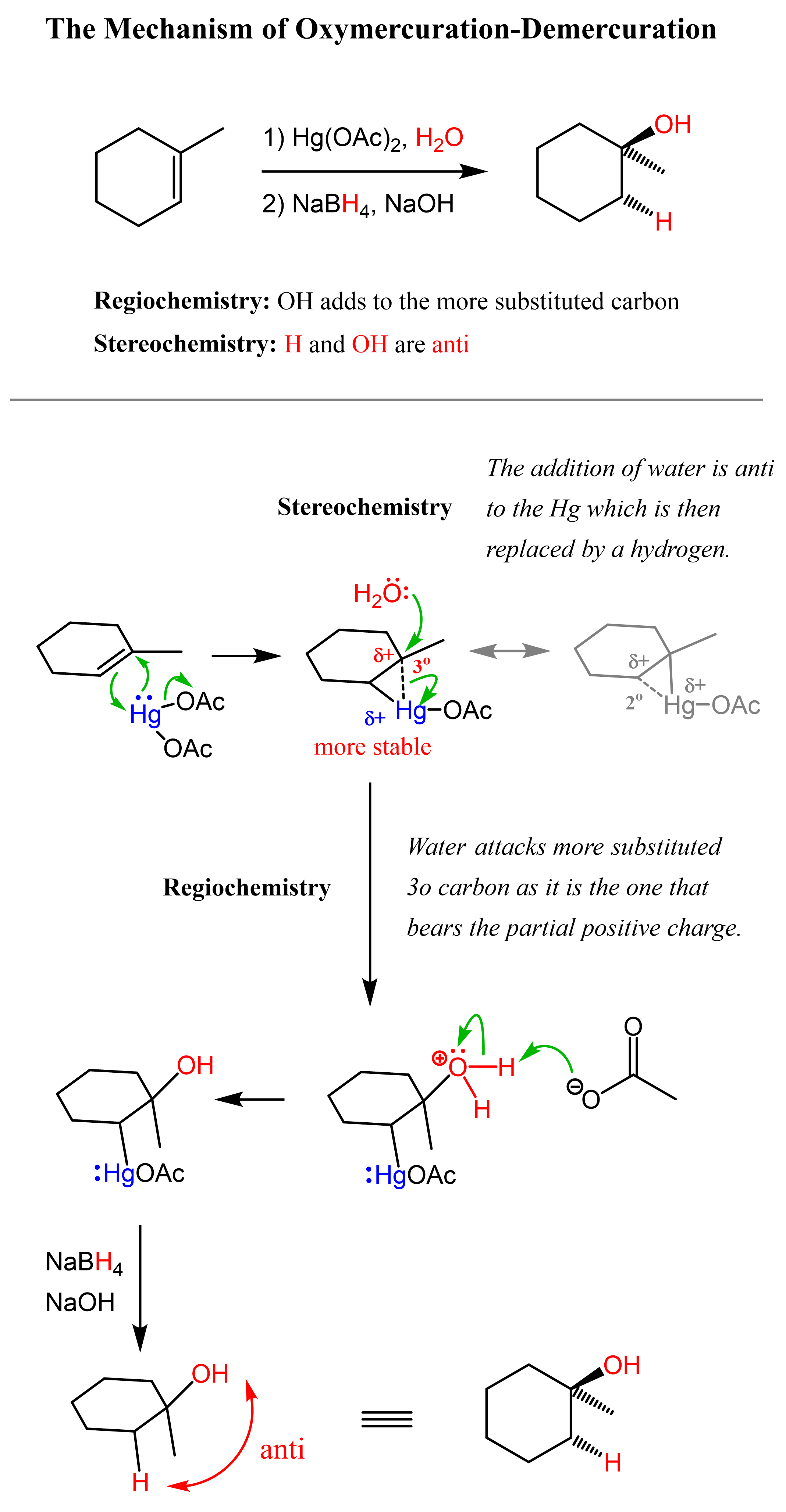
The reaction begins when the nucleophilic π-bond of the alkene attacks the electrophilic mercury(II) ion. Instead of forming a discrete carbocation and a C-Hg bond, the mercury atom uses its lone pairs to immediately form a second bond to the other carbon of the original double bond. This creates a three-membered ring called a cyclic mercurinium ion.
8.3 Acid Catalyzed Hydration, Oxymercuration Demercuration, and Hydroboration Oxidation | OChemistry
The same video provides a clear animation of this first crucial step.
Now, watch from 07:28 to 10:35. Focus on how the mercurinium ion is formed and why this prevents the formation of a carbocation.
This bridged intermediate is the hero of the reaction. Because no free carbocation ever forms, there is no opportunity for a hydride or alkyl shift to occur.
Your interest in the fundamental "why" merits a deeper look. The formation of this bridged ion is conceptually similar to the bromonium ion in halogen addition. From an orbital perspective, you can think of the alkene's filled π orbital donating into an empty orbital on the mercury, and importantly, filled d-orbitals on the mercury atom "back-donating" electron density into the alkene's empty π* antibonding orbital. This delocalizes the positive charge and stabilizes the intermediate.
electrophilic addition: alkenes
For a more rigorous look at the electronic nature of this intermediate, please read the following text. It discusses the mercurinium ion in terms of resonance structures and charge distribution, which explains the reaction's selectivity.
Read the text from the beginning of Figure EA5.3 down to the paragraph just before Figure EA5.6. Focus on the analogy to the bromonium ion and the discussion of the resonance contributors to the mercurinium ion.
Step 2: Nucleophilic Attack and Regiochemistry
Once the mercurinium ion is formed, the solvent—water—acts as a nucleophile. But where does it attack? The reading you just completed provides the answer. Although the positive charge is delocalized, the ring is asymmetrical. The more substituted carbon of the original double bond bears a greater share of the partial positive charge (δ+) because it is better able to stabilize that charge.
Consequently, water attacks this more substituted carbon. This explains the reaction's Markovnikov regioselectivity, even without a formal carbocation.
Step 3: The Demercuration Step
The first phase, oxymercuration, is complete after water attacks and is deprotonated. This leaves an organomercury compound. The second and final step is demercuration, where sodium borohydride (NaBH₄) is used to replace the C-Hg bond with a C-H bond.
8.3 Acid Catalyzed Hydration, Oxymercuration Demercuration, and Hydroboration Oxidation | OChemistry
Let's briefly see how the final step is described. The detailed mechanism is complex and generally considered beyond the scope of introductory-to-advanced organic chemistry.
Watch this short clip from 12:58 to 13:54. The key takeaway is simply what NaBH₄ does: it replaces the mercury group with a hydrogen.
Stereochemistry: Anti-Addition
The bridged structure of the mercurinium ion has a crucial stereochemical consequence. The bulky mercury group blocks one face of the molecule. Therefore, the incoming nucleophile (water) must attack from the opposite face. This is a backside attack, analogous to an Sₙ2 reaction.
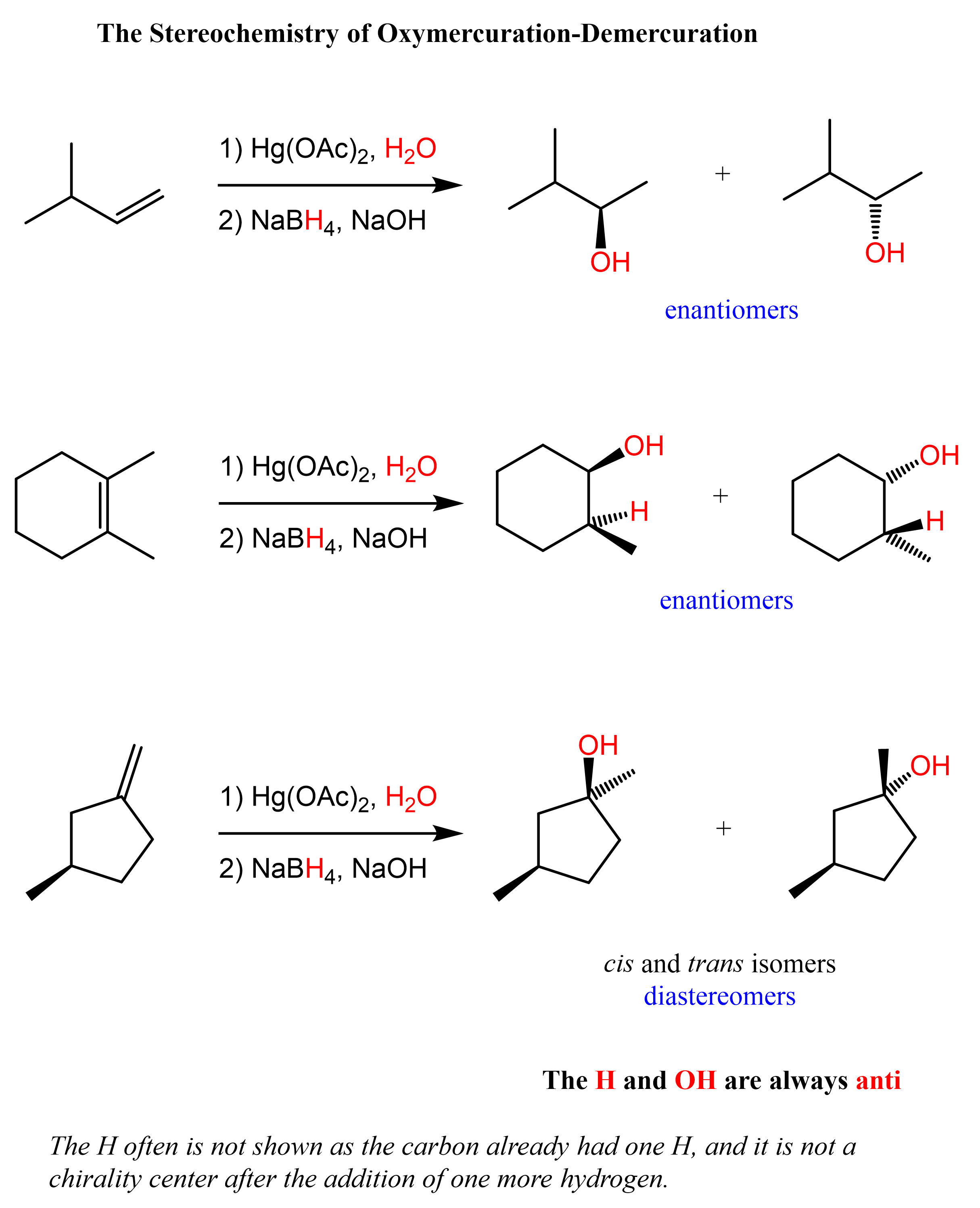
The result is anti-addition: the -OH group and the mercury group are added to opposite faces of the original double bond. While the subsequent demercuration step with NaBH₄ is not always stereospecific, the relative position of the -OH group is locked in during the oxymercuration step.
Test your understanding!
Predict the major organic product, including stereochemistry, when 1-methylcyclopentene is subjected to oxymercuration-demercuration.
Show answer
- Reagents: 1. Hg(OAc)₂, H₂O / 2. NaBH₄. This is oxymercuration-demercuration.
- Regiochemistry: The reaction follows Markovnikov's rule. The -OH group will add to the more substituted carbon of the double bond. In 1-methylcyclopentene, this is the tertiary carbon (C1) that is part of the ring and bears the methyl group. The hydrogen will add to the less substituted secondary carbon (C2).
- Rearrangement: None. The mechanism avoids carbocations.
- Stereochemistry: The oxymercuration step involves anti-addition. The large mercurinium ion will form on one face of the ring (let's say the bottom face). Water must then attack the more substituted carbon from the opposite face (the top face). This places the -OH group and the -HgOAc group trans to each other. The demercuration step replaces -HgOAc with -H, but the position of the -OH group is already set. The hydrogen that replaces the mercury can add from either face, but since this carbon is not a stereocenter, it doesn't affect the final product's identity.
- Product: The final product is 1-methylcyclopentan-1-ol. Because the product does not have two stereocenters in the ring that would create cis/trans isomerism relative to each other, we simply get the alcohol. The key is that the -OH adds to the tertiary carbon.
The Synthetic Advantage: A Clear Comparison
The true power of this reaction is most evident when compared directly with acid-catalyzed hydration for a substrate prone to rearrangement.
8.3 Acid Catalyzed Hydration, Oxymercuration Demercuration, and Hydroboration Oxidation | OChemistry
To conclude, let's watch a fantastic comparative example that pits acid-catalyzed hydration against oxymercuration-demercuration. This will solidify your understanding of why and when you would choose this reaction.
Watch from 20:42 to 23:00. Observe how the same starting alkene gives a rearranged product via the carbocation pathway but the clean, unrearranged Markovnikov product via the oxymercuration pathway.
This comparison makes it clear: when you need to perform a Markovnikov hydration on an alkene and want to avoid the possibility of skeletal rearrangement, oxymercuration-demercuration is the superior method.
Conclusion
Today, we have dissected one of the most reliable reactions in the organic chemist's toolkit. By using a mercury-based electrophile, we can control the reaction pathway to avoid unstable intermediates, thereby gaining predictability and control over the outcome.
Key Takeaways:
- Mechanism: Oxymercuration-demercuration is a two-step sequence. The key is the formation of a cyclic mercurinium ion, which prevents carbocation rearrangements.
- Regiochemistry: The reaction exhibits Markovnikov selectivity. Water attacks the more substituted carbon of the mercurinium ion because that carbon bears a greater partial positive charge.
- Stereochemistry: The oxymercuration step proceeds via anti-addition, as water performs a backside attack on the bridged mercurinium ion.
Preview of the Next Lesson:
We have now mastered a reliable method for producing a Markovnikov alcohol from an alkene. But what if our synthesis requires the opposite regiochemistry? What if we need to place the hydroxyl group on the less substituted carbon? In our next lesson, we will explore hydroboration-oxidation, a remarkable reaction that achieves precisely this anti-Markovnikov hydration, again through a fascinating mechanism with its own unique stereochemical and regiochemical rules.