Hello! Welcome to our lesson on alkene hydration.
In the past few lessons, we have individually explored three powerful methods for converting alkenes into alcohols:
- Acid-Catalyzed Hydration
- Oxymercuration-Demercuration
- Hydroboration-Oxidation
Each reaction accomplishes the same net transformation—adding H and OH across a double bond—but as we've seen, they do so with crucial differences. Today, our goal is to bring all this knowledge together. We will systematically compare the regioselectivity and stereospecificity of these three major alkene hydration methods.
This comparative analysis is not just an academic exercise; it's the foundation of synthetic strategy. By understanding the unique strengths and weaknesses of each tool, you gain the ability to choose the precise reaction needed to build a target molecule with the correct structure and stereochemistry. This moves us from simply knowing reactions to thinking like a synthetic chemist.
The Three Hydration Methods: A Side-by-Side Comparison
To start, let's create a strategic overview. The key is to organize our comparison around three critical questions:
- Regioselectivity: Where does the -OH group add? (Markovnikov vs. Anti-Markovnikov)
- Rearrangements: Is the reaction susceptible to skeletal rearrangements?
- Stereochemistry: What is the spatial relationship of the H and OH groups added? (Syn vs. Anti vs. Not Controlled)
The following reading and table provide a concise and powerful summary that directly addresses these questions.
Summary: Hydration Methods of Alkene
The following resource from Chem LibreTexts provides an excellent summary table comparing the three hydration methods. Please study this table carefully as it will form the framework for our entire lesson.
Focus on the table titled 'Summary: Hydration Methods of Alkene'. Memorizing this is not the goal; rather, use it to organize your understanding of how each reaction's mechanism dictates its outcome.
Now, let's break down each aspect of this comparison, connecting the observed outcome back to the underlying mechanism—the "why" that you're interested in.
1. Regioselectivity and Rearrangements: The Markovnikov Showdown
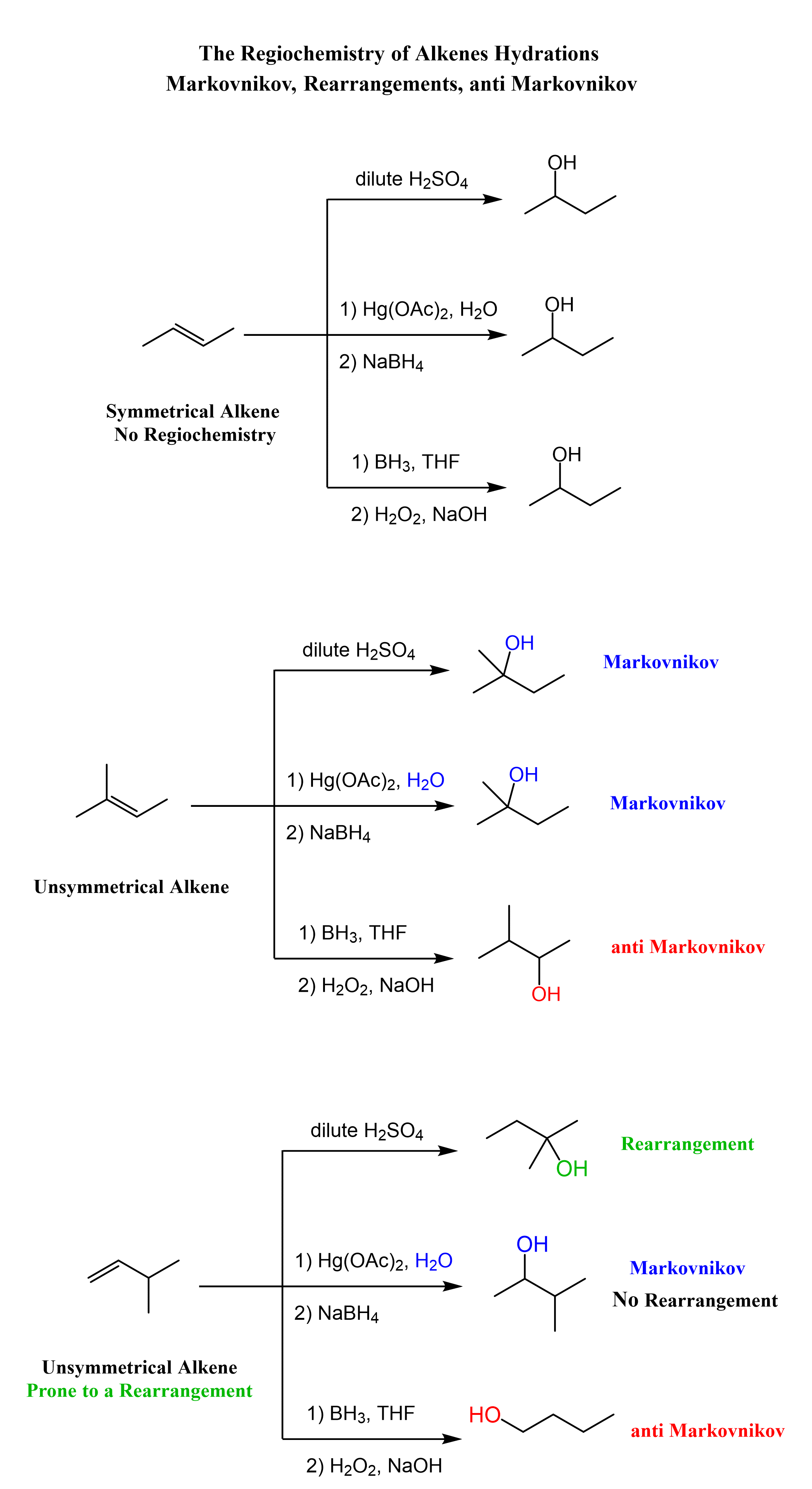
Two methods give Markovnikov regioselectivity, but they are not interchangeable. Their differing susceptibility to rearrangement is a critical distinction.
- Acid-Catalyzed Hydration: Proceeds via a discrete carbocation intermediate. If a 1,2-hydride or 1,2-alkyl shift can form a more stable carbocation, it will happen. This makes the reaction powerful but sometimes unpredictable.
- Oxymercuration-Demercuration: This is the "controlled" Markovnikov hydration. It proceeds via a bridged mercurinium ion. This cyclic intermediate prevents the formation of a free carbocation, and therefore, rearrangements are suppressed. Water attacks the more substituted carbon because that carbon bears a larger partial positive charge, neatly achieving Markovnikov addition without the risk of the carbon skeleton rearranging.
The image below perfectly illustrates this key difference.

- Hydroboration-Oxidation: This is our tool for anti-Markovnikov regioselectivity. As we discussed, this outcome is directed by both sterics (the bulky borane group adds to the less hindered carbon) and electronics (the transition state stabilizes partial positive charge on the more substituted carbon).
This gives us complete control over regiochemistry. If you need the Markovnikov alcohol, you have two choices. If rearrangements are not an issue, the simpler acid-catalyzed method works. If rearrangements are a risk, you must use oxymercuration-demercuration. If you need the anti-Markovnikov alcohol, hydroboration-oxidation is your only choice.
2. Stereochemistry: Syn, Anti, or Mixed?
The stereochemical outcome is a direct consequence of the geometry of the key intermediate or transition state.
-
Acid-Catalyzed Hydration: The intermediate is a planar, sp²-hybridized carbocation. The incoming nucleophile (water) can attack from either the top or bottom face with equal probability. Thus, the reaction is not stereospecific. If a new stereocenter is formed, you will typically get a racemic mixture of both configurations, resulting from both syn and anti addition.
-
Hydroboration-Oxidation: The mechanism is a syn-addition. This is dictated by the concerted, four-membered ring transition state where the B and H atoms are delivered to the same face of the alkene simultaneously. The subsequent oxidation step proceeds with retention of configuration, locking in the syn stereochemistry.
-
Oxymercuration-Demercuration: This is the most nuanced case.
- The first step, oxymercuration, is a stereospecific anti-addition. The nucleophile (water) attacks the three-membered mercurinium ion from the face opposite to the bulky mercury bridge.
- The second step, demercuration with NaBH₄, typically proceeds through a radical mechanism and is not stereospecific. It scrambles the stereochemistry at the carbon bearing the mercury.
What does this mean for the final product? If the only new stereocenter is the one where the -OH group adds, the reaction is effectively an anti-addition. However, if the carbon where the mercury was attached also becomes a stereocenter, its configuration will be randomized. For this reason, many texts (like the LibreTexts resource) simplify the overall stereochemistry to "Not Controlled," even though the initial addition is strictly anti.
Putting It All Together: A Strategic Example
Theory is best understood through application. Let's watch a video that works through a single, carefully chosen alkene and predicts the product for all three hydration reactions. This example beautifully demonstrates how the principles we've just discussed lead to completely different products.
8.3 Acid Catalyzed Hydration, Oxymercuration Demercuration, and Hydroboration Oxidation | OChemistry
The following video from Chad's Prep presents a fantastic strategic example that directly compares the outcomes of the three hydration reactions on an alkene that is prone to rearrangement. This will solidify your ability to predict the products of each.
Please watch the segment from 20:42 to 24:02. Pay close attention to how the same starting material gives three different products, and make sure you can explain why for each case by referring to the mechanism (carbocation rearrangement, no rearrangement, and anti-Markovnikov addition).
This example makes it clear: these are not just three ways to do the same thing. They are three distinct tools for accessing three distinct constitutional isomers from the same starting material.
Test your understanding!
Predict the major organic product(s) for the reaction of 1-ethylcyclopentene with each of the following sets of reagents. Be sure to show the correct regiochemistry and stereochemistry.
- H₃O⁺ (dilute H₂SO₄, H₂O)
-
- Hg(OAc)₂, H₂O / 2. NaBH₄
-
- BH₃·THF / 2. H₂O₂, NaOH
Show answer
Here is the analysis for 1-ethylcyclopentene:
-
Acid-Catalyzed Hydration (H₃O⁺):
- Regiochemistry: Markovnikov. The proton adds to the less substituted carbon (C2), and the OH adds to the more substituted tertiary carbon (C1).
- Rearrangement: The initially formed tertiary carbocation is already the most stable possible on this frame, so no rearrangement will occur.
- Stereochemistry: The carbocation is planar. Water can attack from the top or bottom. Since no new stereocenters are formed (the product, 1-ethylcyclopentan-1-ol, is achiral), stereochemistry is not a factor.
- Product: 1-ethylcyclopentan-1-ol.
-
Oxymercuration-Demercuration (Hg(OAc)₂, H₂O / NaBH₄):
- Regiochemistry: Markovnikov. Same as above. OH adds to C1.
- Rearrangement: No rearrangements.
- Stereochemistry: Not a factor as the product is achiral.
- Product: 1-ethylcyclopentan-1-ol. (In this specific case, methods 1 and 2 give the same product because no rearrangement was possible).
-
Hydroboration-Oxidation (BH₃ / H₂O₂, NaOH):
- Regiochemistry: Anti-Markovnikov. The OH group adds to the less substituted carbon (C2).
- Stereochemistry: Syn-addition. The H and OH add to the same face of the double bond. This creates two stereocenters (C1 and C2). The H (on C1) and OH (on C2) will be either both wedge or both dash. This means the ethyl group at C1 and the OH group at C2 will have a trans relationship.
- Product: You will form a racemic mixture of the two enantiomers of trans-2-ethylcyclopentan-1-ol.
Conclusion
You have now completed your survey of the three principal methods for alkene hydration. You have moved beyond learning individual mechanisms to building a comparative framework for synthetic problem-solving.
Key Takeaways:
- Your Toolkit: You now have three distinct tools to synthesize alcohols from alkenes.
- Regiocontrol: You can choose to produce either the Markovnikov alcohol (with acid or oxymercuration) or the anti-Markovnikov alcohol (with hydroboration).
- Rearrangement Control: Within Markovnikov additions, you can choose to allow for rearrangements (acid-catalyzed) or suppress them (oxymercuration-demercuration).
- Stereocontrol: You can enforce a syn-addition (hydroboration-oxidation), an anti-addition in the first step (oxymercuration), or have no stereochemical control (acid-catalyzed).
Mastering this strategic thinking is a significant step in your journey toward a deeper understanding of organic chemistry.
Preview of the Next Lesson:
Having focused on adding H and OH, our next topic will explore a different kind of addition reaction: ozonolysis. This reaction is unique because instead of adding across the double bond, it cleaves the C=C bond entirely, splitting the molecule into two smaller carbonyl-containing fragments. This is a powerful tool for both degradation (to determine structure) and synthesis.