Hello! Welcome to your next lesson in organic chemistry.
In our last session, we completed our survey of alkene hydration by comparing three key reactions. We saw how a deep understanding of their mechanisms—involving carbocations, mercurinium ions, or concerted additions—allows a chemist to strategically choose the right tool to control regiochemistry and stereochemistry.
Today, we shift from reactions that add across a double bond to one that cleaves it entirely. Our focus is on ozonolysis, a powerful reaction that breaks both the sigma (σ) and pi (π) bonds of an alkene or alkyne, splitting the molecule into smaller carbonyl-containing fragments.
Your learning outcome for this lesson is to describe the mechanism of ozonolysis for alkenes and alkynes and predict the products. We will dissect this reaction from the ground up, starting with a practical method for predicting products and then delving into the elegant, multi-step mechanism that explains the "why" behind this transformation.
An Overview of Ozonolysis
Ozonolysis is a two-step process. First, the substrate reacts with ozone (O₃), usually at low temperatures. This forms an unstable intermediate called an ozonide. Second, a "workup" reagent is added to decompose the ozonide and yield the final products. The choice of workup reagent is critical as it determines the final oxidation state of the products.
This image provides a fantastic roadmap for our entire lesson. It summarizes the overall transformation for both alkenes and alkynes under the two main types of workup conditions.
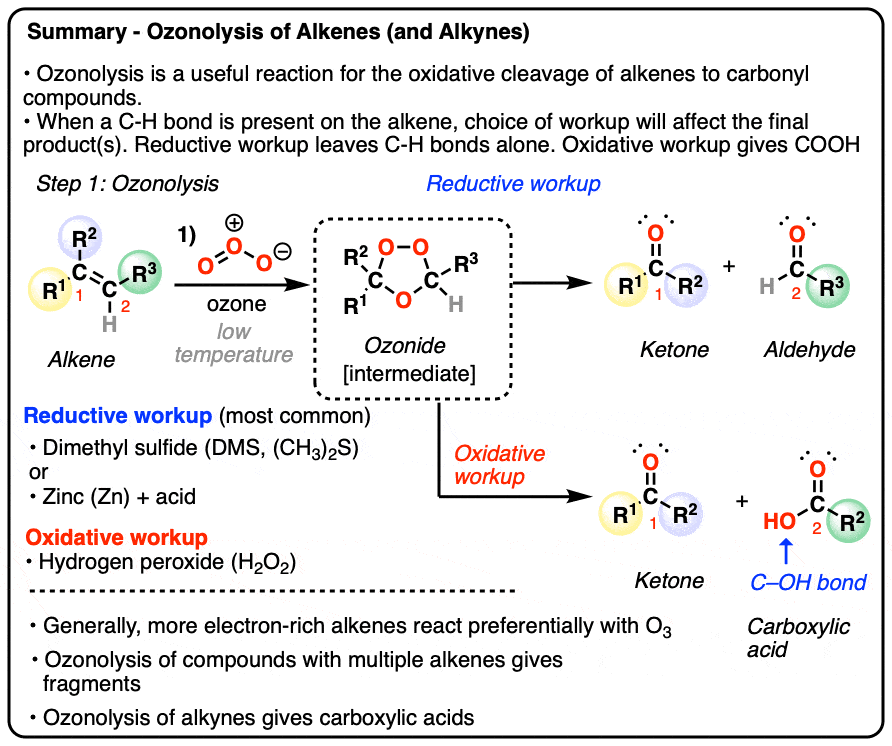
Let's start by mastering the practical skill of predicting these products.
Part 1: Predicting the Products of Ozonolysis
Before we dive into the mechanism, it's useful to have a simple and reliable method for determining the products. The video below demonstrates a "slice and dice" trick that works beautifully for both reductive and oxidative workups.
Ozonolysis of Alkenes Reaction, Product Trick, and Mechanism: Alkene Reactions 12
This video from Leah4sci provides an excellent shortcut for predicting the products of ozonolysis. It clearly distinguishes between reductive and oxidative workup conditions, which is crucial for correct product prediction.
Please watch from the beginning to 6:19. Focus on the 'slice and dice' method and how the products change depending on whether the workup is reductive (DMS, Zn) or oxidative (H₂O₂).
As you saw in the video, the core idea is simple:
- Mentally cleave the C=C double bond in half.
- Add a double-bonded oxygen atom to each of the two carbons that were part of the original double bond.
The final product depends on the workup and the original substitution pattern:
- Reductive Workup (e.g., O₃ followed by (CH₃)₂S or Zn/CH₃COOH): This workup "gently" breaks down the ozonide.
- Carbons with two alkyl/aryl groups become ketones.
- Carbons with at least one hydrogen become aldehydes.
- A terminal
=CH₂group becomes formaldehyde (H₂C=O).
- Oxidative Workup (e.g., O₃ followed by H₂O₂): This workup is more aggressive and oxidizes any initially formed aldehydes.
- Carbons with two alkyl/aryl groups still become ketones.
- Carbons with at least one hydrogen are oxidized all the way to carboxylic acids.
- A terminal
=CH₂group is oxidized to carbon dioxide (CO₂). (Note: some sources show formic acid, but further oxidation to CO₂ is common).
Test your understanding!
Predict the major organic products for the following reaction under both reductive (O₃, then DMS) and oxidative (O₃, then H₂O₂) conditions:
Show answer
This molecule has two double bonds, and ozonolysis will cleave both. Let's analyze them separately.
1. Endocyclic (internal) double bond:
- It's a bond between two tertiary carbons.
- Cleaving this bond and adding oxygens will create two ketone functional groups within a single, now linear, molecule.
2. Exocyclic (terminal) double bond:
- It's a bond between a quaternary carbon and a
=CH₂group. - Cleaving this gives a ketone from the quaternary carbon.
- The
=CH₂fragment gives formaldehyde under reductive workup and CO₂ under oxidative workup.
Products:
-
Reductive Workup (O₃, then DMS): You will get two products.
- A diketone from the cleavage of the ring: O=CH(CH₃)CH₂CH₂CH₂C(=O)CH₃
- Formaldehyde (CH₂O) from the cleavage of the exocyclic double bond.
-
Oxidative Workup (O₃, then H₂O₂): You will get two products.
- The same diketone as above (since ketones are not further oxidized).
- Carbon dioxide (CO₂) from the cleavage and oxidation of the
=CH₂group.
Part 2: The Mechanism - A Tale of Cycloadditions
Now that you can predict the "what," let's explore the "why." The mechanism of ozonolysis, first proposed by Rudolf Criegee, is a beautiful sequence of reactions that perfectly aligns with your interest in a deeper, more fundamental understanding.
The Reactants: A Molecular Orbital Perspective
Ozone (O₃) is an unusual molecule. It's a resonance hybrid, with the central oxygen atom bearing a positive formal charge and the two terminal oxygens sharing a negative charge. This makes ozone a 1,3-dipole.
The reaction begins with the interaction between the highest occupied molecular orbital (HOMO) of the alkene (the π bond) and the lowest unoccupied molecular orbital (LUMO) of ozone.

This interaction leads to a [3+2] cycloaddition, a type of pericyclic reaction where three atoms from the dipole (O-O-O) react with two atoms from the alkene (C=C) in a single, concerted step.
The Criegee Mechanism
The full mechanism can be broken down into three main stages. The following video provides a clear, step-by-step walkthrough.
Ozonolysis | Alkenes and Alkynes | Organic chemistry | Khan Academy
This Khan Academy video provides an excellent and clear animation of the full Criegee mechanism, starting from the resonance of ozone and proceeding through each intermediate to the final products after a reductive workup with DMS.
Please watch from 0:28 to 11:15. Follow the flow of electrons carefully through these three stages: Formation of the unstable molozonide. Its collapse (a retro-cycloaddition) into a carbonyl compound and a carbonyl oxide. Their recombination to form the more stable ozonide. The final workup with dimethyl sulfide (DMS).
To summarize the key steps from the video:
- Alkene + Ozone → Molozonide: A concerted [3+2] cycloaddition forms a five-membered ring with three adjacent oxygen atoms. This primary ozonide, or molozonide, is highly unstable.
- Molozonide → Carbonyl + Carbonyl Oxide: The molozonide rapidly undergoes a retro-[3+2] cycloaddition. The C-C bond and one O-O bond break, forming a stable carbonyl compound (an aldehyde or ketone) and a highly reactive zwitterionic species called a carbonyl oxide.
- Carbonyl + Carbonyl Oxide → Ozonide: The two fragments immediately recombine in a different orientation via another [3+2] cycloaddition to form the ozonide (also called a 1,2,4-trioxolane). This structure is more stable than the molozonide because it lacks the weak O-O-O linkage.
- Ozonide + Workup Reagent → Products: The ozonide is then cleaved by the workup reagent. With a reductive agent like DMS, the weak O-O bond is broken, and DMS is oxidized to dimethyl sulfoxide (DMSO), yielding two carbonyl compounds.
A Deeper Mechanistic Insight
For a truly advanced perspective, we can examine the finer details of the carbonyl oxide intermediate. This is where we can find explanations for some non-intuitive experimental observations.
The following text from Michigan State University provides a high-level discussion of the Criegee mechanism. It introduces concepts that go beyond a standard textbook treatment, offering the 'hyper deep' perspective you're looking for.
Read the sections titled 'The Mechanism of Ozonolysis' and the paragraph beginning 'Intramolecular recombination...'. Pay attention to two key ideas: Ozone is described as a 1,3-dipole participating in a cycloaddition. The carbonyl oxide can exist as syn and anti stereoisomers, and this can influence whether the final ozonide is formed from intramolecular recombination (as in cyclopentene) or intermolecularly (leading to oligomers, as in cyclohexene).
This advanced treatment highlights that the geometry of the carbonyl oxide intermediate can dictate the reaction pathway, providing a satisfyingly complex answer to why seemingly similar molecules like cyclopentene and cyclohexene can behave differently during ozonolysis.
Part 3: Ozonolysis of Alkynes
The ozonolysis reaction is not limited to alkenes; it also cleaves alkynes. The process is similar, but the outcome is generally simpler.
This article from Master Organic Chemistry provides a concise section on the ozonolysis of alkynes.
Please read section 8, 'Alkynes'. Note the products and the information on relative reactivity.
As the reading explains, the ozonolysis of an alkyne also cleaves the carbon-carbon triple bond. The key points are:
- Products: The reaction breaks the C≡C bond and fully oxidizes both carbons, resulting in two carboxylic acids. There isn't a "reductive workup" option for alkynes in the same way as for alkenes; the process is inherently oxidative.
- Terminal Alkynes: If the alkyne is terminal (R-C≡C-H), the terminal carbon atom is fully oxidized to carbon dioxide (CO₂).
- Reactivity: Alkynes are generally less reactive towards ozone than alkenes. This makes it possible, in a molecule containing both an alkene and an alkyne, to selectively react only the alkene if the conditions are carefully controlled.
Conclusion
Today we have explored ozonolysis, a reaction that stands apart from the additions we've studied previously. It is a powerful tool for oxidative cleavage, allowing chemists to break carbon-carbon multiple bonds and generate smaller, oxygenated fragments.
Key Takeaways:
- Overall Transformation: Ozonolysis cleaves C=C and C≡C bonds.
- Mechanism: The reaction proceeds via a sophisticated pathway involving [3+2] cycloadditions and retro-cycloadditions, passing through molozonide and ozonide intermediates. The "why" is rooted in pericyclic reaction theory and the dipolar nature of ozone.
- Product Control in Alkenes: The final products from an alkene depend critically on the workup. Reductive workups yield aldehydes and ketones, while oxidative workups yield carboxylic acids and ketones.
- Products from Alkynes: Ozonolysis of alkynes is simpler, directly yielding carboxylic acids (or CO₂ from a terminal carbon).
Historically, ozonolysis was a crucial tool for structure elucidation—chemists would break down large, unknown molecules into smaller, identifiable fragments to piece together the original structure.
Preview of the Next Lesson:
While classical methods like ozonolysis are powerful, modern organic chemistry relies heavily on spectroscopic techniques to determine structure. In our next lesson, Advanced Nomenclature and Spectroscopic Evidence, we will begin our study of these modern methods, starting with Infrared (IR) spectroscopy and Nuclear Magnetic Resonance (NMR) spectroscopy. These techniques allow us to "see" the functional groups and connectivity within a molecule, providing the evidence that confirms the outcomes of the reactions we've been studying.