Hello! Welcome to your next lesson in advanced organic chemistry.
In our last lesson, we investigated ozonolysis, a powerful reaction that cleaves carbon-carbon multiple bonds through a fascinating mechanism involving cycloadditions. Today, we turn our attention to a reaction that also transforms an alkene's π bond but preserves the carbon skeleton: epoxidation. We'll see how a peroxy acid can deliver a single oxygen atom to an alkene, forming a strained but synthetically valuable three-membered ring called an epoxide.
Your learning outcome for this lesson is to describe the mechanism for epoxidation of alkenes with peroxy acids. In line with your interest in the fundamental principles, we will not only cover the arrow-pushing mechanism but also delve into the frontier molecular orbital interactions that govern this transformation, providing a deeper understanding of why the reaction proceeds as it does.
Part 1: The Epoxidation Reaction and Key Reagents
Epoxidation is the conversion of an alkene into an epoxide. An epoxide is a cyclic ether with a three-membered ring. This reaction is a cornerstone of organic synthesis.
The overall transformation is:
The key reagent is a peroxy acid (or peracid), which is like a carboxylic acid but with an extra oxygen atom inserted between the carbonyl carbon and the acidic hydrogen. This creates a weak O-O single bond, making the molecule highly reactive and the terminal oxygen atom electrophilic.
Let's familiarize ourselves with the common reagents used for this reaction.
This video from Organic Chemistry with Victor introduces the most common peroxy acids used for epoxidation.
Please watch from 2:16 to 3:24. Pay attention to the structures of the common reagents, especially mCPBA, and why it is so frequently used.
As the video highlighted, the most common peroxy acid you will encounter is meta-chloroperoxybenzoic acid (mCPBA). Its popularity stems from the fact that it is a relatively stable crystalline solid that can be handled more easily than other peroxy acids, which often need to be prepared immediately before use. For most purposes, reagents like mCPBA, peroxyacetic acid, and MMPP are interchangeable.
Part 2: The Concerted "Butterfly" Mechanism
The mechanism of epoxidation is a beautiful example of a concerted reaction, meaning all bond-breaking and bond-forming events occur in a single, simultaneous step through a single transition state. This has profound implications for the reaction's stereochemical outcome, as we will see later.
The following video provides a clear, animated walkthrough of the electron flow in this mechanism.
This video, also from Organic Chemistry with Victor, demonstrates the concerted, four-arrow mechanism for epoxidation. Visualizing the flow of electrons is key to understanding this process.
Please watch from 0:32 to 2:16. Focus on how the alkene's π bond attacks the electrophilic oxygen, and how the other bonds rearrange simultaneously to form the epoxide and the carboxylic acid byproduct.
The mechanism is often called the "butterfly mechanism" due to the shape of the transition state. Let's examine this transition state more closely.
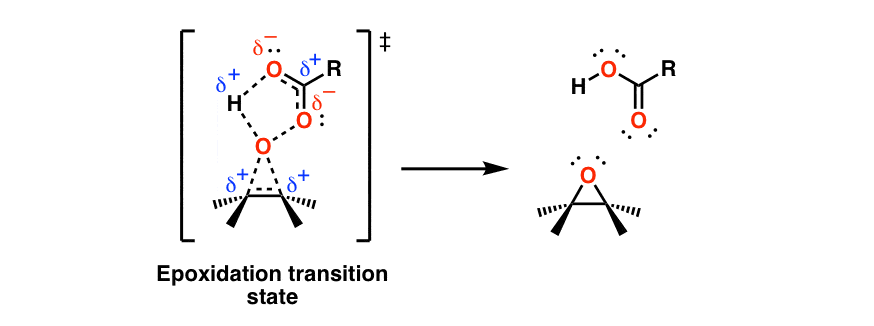
Key features of this mechanism are:
- The alkene's π bond acts as a nucleophile, attacking the electrophilic terminal oxygen of the peroxy acid.
- Simultaneously, the O-H bond of the peroxy acid breaks, and the carbonyl oxygen picks up the proton.
- The weak O-O bond cleaves.
- A new C-O bond forms from the peroxy acid oxygen to the other carbon of the original double bond.
- Because this all happens in one step, there are no carbocation intermediates, and thus no possibility of carbocation rearrangements.
Part 3: A Deeper Dive with Frontier Molecular Orbital Theory
To truly understand why this reaction occurs, we need to look at it through the lens of your quantum chemistry background. The concerted mechanism can be elegantly explained by examining the interaction between the frontier molecular orbitals (FMOs) of the reactants.
The Wikipedia article on the Prilezhaev reaction provides an excellent, concise explanation of the FMO theory behind the butterfly mechanism. This will connect the arrow-pushing diagram to the underlying quantum mechanics.
Please read the section titled 'Reaction mechanism'. Focus on the roles of the HOMO and LUMO, and how this model explains the reactivity trend of substituted alkenes.
As the reading explains, the reaction is primarily driven by the interaction between:
- The Highest Occupied Molecular Orbital (HOMO) of the alkene: the π bond.
- The Lowest Unoccupied Molecular Orbital (LUMO) of the peroxy acid: the σ* orbital of the weak O-O bond.
The alkene's electron-rich π orbital (the nucleophile) donates electron density into the low-lying, antibonding σ* orbital of the O-O bond (the electrophile). Populating this antibonding orbital weakens and ultimately cleaves the O-O bond, facilitating the transfer of the oxygen atom.
This FMO model perfectly explains the observed regioselectivity of the reaction. Electron-donating groups (like alkyl groups) on the alkene raise the energy of its HOMO. A higher energy HOMO is a better nucleophile and is closer in energy to the peracid's LUMO, leading to a stronger interaction and a faster reaction rate. This is why more substituted, electron-rich alkenes are epoxidized more quickly.
Reactivity Trend:
Tetrasubstituted > Trisubstituted > Disubstituted > Monosubstituted > Ethylene
Part 4: Stereospecificity of Epoxidation
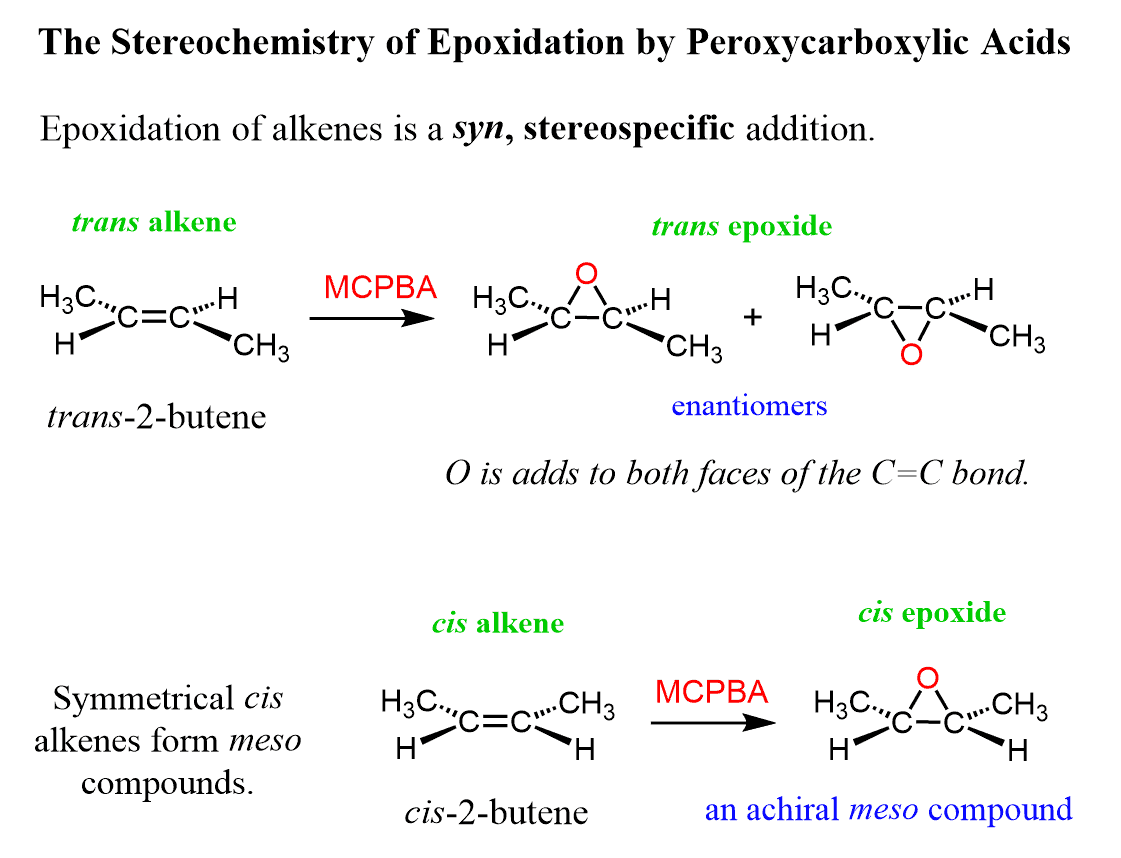
The concerted nature of the butterfly mechanism has a direct and predictable stereochemical consequence: the reaction is a stereospecific syn-addition. The oxygen atom is delivered to one face of the planar alkene, and the original stereochemistry of the substituents on the double bond is perfectly retained in the epoxide product.
- A cis-alkene gives a cis-epoxide (a meso compound if symmetrically substituted).
- A trans-alkene gives a trans-epoxide (a racemic mixture of enantiomers).
This is one of the most important features of the reaction. The resource below provides a clear explanation with excellent diagrams.
This article from Chemistry Steps provides a thorough explanation of the stereospecific nature of epoxidation.
Please read the section 'The Stereochemistry of Alkene Epoxidation'. Pay close attention to the examples showing how cis- and trans-alkenes yield different stereoisomeric products.
This image, from the article you just read, powerfully summarizes this principle.
Test your understanding!
Predict the product(s) of the following reaction. Be sure to specify the stereochemistry and the relationship between the products, if more than one is formed.
(R)-3-methylcyclopentene reacts with mCPBA.
Show answer
The starting material, (R)-3-methylcyclopentene, is chiral. Epoxidation is a syn-addition and can occur from either face of the double bond (top or bottom).
- Attack from the 'top' face: The oxygen adds from the same face as the methyl group is pointing (if drawn 'up'). This creates one diastereomer.
- Attack from the 'bottom' face: The oxygen adds from the opposite face of the methyl group. This creates a second diastereomer.
Since the starting material is chiral and the reaction creates a new stereocenter (in this case, two new stereocenters on the epoxide ring), the two products are not mirror images of each other. They are diastereomers. The syn-addition from the two different faces of the chiral alkene results in a mixture of diastereomeric epoxides.
Conclusion
In this lesson, we have dissected the epoxidation of alkenes, a fundamental transformation in organic chemistry. You learned how to describe its elegant and powerful mechanism from multiple perspectives.
Key Takeaways:
- Epoxidation is the reaction of an alkene with a peroxy acid (e.g., mCPBA) to form an epoxide, a three-membered cyclic ether.
- The reaction proceeds via a concerted "butterfly mechanism" in a single step, with no ionic intermediates.
- From a molecular orbital perspective, the reaction is driven by the interaction of the alkene's π (HOMO) with the peroxy acid's σ* O-O (LUMO). This explains why electron-rich alkenes react faster.
- A direct consequence of the mechanism is that epoxidation is a stereospecific syn-addition, meaning the stereochemistry of the starting alkene is preserved in the epoxide product.
Preview of the Next Lesson:
Epoxidation is one of several important syn-addition reactions. In our next lesson, we will explore another: syn-dihydroxylation. We will see how reagents like potassium permanganate (KMnO₄) and osmium tetroxide (OsO₄) can also add to one face of an alkene, but this time delivering two oxygen atoms to form a 1,2-diol. We will compare the mechanisms and see how chemists can choose between these reactions to achieve different synthetic goals.