Hello! Welcome to your next lesson in our exploration of advanced organic chemistry.
In our previous lesson, we examined epoxidation, a beautiful example of a concerted, stereospecific syn-addition that delivers a single oxygen atom to one face of an alkene. Today, we'll build directly on that theme by studying syn-dihydroxylation, a process that also adds groups to the same face of an alkene, but this time delivers two hydroxyl groups to form a 1,2-diol (also known as a glycol).
Your learning outcome for this lesson is to describe the mechanism for syn-dihydroxylation of alkenes using KMnO₄ or OsO₄. We will delve into the mechanisms for both reagents, highlighting their similarities and crucial differences. You'll see how the formation of a cyclic intermediate is the key to understanding the reaction's stereochemical outcome, a principle that should resonate with our previous discussion of the "butterfly" mechanism in epoxidation.
Part 1: The Osmium Tetroxide (OsO₄) Pathway
Osmium tetroxide (OsO₄) is the gold standard for syn-dihydroxylation. It is a highly reliable and selective reagent that cleanly converts an alkene into a cis-diol (or syn-diol).
The overall reaction involves two steps:
- Reaction of the alkene with OsO₄ to form an intermediate called a cyclic osmate ester.
- Hydrolysis of the osmate ester to yield the diol. This is typically done with a mild reducing agent like sodium bisulfite (NaHSO₃) or sodium sulfite (Na₂SO₃) in water.
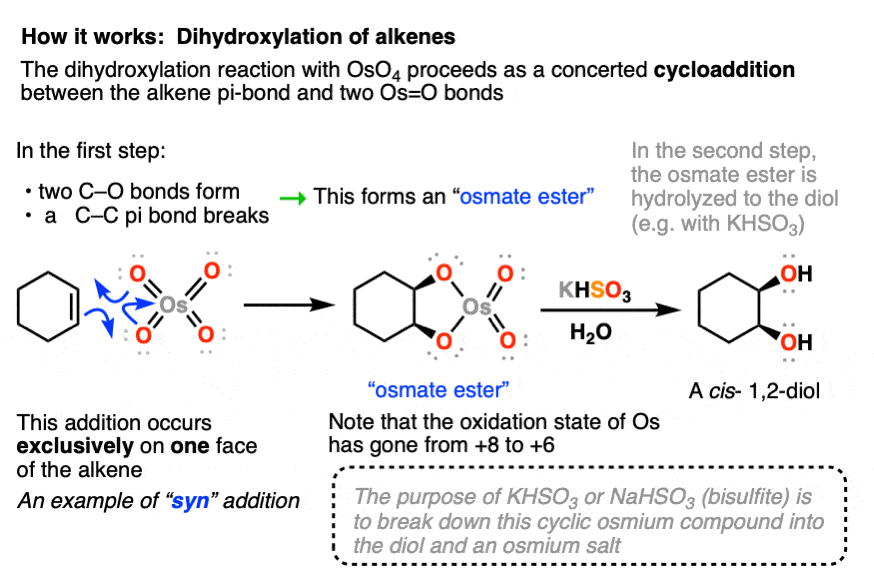
The key to this reaction's stereospecificity lies in the first step. To understand the electron flow, let's watch a short video segment.
Syn dihydroxylation | Alkenes and Alkynes | Organic chemistry | Khan Academy
The Khan Academy Organic Chemistry channel provides a clear explanation of the concerted, six-electron movement that forms the osmate ester. This is the mechanistic heart of the reaction.
Please watch from 0:45 to 2:10. Focus on how the alkene's π bond and the osmium reagent interact in a single, concerted step to form the cyclic intermediate. Notice how this forces both oxygen atoms to add from the same face of the alkene.
As the video showed, the reaction is a [3+2] cycloaddition. Three atoms from the OsO₄ molecule (Os and two O atoms) react with the two carbon atoms of the alkene's π bond. Because all the bonds form simultaneously on one face of the alkene, the resulting stereochemistry is fixed. This is analogous to how the peroxy acid delivered its oxygen atom from one side in epoxidation.
Part 2: The Catalytic Upjohn Dihydroxylation
Given your interest in the principles behind the chemistry, it's important to address the practicalities of using OsO₄. It is both highly toxic and extremely expensive. Using a full stoichiometric equivalent for every reaction is impractical and hazardous.
Chemists have developed a clever solution: use a catalytic amount of OsO₄ and a stoichiometric amount of a cheaper, safer co-oxidant to regenerate the OsO₄ after each cycle. The most common method is the Upjohn dihydroxylation, which uses N-methylmorpholine N-oxide (NMO) as the co-oxidant.
Let's explore this catalytic cycle.
OsO4 (Osmium Tetroxide) for Dihydroxylation of Alkenes
This article from Master Organic Chemistry explains the rationale and mechanism of the catalytic Upjohn process.
Please read section 5, titled 'Catalytic OsO4 Using Stoichiometric Oxidant'. Focus on understanding the role of NMO in the catalytic cycle shown in the diagram.
The catalytic cycle works as follows:
- The alkene reacts with OsO₄ (in its +8 oxidation state) to form the cyclic osmate ester, reducing osmium to Os(VI).
- Hydrolysis occurs, releasing the diol product.
- The co-oxidant, NMO, then oxidizes the Os(VI) species back to Os(VIII), regenerating the OsO₄ catalyst.
- The regenerated catalyst is now free to react with another molecule of the alkene.
This elegant solution allows the reaction to proceed with only a small (1-2 mol%) amount of the precious osmium reagent, making the transformation far more practical.
Part 3: The Potassium Permanganate (KMnO₄) Pathway
Potassium permanganate (KMnO₄) is another reagent capable of syn-dihydroxylation. It is much cheaper than OsO₄ but is a more powerful and less selective oxidizing agent, which introduces some important limitations.
For syn-dihydroxylation to be the primary outcome, the reaction must be carried out under specific, mild conditions: cold, dilute, and alkaline (basic, e.g., with NaOH).
Mechanistically, the reaction is analogous to the OsO₄ reaction.

Let's watch a video that illustrates this process.
This video from The Organic Chemistry Tutor demonstrates the syn-dihydroxylation mechanism using potassium permanganate.
Please watch from 1:31 to 3:11. Observe the formation of the cyclic manganate ester and its subsequent hydrolysis. Note the strong similarity to the osmate ester pathway.
Just like with osmium, the permanganate ion adds to the alkene in a concerted cycloaddition, forming a five-membered cyclic manganate ester. This intermediate ensures that both oxygen atoms are delivered to the same face of the double bond, resulting in a syn-diol after hydrolysis.
Part 4: KMnO₄ — A Powerful Oxidant with a Crucial Catch
The necessity of using cold, basic, and dilute KMnO₄ cannot be overstated. Unlike OsO₄, which generally stops at the diol stage, KMnO₄ is a very strong oxidizing agent. If the reaction is performed under hot, acidic, or concentrated conditions, it will not stop at the diol. Instead, it will proceed to cleave the carbon-carbon bond entirely. This is called oxidative cleavage.
Syn dihydroxylation | Alkenes and Alkynes | Organic chemistry | Khan Academy
It's essential to understand the different outcomes when using KMnO₄ under different conditions. The Khan Academy video you saw earlier provides an excellent explanation of this.
Please watch from 9:21 to 13:30. Pay close attention to how heating the reaction with KMnO₄ leads to alkene cleavage, producing ketones or carboxylic acids, instead of the diol.
This dual reactivity makes OsO₄ the preferred reagent when a diol is the desired product, as the yields are higher and the reaction is more reliable. The KMnO₄ reaction is often used as a qualitative test for alkenes (the Baeyer test), where the disappearance of the deep purple color of the permanganate ion indicates that a reaction has occurred.
Test your understanding!
Consider the reaction of (E)-3,4-dimethylhex-3-ene with the following reagents:
- OsO₄ (catalytic), NMO
- Cold, dilute, basic KMnO₄
- Hot, acidic KMnO₄
Predict the major product(s) for each case. Pay attention to stereochemistry for reactions 1 and 2.
Show answer
The starting material is a symmetrically substituted trans (E) alkene.
-
OsO₄/NMO: This is a stereospecific syn-dihydroxylation. Addition of two -OH groups to the same face of a trans double bond will create a racemic mixture of enantiomers. The products are (3R,4R)-3,4-diethyl-3,4-hexanediol and (3S,4S)-3,4-diethyl-3,4-hexanediol.
-
Cold, dilute, basic KMnO₄: This reaction also gives stereospecific syn-dihydroxylation. The products will be the same as in case 1: a racemic mixture of the two enantiomeric diols.
-
Hot, acidic KMnO₄: These are conditions for oxidative cleavage. The double bond will be broken completely. Each carbon of the original double bond is bonded to two other carbon atoms (i.e., they are tertiary). The oxidation of a tertiary carbon center in this context leads to the formation of a ketone. Since the starting material is symmetric, cleavage will result in two identical molecules of butan-2-one (ethyl methyl ketone).
Conclusion
In this lesson, we explored the mechanisms of syn-dihydroxylation, a key reaction for converting alkenes into 1,2-diols with controlled stereochemistry.
Key Takeaways:
- Syn-dihydroxylation is the addition of two hydroxyl groups to the same face of an alkene's double bond, resulting in a cis-1,2-diol.
- Both OsO₄ and cold, alkaline KMnO₄ achieve this via a concerted [3+2] cycloaddition mechanism, which forms a five-membered cyclic ester intermediate (an osmate or manganate ester). The formation of this intermediate is what guarantees the stereospecific syn-addition.
- OsO₄ is a mild, high-yield reagent that is often used in catalytic amounts with a co-oxidant like NMO (Upjohn dihydroxylation) due to its toxicity and cost.
- KMnO₄ is a powerful, less expensive oxidant. The reaction must be kept cold and basic to stop at the diol stage. Under hot or acidic conditions, KMnO₄ causes oxidative cleavage of the C=C bond.
Preview of the Next Lesson:
We've now seen several ways to add functional groups across a double bond: epoxidation (one oxygen), and dihydroxylation (two oxygens). Our next lesson will step back to compare the three principal methods for adding just one H and one OH group: alkene hydration. We will analyze how acid-catalyzed hydration, oxymercuration-demercuration, and hydroboration-oxidation provide chemists with exquisite control over both regioselectivity (Markovnikov vs. anti-Markovnikov) and stereochemistry, rounding out your toolkit for alkene additions.