Hello! Welcome to your next lesson.
In our last session, we explored how reactions like osmium tetroxide dihydroxylation can create molecules with specific, predictable stereochemistry. A crucial part of chemistry is not just making these molecules but also communicating their exact structure to others without ambiguity. This is where a systematic naming convention becomes indispensable.
Today, we will master the language used for this purpose: IUPAC Nomenclature. Your learning outcome is to apply IUPAC rules to name complex polyfunctional organic molecules with multiple functional groups and stereocenters.
We will treat this not as rote memorization, but as a logical, hierarchical system—an algorithm—for translating a 2D or 3D chemical structure into a unique, universally understood name. This lesson will equip you with the advanced rules needed to handle molecules with multiple competing functional groups and to precisely describe their three-dimensional geometry.
1. The Systematic Approach: An Algorithm for Naming
At its core, IUPAC nomenclature follows a clear, step-by-step procedure. For any given complex molecule, the process is as follows:
- Identify all functional groups present in the molecule.
- Determine the principal characteristic group. This is the highest-priority functional group, and it will define the molecule's class and the suffix of the name.
- Identify the senior parent structure (the main chain or ring system) that contains the principal group. For complex molecules, there are specific seniority criteria to resolve any ambiguity.
- Number the parent structure. The numbering scheme is chosen to give the principal group the lowest possible locant (number). Further rules decide the numbering for multiple bonds, substituents, etc.
- Name all other functional groups and alkyl fragments as prefixes.
- Assemble the name: Arrange the prefixes in alphabetical order, add the name of the parent structure, and attach the suffix for the principal group. Insert locants to specify the position of all features.
- Determine the configuration of all stereocenters (e.g., chiral centers, double bonds) and add the appropriate stereodescriptors (like R/S, E/Z) to the beginning of the name.
This systematic process ensures that we can deconstruct any complex molecule and arrive at a single, preferred IUPAC name (PIN).
2. Handling Polyfunctional Molecules: The Priority System
When a molecule contains multiple functional groups, we can't give them all a suffix. A hierarchy must be established. The highest-priority group gets the suffix, and all others are demoted to prefix status.
The video below provides an excellent introduction to this concept and demonstrates how to name molecules with several common functional groups.
Naming Polyfunctional Compounds
This video by Josh Osbourn, 'Naming Polyfunctional Compounds', clearly explains the concept of functional group priority and how to name lower-priority groups as substituents.
Watch the entire video. Pay close attention to the priority table presented at the beginning and how the names of substituent functional groups are derived (e.g., ketone -> 'oxo', aldehyde -> 'formyl', alcohol -> 'hydroxy'). Notice the systematic approach used in each example.
As the video explained, the priority of functional groups is a cornerstone of naming complex molecules. The general principle is that the priority increases with the oxidation state of the carbon atom in the functional group. Here is a summary of the seniority order for common classes, from highest to lowest:
- Carboxylic Acids (-COOH)
- Carboxylic Acid Derivatives (Anhydrides, Esters, Acid Halides, Amides)
- Nitriles (-C≡N)
- Aldehydes (-CHO)
- Ketones (=O)
- Alcohols (-OH)
- Thiols (-SH)
- Amines (-NH₂)
Groups like halides (-F, -Cl, -Br, -I), ethers (-OR), and nitro groups (-NO₂) are always treated as prefixes.
Let's apply this to an example.

- Functional Groups: Carboxylic acid, ester, alkene.
- Principal Group: The carboxylic acid (
-COOH) is the highest priority group. The name will end in-oic acid. - Parent Structure: The longest carbon chain containing the principal group. This is the 6-carbon chain, so the parent is a derivative of hexanoic acid.
- Numbering: The chain is numbered starting from the carboxylic acid carbon as C1.
- Prefixes: The ester group at C4 is named as a substituent. This
–COOCH₂CH₃group is an "ethoxycarbonyl" group. The double bond is at C4. - Assemble:
- Parent:
hex-4-enoic acid(double bond at C4) - Add prefix:
4-(ethoxycarbonyl)hex-4-enoic acid
(Note: Enclosing marks are used for the complex prefix).
- Parent:
This name perfectly encodes the structure, prioritizing the acid over the ester and alkene.
3. Integrating Stereochemistry: R/S and E/Z Descriptors
A complete name must also describe the molecule's 3D structure. This is done by adding stereodescriptors for chiral centers and double bonds. You have already learned the Cahn-Ingold-Prelog (CIP) priority rules for this purpose. The next step is to integrate them correctly into the name.
The following video provides a thorough review of assigning R/S configuration and, critically, demonstrates how to include these descriptors in the final IUPAC name.
5.2 How to Assign R and S Configuration | Absolute Configuration | Organic Chemistry
This video, 'How to Assign R and S Configuration' from Chad's Prep, covers the application of CIP rules and their incorporation into IUPAC names for molecules with single and multiple stereocenters.
Watch from the beginning until 24:57. Focus on these key parts: The CIP priority rules (0:00 - 3:06). Handling different orientations of the lowest priority group (3:06 - 6:15). Dealing with complex branching and double bonds (10:27 - 18:47). Most importantly, how R/S descriptors are formatted in the final name for single (18:47 - 20:47) and multiple (20:47 - 24:57) chiral centers.
Summary of Incorporating Stereodescriptors:
- Stereodescriptors are placed at the very beginning of the name (or the part of the name to which they refer), enclosed in parentheses.
- For a molecule with one stereocenter, the name starts with
(R)-or(S)-. - For molecules with multiple stereocenters, the locant for each center is included, for example,
(2R,5S)-. - The same format applies to double bond geometry, for example,
(3E,5Z)-. - If both types are present, they are combined in the same set of parentheses, ordered by locant number:
(2R,4E)-.
4. The Grammar of Nomenclature: Rules for Writing Names
To achieve the "hyper deep" understanding you're looking for, it's worth appreciating the strict "grammatical" rules that ensure IUPAC names are written consistently. These are detailed in the official IUPAC "Blue Book," a comprehensive guide to organic nomenclature. While reading the entire book is unnecessary, understanding its core principles adds a layer of rigor.
Here are some key rules from the official IUPAC recommendations (LINK and LINK):
- Locants: Numbers are placed immediately before the part of the name they locate. For example, hex-2-ene, not 2-hexene.
- Punctuation: Commas separate numbers (
2,3-dimethyl), and hyphens separate numbers from letters (hex-2-ene). There are no spaces in a single-word substitutive name. - Alphabetical Order: Prefixes are cited in alphabetical order. Multiplicative prefixes like
di-,tri-,sec-, andtert-are ignored for alphabetization. For example,ethylcomes beforedimethyl. - Multiplicative Prefixes: Use
di-,tri-,tetra-for simple prefixes (likemethyl). Usebis-,tris-,tetrakis-for complex (substituted) prefixes or to avoid ambiguity (e.g.,bis(2-chloroethyl)). - Enclosing Marks: Parentheses
()are used to enclose complex prefixes. If the prefix already contains parentheses, square brackets[]are used, followed by braces{}, in a nesting order of{[()]}.
Adhering to these syntactic rules is what makes nomenclature a truly systematic and unambiguous language.
Test your understanding!
Provide the complete, stereochemically precise IUPAC name for the following molecule.
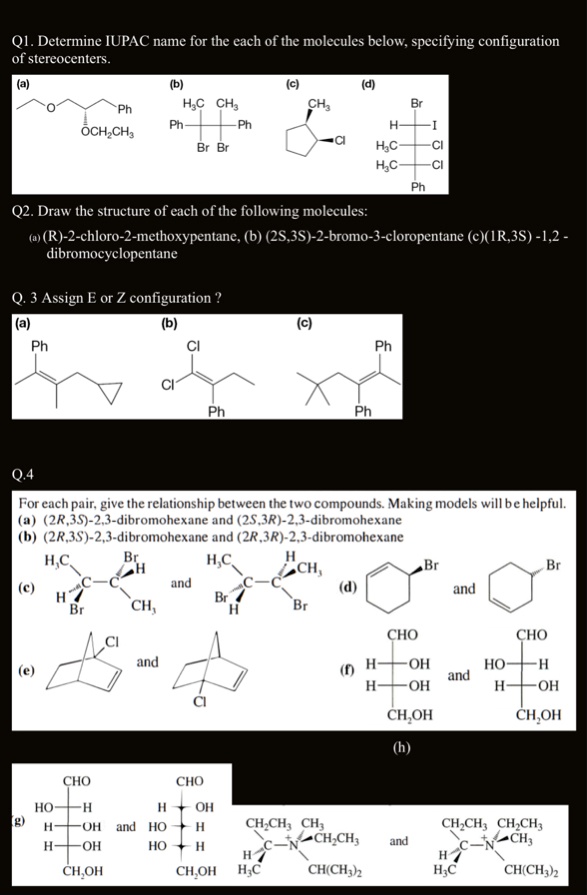
Show answer
Let's apply the IUPAC algorithm to structure 1d.
-
Functional Groups: Carboxylic acid (
-COOH), alcohol (-OH), and an alkyl group (-CH₃). -
Principal Group: The carboxylic acid is the highest priority group. The name will end in
-oic acid. -
Parent Structure: The longest chain containing the carboxylic acid is a 5-carbon chain. The parent is pentanoic acid.
-
Numbering: The chain is numbered starting from the carboxylic acid carbon as C1. This places the methyl group at C2 and the hydroxyl group at C3.
-
Prefixes: The alcohol is a substituent, named
hydroxy. The methyl group is namedmethyl. -
Assemble (preliminary name): Alphabetizing the prefixes,
hydroxycomes beforemethyl. The name is3-hydroxy-2-methylpentanoic acid. -
Stereodescriptors:
- At C2: The priorities are:
-COOH(1),-CH(OH)CH₂CH₃(2),-CH₃(3), and-H(4, dashed). Tracing from 1→2→3 gives a counter-clockwise circle. Thus, C2 is S. - At C3: The priorities are:
-OH(1),-CH(CH₃)COOH(2),-CH₂CH₃(3), and-H(4, dashed). Tracing from 1→2→3 gives a clockwise circle. Thus, C3 is R.
- At C2: The priorities are:
-
Final Name: Combine the stereodescriptors with the name.
The complete IUPAC name is (2S,3R)-3-hydroxy-2-methylpentanoic acid.
Conclusion
Today, we've dissected the logic of modern IUPAC nomenclature, treating it as a systematic process for encoding molecular structure. This system allows chemists to communicate complex structural and stereochemical information with perfect fidelity.
Key Takeaways:
- IUPAC naming is a hierarchical process, starting with the principal characteristic group, which determines the suffix.
- All other functional groups are treated as prefixes and are listed alphabetically.
- The parent structure is the senior chain or ring that contains the principal group, and it is numbered to give the principal group the lowest possible locant.
- Stereodescriptors like
(2R,3S)-and(4E)-are placed at the beginning of the name to specify the molecule's 3D arrangement. - Strict rules for punctuation, locant placement, and the use of multiplicative prefixes ensure that names are unambiguous.
Preview of the Next Lesson:
Now that you can precisely name a molecule, we can turn our attention back to reaction mechanisms. How do chemists prove that a proposed mechanism is correct? One powerful technique involves "tagging" atoms to see where they end up. In our next lesson, we will explore how isotopic labeling experiments are designed and interpreted to provide definitive evidence for or against a mechanistic pathway.