Hello! Welcome to your next lesson.
In our last session, we mastered IUPAC nomenclature, a precise language for describing the static structure of a molecule. However, organic chemistry is fundamentally about change—how molecules react and transform. Proposed reaction mechanisms are hypotheses, and like any scientific hypothesis, they require experimental proof.
Today, we delve into one of the most elegant and powerful tools physical organic chemists use to validate or refute these hypotheses. Your learning outcome is to describe how isotopic labeling experiments can be used to distinguish between alternative mechanistic pathways.
We will explore two distinct but related applications of this technique:
- Using isotopes as tracers to follow the path of specific atoms through a reaction.
- Measuring the Kinetic Isotope Effect (KIE), a subtle change in reaction rate upon isotopic substitution, which provides profound insights into bond-breaking events and the nature of the transition state.
This topic is a perfect intersection of your interests, connecting quantum mechanical principles (like zero-point energy and molecular vibrations) directly to the observable outcomes of chemical reactions.
1. Isotopes as Markers: Following the Atoms
The most straightforward use of isotopes is as "tags" or "labels." By replacing an atom in a reactant with one of its heavier, stable isotopes (like replacing ¹²C with ¹³C or ¹⁶O with ¹⁸O), we can trace its journey to the final product. Since these heavier isotopes have nearly identical chemical properties, they don't significantly alter the reaction mechanism; they just act as reporters.
Analytical techniques like Mass Spectrometry (MS) or Nuclear Magnetic Resonance (NMR) spectroscopy are then used to pinpoint the isotope's final location, providing a map of the bond-forming and bond-breaking events.
Case Study 1: The Mechanism of Ester Hydrolysis
A classic example is the hydrolysis of an ester, like ethyl benzoate. Does the incoming nucleophile (hydroxide or water) attack the carbonyl carbon or the alkyl carbon? This corresponds to two different bond cleavages.
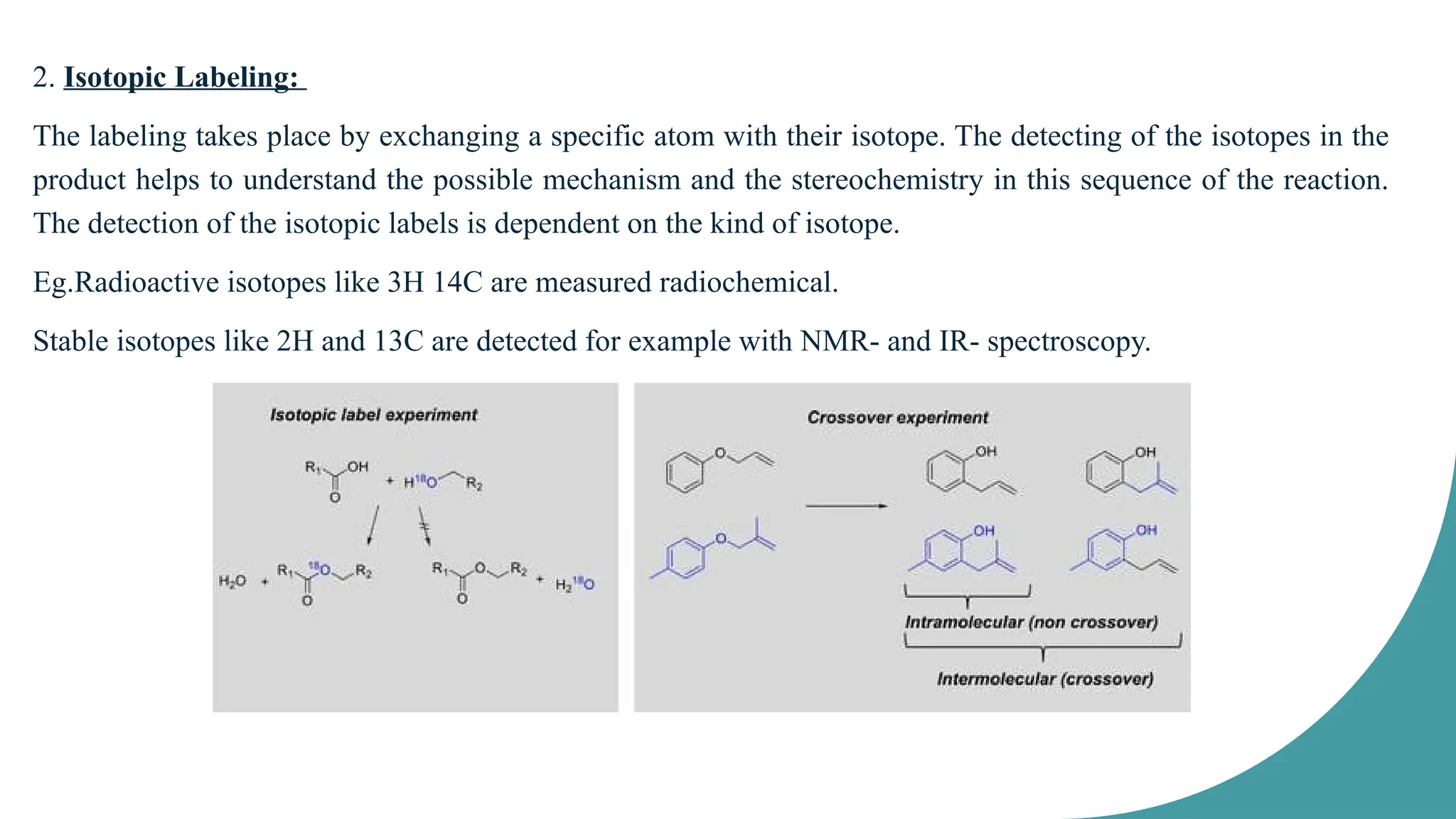
How can we distinguish them? By performing the reaction in water enriched with the oxygen-18 isotope (H₂¹⁸O).
- If acyl-oxygen cleavage occurs, the ¹⁸O from the water will become part of the new carboxylic acid.
- If alkyl-oxygen cleavage occurs, the ¹⁸O will end up in the alcohol product.
Experimentally, the ¹⁸O is found exclusively in the carboxylic acid, providing definitive evidence for the acyl-oxygen cleavage mechanism.
To explore this foundational experiment in more detail, please read the following guide.
A Comparative Guide to Isotopic Labeling in Mechanistic Studies
The guide 'A Comparative Guide to Isotopic Labeling in Mechanistic Studies' from BenchChem provides a concise, well-structured explanation of this experiment.
Please read 'Case Study 1: Elucidating the Mechanism of Ester Hydrolysis with ¹⁸O Labeling' and the associated 'Experimental Protocol'. Focus on how the predicted location of the ¹⁸O label differs for the two mechanisms and how a mass spectrometer would detect this difference.
Case Study 2: Proving the Benzyne Intermediate
Sometimes, isotopic labeling can reveal the existence of a highly reactive, unexpected intermediate. A famous example is J.D. Roberts's proof of the "benzyne" intermediate in nucleophilic aromatic substitution.
When chlorobenzene labeled with ¹⁴C at the C-1 position (the carbon attached to chlorine) is reacted with amide anion (⁻NH₂), two different products are formed in nearly equal amounts. One has the -NH₂ group on the labeled carbon (C-1), and the other has it on the adjacent carbon (C-2).
This result is incompatible with a simple direct substitution (SₙAr) mechanism, which would only yield the first product. Roberts proposed that the reaction proceeds through a symmetric "benzyne" intermediate, which can be attacked at either of its two "triple-bonded" carbons.
The following resource provides a clear summary of this landmark experiment.
Use of Isotopes for Studying Reaction Mechanisms
The article 'Use of Isotopes for Studying Reaction Mechanisms' by Uday Maitra and J. Chandrasekhar explains the benzyne experiment elegantly.
Read the section titled 'The Classic Case of the Benzyne Mechanism' (with Figure 2). Note how the 50/50 product distribution strongly implies a symmetrical intermediate.
2. The Kinetic Isotope Effect (KIE): A Quantum Mechanical Probe
Tracer experiments are powerful, but they don't tell us much about the rate of a reaction or the structure of its transition state. For that, we turn to the Kinetic Isotope Effect (KIE).
The KIE is observed when replacing an atom with its isotope changes the rate of the reaction. This effect is most pronounced when the substituted atom is involved in a bond that is being formed or broken in the rate-determining step. The most common KIE studied is the substitution of hydrogen (H) with its heavier isotope, deuterium (D).
The KIE is defined as the ratio of the rate constant for the lighter isotope () to the rate constant for the heavier isotope ():
The Quantum Origin of KIE
The reason for the KIE lies in the quantum mechanical nature of chemical bonds. A bond can be modeled as a spring, and it has a ground-state vibrational energy known as the Zero-Point Energy (ZPE).
The vibrational frequency () of a bond is related to the bond strength (force constant, ) and the reduced mass of the two atoms (). From Hooke's Law:
Since deuterium is twice as heavy as hydrogen, the reduced mass of a C-D bond is greater than that of a C-H bond. Consequently, the C-D bond has a lower vibrational frequency and a lower ZPE.

This difference in ZPE is the heart of the KIE. Because the C-D bond "sits deeper" in its potential energy well, it requires more energy to be broken.
The following video provides an excellent, in-depth exploration of the theory behind KIE and its application. It is a graduate-level resource, which should align perfectly with your desire for a rigorous treatment of the topic.
Advanced Organic Chemistry: Hammetts and KIEs
This video, 'Advanced Organic Chemistry: Hammetts and KIEs' from Synthesis Workshop Videos, offers a deep dive into the theoretical underpinnings of the kinetic isotope effect.
Please watch the following segments carefully: Origin of Isotope Effects (15:02 - 17:54): Focus on the explanation of ZPE, vibrational frequencies, and how isotopic substitution affects the reduced mass and ZPE. Primary KIE (17:54 - 23:49): Pay attention to how the magnitude of the KIE relates to the structure of the transition state (early, late, or symmetric). Secondary KIE (25:40 - 28:23): Understand how rehybridization effects (sp³ ↔ sp²) in the transition state can cause smaller, but still informative, KIEs. Quantum Tunneling (28:23 - 30:31): This section discusses a fascinating quantum effect that leads to exceptionally large KIEs.
Interpreting KIE Values
Based on the video and our understanding, we can categorize KIEs:
- Primary KIE (): A large KIE is observed. This is strong evidence that the C-H bond is being broken (or formed) in the rate-determining step of the reaction. The theoretical maximum for a C-H bond breaking at room temperature is around 7.
- Secondary KIE (): A small KIE is observed. This occurs when the C-H bond is not broken in the rate-determining step, but its electronic or steric environment changes. This is often due to a change in hybridization at the carbon atom.
- Normal Secondary KIE (): Usually seen when an sp³ carbon becomes sp² in the transition state (e.g., in an Sₙ1 reaction). The sp² state is less crowded, and C-H bending vibrations are "looser," making the C-H bond slightly easier to deform.
- Inverse Secondary KIE (): Usually seen when an sp² carbon becomes sp³ in the transition state (e.g., nucleophilic addition to a carbonyl). The sp³ state is more crowded, and C-D bonds are "shorter" and less disruptive, making the deuterated compound react slightly faster.
- No KIE (): The C-H bond is not involved in the rate-determining step, either directly or through secondary effects. This tells you that C-H bond cleavage must occur in a fast step before or after the rate-determining step.
Test your understanding!
Consider two elimination reactions:
- An E2 reaction where a strong base removes a proton in a concerted step with leaving group departure.
- An E1 reaction where the leaving group first departs to form a carbocation in the slow step, followed by fast deprotonation by a weak base.
If you measure the KIE for the C-H bond being broken, would you expect a primary or secondary KIE for each reaction? Explain your reasoning.
Show answer
-
E2 Reaction: You would expect a primary KIE (e.g., = 4-8). In the E2 mechanism, the C-H bond is broken in the rate-determining step. The entire reaction rate depends on the speed of this concerted process, so the difference in ZPE between the C-H and C-D bonds has a large effect on the overall rate.
-
E1 Reaction: You would expect a secondary KIE (e.g., = 1.1-1.2) or no KIE at all. The rate-determining step is the formation of the carbocation, which does not involve breaking the C-H bond. The C-H bond is broken in a subsequent, fast step. While there might be a small normal secondary KIE due to hyperconjugation stabilizing the developing carbocation transition state (which is weaker for C-D), the effect will be much smaller than in the E2 case. The absence of a primary KIE is a key piece of evidence used to distinguish E1 from E2.
3. Advanced Analysis: Dissecting Multi-Step Mechanisms
The true power of KIE analysis comes from clever experimental design, which allows us to probe different steps in a complex, multi-step reaction. By comparing the KIEs obtained from different experiments, we can build a detailed picture of the reaction pathway.
The Synthesis Workshop video you watched earlier introduces three main experimental setups. Let's explore how their results can be interpreted.
Advanced Organic Chemistry: Hammetts and KIEs
Let's return to the Synthesis Workshop video to see how experimental design is used to decipher complex mechanisms.
Please watch the following segments: Experimental Methods (31:16 - 37:32): Understand the difference between measuring absolute rates, intermolecular competition, and intramolecular competition. Note the key takeaway: competition experiments are often more accurate and reveal information about the first irreversible step (substrate-committing step), not necessarily the overall rate-determining step. Interpreting Results (37:32 - 42:27): This is the most critical part. Follow the logic for how comparing KIEs from different experiments can tell you if C-H cleavage is rate-determining, post-rate-determining, or part of a pre-equilibrium.
Here's a summary of the logic:
- Scenario A: C-H cleavage is the rate-determining step.
- Result: All three methods (absolute, intermolecular, intramolecular) will show a large primary KIE.
- Scenario B: C-H cleavage occurs after a separate, slower rate-determining step (e.g., catalyst activation).
- Result: Absolute rate KIE ≈ 1. Competition KIEs will be > 1. This tells you the overall rate isn't affected by the isotope, but once the active reagent is formed, it preferentially reacts with the lighter isotope.
- Scenario C: The rate-determining step is the irreversible binding of the substrate to a catalyst, followed by C-H cleavage.
- Result: Absolute rate KIE ≈ 1. Intermolecular KIE ≈ 1 (because the catalyst commits to either substrate molecule at the same rate before the C-H bond is touched). Intramolecular KIE will be > 1 (because once bound, the catalyst can choose between the H and D on the same molecule).
This level of analysis is at the cutting edge of mechanistic chemistry and shows how these experiments are not just confirmatory but truly investigative.
Conclusion
Today we've seen how isotopic labeling provides irrefutable, quantitative evidence to understand reaction mechanisms, moving far beyond simply drawing arrows.
Key Takeaways:
- Isotopes can be used as tracers (e.g., ¹⁸O, ¹⁴C) to map the movement of atoms, as seen in ester hydrolysis and the benzyne mechanism.
- The Kinetic Isotope Effect (KIE) arises from the difference in zero-point energy between bonds to different isotopes (e.g., C-H vs. C-D).
- A primary KIE () is a fingerprint for bond cleavage involving that atom in the rate-determining step.
- A secondary KIE () provides information about changes in hybridization or bonding at the transition state.
- By combining different experimental designs (e.g., competition experiments), chemists can dissect complex, multi-step reaction pathways and pinpoint the exact role of C-H bond cleavage.
Preview of the Next Lesson:
The KIE is a direct consequence of molecular vibrations. In our next lesson, we will explore another technique that also probes these vibrations: Infrared (IR) Spectroscopy. We will see how measuring the characteristic vibrational frequencies of different functional groups allows us to identify them within a molecule, providing another essential piece of the puzzle in structural elucidation.