Hello! Welcome to the third lesson in our module on Reaction Thermodynamics and Kinetics.
In the past two lessons, we explored the two fundamental driving forces of chemical reactions: enthalpy (), which quantifies the change in heat, and entropy (), which measures the change in molecular freedom. We saw that exothermic reactions () are favorable, as are reactions that increase disorder ().
However, what happens when these two forces conflict? For example, the combustion of gasoline is highly exothermic but results in a decrease in the number of gas molecules, an entropically unfavorable process. How do we determine the overall direction of a reaction?
This lesson introduces the ultimate arbiter of chemical spontaneity: Gibbs Free Energy (). This powerful thermodynamic function elegantly combines enthalpy and entropy to provide a single, definitive criterion for whether a reaction will proceed on its own. Your learning outcome for today is to use Gibbs free energy () to predict the spontaneity and equilibrium position of an organic reaction.
We will start with the fundamental thermodynamic reasoning that elevates Gibbs free energy to this crucial role, a perspective that your background in mathematics and quantum chemistry will equip you to appreciate fully.
1. From Universal Entropy to Gibbs Energy
In the previous lesson, we established that for any spontaneous process, the total entropy of the universe must increase (). While fundamentally correct, this isn't practical for a chemist, as measuring the entropy change of the entire universe is impossible. We need a criterion that depends only on the properties of the system (our reaction).
This is where Gibbs free energy originates. By considering a system in thermal and pressure equilibrium with its surroundings (a constant T and P environment, typical for lab chemistry), it can be rigorously shown that the condition is mathematically equivalent to .
Let's briefly trace this crucial derivation. The total entropy change is the sum of the system's and surroundings' entropy changes:
The heat released by the system () is absorbed by the surroundings, so the entropy change of the surroundings is . Substituting this in gives:
Multiplying by (and reversing the inequality) yields:
This expression, , is defined as the change in Gibbs Free Energy, . Thus, we arrive at the second law of thermodynamics, restated in its most useful form for chemists:
At constant temperature and pressure, a process is spontaneous if and only if .
To begin, let's watch a brief overview of this concept.
16. Thermodynamics: Gibbs Free Energy and Entropy
The following video from MIT OpenCourseWare introduces Gibbs free energy as the key predictor of spontaneity and formally defines its relationship with enthalpy and entropy.
Watch from the beginning to 05:33. Pay attention to how ΔG is introduced as the solution to the problem that ΔH alone cannot predict spontaneity. Note the definitions of spontaneous, non-spontaneous, and equilibrium in terms of the sign of ΔG.
This leads to the following clear criteria:
- : The reaction is spontaneous in the forward direction. These are also called exergonic reactions.
- : The reaction is non-spontaneous in the forward direction. It is, however, spontaneous in the reverse direction. These are called endergonic reactions.
- : The system is at equilibrium, with the forward and reverse reaction rates being equal. There is no net change.
2. The Interplay of Enthalpy, Entropy, and Temperature
The equation reveals a fascinating competition between enthalpy and entropy, with temperature acting as the weighting factor for the entropy term. By analyzing the signs of and , we can predict the conditions under which a reaction will be spontaneous.
6.2 Entropy, Gibbs Free Energy, and the Equilibrium Constant | Organic Chemistry
This video from Chad's Prep provides a systematic breakdown of the four possible scenarios based on the signs of ΔH and ΔS. This analysis is fundamental to predicting reaction outcomes.
Watch from 06:21 to 14:45. The video walks through a table analyzing how temperature affects spontaneity for each of the four sign combinations. Focus on the logic for each case.
Here is a summary of the four scenarios:
| Spontaneity | |||
|---|---|---|---|
| − | + | Always negative | Spontaneous at all temperatures. |
| + | − | Always positive | Non-spontaneous at all temperatures. |
| − | − | Negative at low T, Positive at high T | Spontaneous at low temperatures. |
| + | + | Positive at low T, Negative at high T | Spontaneous at high temperatures. |
Case 3 (): This is an enthalpically-driven reaction. It is favorable from an energy standpoint but unfavorable from a disorder standpoint. At low temperatures, the favorable term dominates, making negative. At high temperatures, the unfavorable term becomes large and positive, making positive. Many organic addition reactions fall into this category.
Case 4 (): This is an entropically-driven reaction. It is unfavorable energetically but favorable entropically. At low temperatures, the unfavorable term dominates. At high temperatures, the favorable term becomes large and negative, driving the reaction forward. Many organic elimination or decomposition reactions fit this profile.
Test your understanding!
The Diels-Alder reaction, which we discussed in the last lesson, is a classic [4+2] cycloaddition. For the reaction of 1,3-butadiene with ethene to form cyclohexene, kJ/mol and kJ/(mol·K).
Is this reaction spontaneous at 25 °C (298 K)? At what approximate temperature would this reaction cease to be spontaneous?
Show answer
This reaction has a favorable enthalpy change () but an unfavorable entropy change (). This is Case 3 from our table, so it should be spontaneous at low temperatures.
-
Calculate at 298 K:
Since is negative, the reaction is spontaneous at 25 °C. -
Find the equilibrium temperature:
The reaction ceases to be spontaneous when crosses from negative to positive. This occurs when .
Above approximately 795 K (or 522 °C), the unfavorable entropy term will dominate, and the reaction will become non-spontaneous. The reverse reaction (retro-Diels-Alder) will become spontaneous.
3. Gibbs Free Energy and the Equilibrium Constant ()
Spontaneity tells us the direction a reaction will proceed from a given state, but it doesn't tell us the extent. To understand the final composition of a reaction mixture at equilibrium, we must relate to the equilibrium constant, .
This is achieved through the equation:
Here, is the standard Gibbs free energy change, which is under standard conditions (1 atm pressure, 1 M concentration, 298 K). is the gas constant (8.314 J/mol·K).
This simple equation has profound implications:
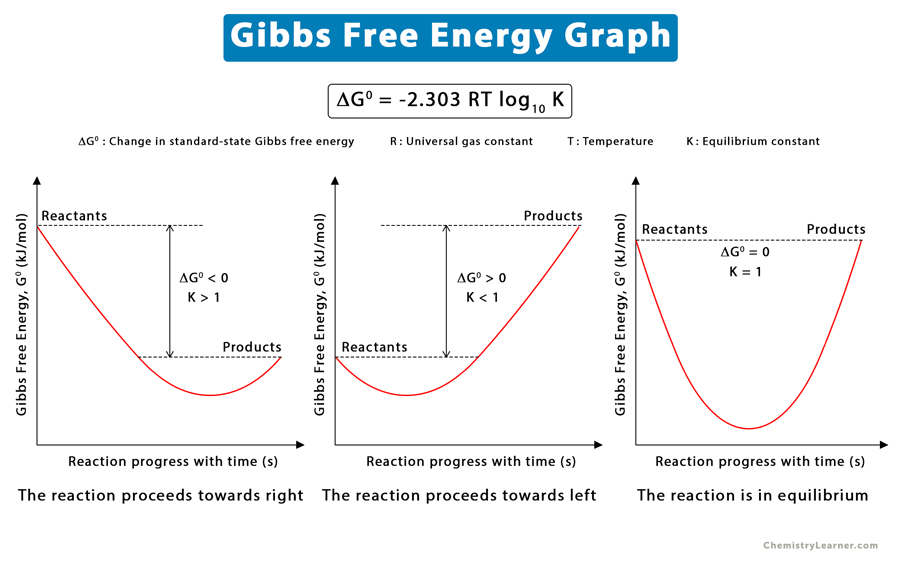
The key relationships are:
- If , then , so . The reaction is product-favored at equilibrium.
- If , then , so . The reaction is reactant-favored at equilibrium.
- If , then , so . Reactants and products are present in comparable amounts at equilibrium.
Let's watch a short segment to solidify this connection.
6.2 Entropy, Gibbs Free Energy, and the Equilibrium Constant | Organic Chemistry
This video clip will summarize the mathematical relationship between the standard Gibbs free energy change and the equilibrium constant.
Watch from 14:45 to 17:54. Focus on how the sign of ΔG° directly determines whether Keq is greater or less than 1, and thus whether products or reactants are favored.
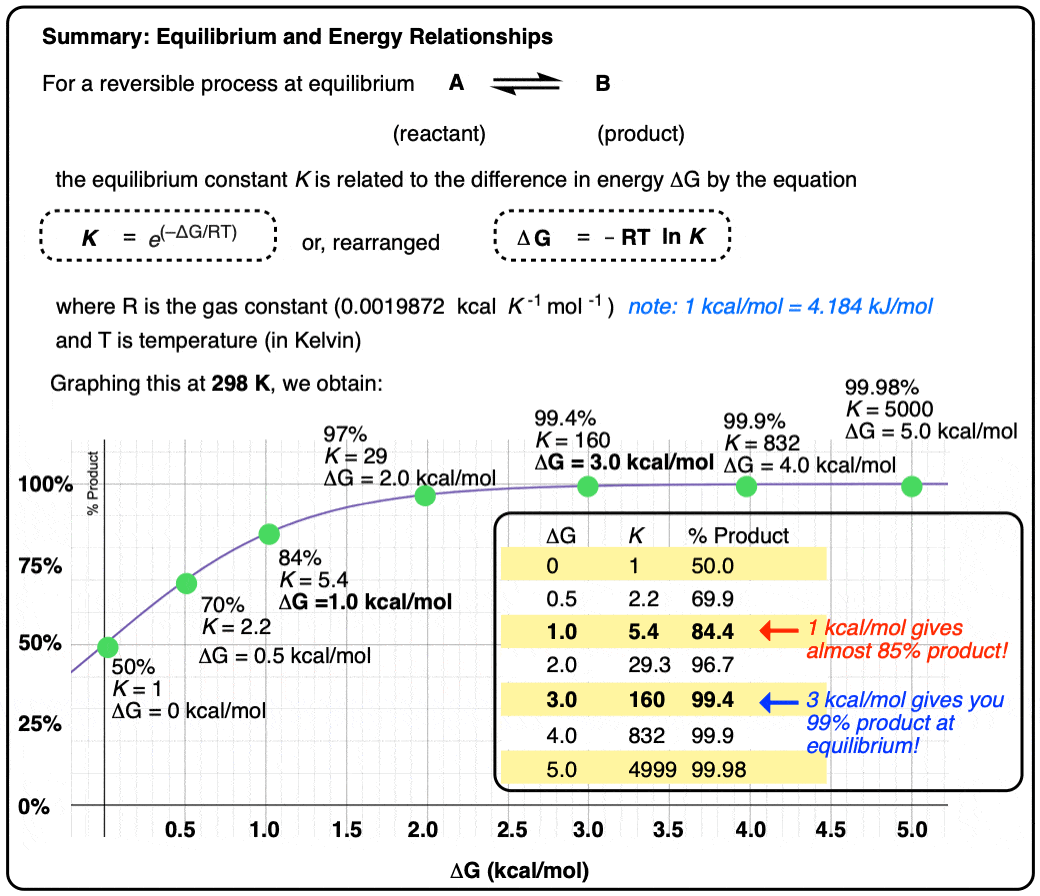
The magnitude of is a powerful indicator of how complete a reaction will be. Even small values have a dramatic effect on the equilibrium position.
4. A Practical Calculation
Let's walk through a calculation to see how these principles are applied. It is crucial to be mindful of units, as is typically given in kJ/mol while is in J/mol·K. You must convert one to match the other.
16. Thermodynamics: Gibbs Free Energy and Entropy
The following demonstration from the MIT OpenCourseWare video shows how to calculate ΔG for a reaction and use it to determine spontaneity. Note the critical step of converting units for entropy.
Watch from 05:33 to 11:15. Follow the calculation for the decomposition of ammonium nitrate. Pay close attention to how the units of ΔS (Joules) are converted to kJ to be consistent with ΔH.
This example highlights that a reaction can be spontaneous () even if it is endothermic (), as long as the temperature is high enough to make the entropy term () sufficiently negative to overcome the positive enthalpy.
Conclusion
Today, we have unified the concepts of enthalpy and entropy into the single, decisive function of Gibbs free energy. You are now equipped to analyze the thermodynamic viability of any organic reaction.
Key Takeaways:
- Gibbs free energy () is the ultimate criterion for spontaneity at constant temperature and pressure. A negative signifies a spontaneous (exergonic) process.
- The spontaneity of a reaction is governed by the interplay between enthalpy, entropy, and temperature, as described by the equation .
- Reactions can be either enthalpically-driven (spontaneous at low T) or entropically-driven (spontaneous at high T).
- The standard Gibbs free energy change () is directly related to the equilibrium constant () by the equation . This allows you to predict the position of equilibrium from thermodynamic data.
Preview of the Next Lesson:
Thermodynamics tells us where a reaction is going (the equilibrium state), but it tells us nothing about how fast it will get there. A reaction can be highly exergonic () but proceed at an imperceptibly slow rate. In our next lesson, we will shift our focus from thermodynamics to kinetics. We will analyze reaction coordinate diagrams to understand the energy barriers (activation energy) that control the speed of a reaction, and we will identify key features like transition states and intermediates.