Hello! Welcome to the second lesson in our module on Reaction Thermodynamics and Kinetics.
In our previous lesson, we established a quantitative method for determining the heat change of a reaction by calculating the enthalpy change (ΔH) from bond dissociation energies. You learned that ΔH represents the balance between the energy required to break bonds and the energy released when new bonds are formed.
However, enthalpy is only one part of the story. A reaction's tendency to occur depends not just on its heat change, but also on its change in disorder. Today, we delve into this second critical factor: entropy. Your learning outcome is to be able to predict the sign of the entropy change (ΔS) for organic reactions based on changes in molecular freedom.
Given your interest in the fundamental "why," we will go beyond the simple analogy of "randomness." We will start with the statistical and quantum mechanical basis of entropy and see how this foundation gives rise to the practical rules we use for prediction.
1. The Statistical Nature of Entropy
You've likely encountered entropy described as a measure of "disorder" or "randomness." While a useful starting point, a more rigorous definition comes from statistical mechanics.
At its core, entropy (S) is a measure of the number of possible microscopic arrangements, or microstates (W), that are consistent with the macroscopic state of a system (its temperature, pressure, etc.). This relationship is captured by one of the most fundamental equations in physical science, the Boltzmann equation:
Here, is the Boltzmann constant. This equation beautifully connects the macroscopic property of entropy to the microscopic world of atoms and molecules. A system with more available microstates has a higher entropy.
18.2 Entropy | General Chemistry
This video from Chad's Prep provides an excellent introduction to this statistical view of entropy, connecting it to microstates and the Third Law of Thermodynamics.
Watch from the beginning to 05:41. Focus on the definition of microstates (W) and how an increase in the number of microstates leads to an increase in entropy.
The Third Law of Thermodynamics follows directly from this: a perfect, pure crystal at absolute zero (0 K) has only one possible microstate (W=1), so its entropy is zero ().
2. Molecular Freedom: The Origin of Microstates
This begs the question: what gives rise to these microstates in a collection of molecules? The answer lies in molecular freedom—the various ways molecules can move and store energy. These motions are quantized, meaning they occur at discrete energy levels.
The primary forms of molecular motion are:
- Translational motion: Movement of the entire molecule from one point in space to another.
- Rotational motion: Tumbling of the molecule about its center of mass.
- Vibrational motion: Stretching, bending, and twisting of the bonds within the molecule.
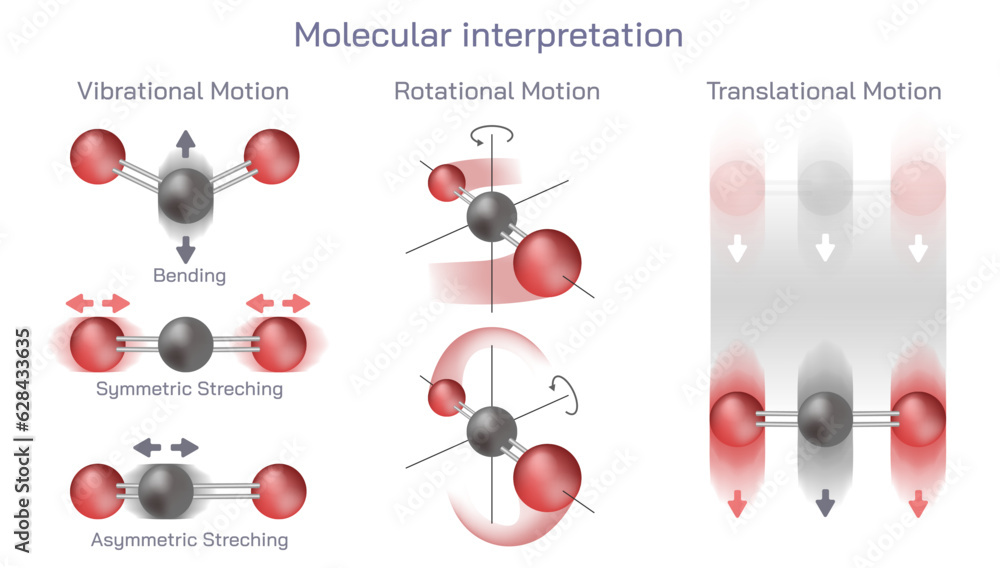
Each accessible translational, rotational, or vibrational quantum state is a component of a possible microstate. The more ways a molecule can move and vibrate, the greater the number of accessible states, and thus, the higher its entropy.
3. Quantifying Molecular Freedom: The Partition Function
Your background in mathematics and quantum chemistry will appreciate that we can formalize the concept of "accessible states." The molecular partition function (q) is a mathematical construct that does precisely this. It is defined as a sum over all possible quantum states (i) of the molecule:
where is the energy of the i-th state. The physical meaning of is profound: it represents the effective number of thermally accessible quantum states for a molecule at a given temperature.
A larger partition function implies more accessible states, which corresponds to a larger number of microstates (W) for the system, and therefore a higher entropy (S). In fact, entropy can be calculated directly from the partition function.
To bridge this concept with organic chemistry, we will now look at a resource that connects the partition function to molecular motion and entropy.
Chapter 15. Statistical Thermodynamics
To see the quantitative link between molecular motion and entropy, we'll examine excerpts from a chapter on Statistical Thermodynamics. This will introduce the partition function and show how it mathematically captures the idea of molecular freedom.
Read the sections titled 'Generalizations Regarding the Partition Function', 'Contributions to Partition Function', and the first two parts of 'Entropy and the Partition Function' (stopping before the Sackur-Tetrode Equation). Your goal is not to memorize the formulas, but to grasp the core ideas: (1) The partition function q represents the number of accessible states. (2) The total q is a product of translational, rotational, and vibrational components (q = q_T * q_R * q_V). (3) Entropy S is directly related to ln(q). Pay attention to how the formulas for each component depend on physical properties like mass, volume, and temperature.
From this reading, we can draw crucial connections:
- Translational Entropy (): Increases significantly with volume and the mass of the particle. This is why gases, which occupy large volumes, have vastly more entropy than liquids or solids.
- Rotational Entropy (): Increases for larger, more complex molecules with larger moments of inertia. It decreases for highly symmetric molecules because many rotations lead to indistinguishable orientations.
- Vibrational Entropy (): Increases as temperature rises, populating more vibrational levels. Molecules with weak bonds (low-frequency vibrations) also have higher vibrational entropy.
4. A Practical Guide to Predicting the Sign of ΔS
With this deep theoretical framework, we can now establish a simple, hierarchical set of rules for qualitatively predicting the sign of ΔS in a reaction. These rules are direct consequences of the principles we've just discussed.
18.2 Entropy | General Chemistry
This video provides a practical, step-by-step method for quickly predicting the sign of ΔS. It organizes the contributing factors into a clear hierarchy.
Watch from 16:52 to 24:34. Focus on the order of operations for making a prediction: 1. Change in moles of gas. 2. Phase changes. 3. Change in number of particles/complexity.
Here is a summary of the predictive hierarchy, connecting each rule back to our fundamental understanding:
-
Change in Moles of Gas (): This is the most dominant factor.
- If (more moles of gas produced), then . This is due to the massive increase in translational entropy as molecules occupy a much larger volume.
- If (fewer moles of gas produced), then .
- Example: C₃H₈(g) + 5O₂(g) → 3CO₂(g) + 4H₂O(g). We go from 6 moles of gas to 7 moles. , so we predict .
-
Phase Changes: If there is no change in the moles of gas, look at phase transitions.
- Processes like melting (solid → liquid), boiling (liquid → gas), and sublimation (solid → gas) all lead to . This reflects the dramatic increase in translational and rotational freedom.
- Conversely, freezing, condensation, and deposition all lead to .
-
Total Number of Moles: If phase and moles of gas are constant, compare the total number of moles of reactants and products.
- If a reaction involves fewer product molecules than reactant molecules (e.g., 2A + B → C), is typically negative. This is because combining particles into one larger unit results in a net loss of translational and rotational freedom for the system as a whole.
- If more product molecules are formed (e.g., A → B + C), is typically positive.
-
Molecular Complexity and Flexibility: If the number of moles is also constant, consider the structure of the molecules.
- A reaction that opens a ring to form a flexible chain (e.g., cyclohexane → hexane) increases entropy (). The chain has more accessible conformations due to free rotation around its single bonds, increasing its rotational and vibrational entropy.
- Conversely, a reaction that forms a ring from a chain decreases entropy ().
Test your understanding!
Predict the sign of ΔS for each of the following reactions and briefly justify your answer.
- The complete combustion of acetylene: 2 C₂H₂(g) + 5 O₂(g) → 4 CO₂(g) + 2 H₂O(l)
- The polymerization of ethene to form a segment of polyethylene: n H₂C=CH₂(g) → -[CH₂-CH₂]n-(s)
- The isomerization of cis-2-butene to trans-2-butene.
Show answer
- Negative (). We start with 7 moles of gas (2 C₂H₂ + 5 O₂) and end with 4 moles of gas (4 CO₂). The product water is a liquid. Since the number of moles of gas decreases significantly (), the entropy change is negative.
- Negative (). This reaction converts many individual gas molecules into a single, large solid polymer molecule. There is a massive decrease in the number of particles and a phase change from gas to solid. Both factors lead to a huge loss of translational, rotational, and conformational freedom.
- Slightly positive (, but likely positive). The number of molecules, phase, and moles of gas are all constant. We are comparing two isomers. The trans isomer is less sterically hindered than the cis isomer. While the symmetry of the trans isomer might slightly lower its rotational entropy, this effect is generally very small. Often, there are subtle differences in vibrational modes, but without more information, we'd predict the entropy change to be very close to zero. In reality, the standard entropy of trans-2-butene is slightly lower than cis-2-butene due to symmetry, making ΔS for this specific reaction slightly negative, but predicting it to be near zero is the correct chemical reasoning at this level.
5. Applications in Organic Chemistry
Let's apply these principles to some classic organic reactions where entropy plays a decisive role.
Example 1: Cycloadditions (The Diels-Alder Reaction)
The Diels-Alder reaction is a powerful tool for forming six-membered rings. Let's analyze its entropy.
The Diels-Alder reaction is a perfect case study for seeing how changes in particle number and conformational freedom affect entropy.
Read the first section about the basic Diels-Alder reaction (butadiene + ethene). Pay close attention to the sign of ΔSº and the two reasons provided for it.
As the text explains, the Diels-Alder reaction has a large, negative ΔSº. This is because:
- Two independent molecules combine to form one. The system loses the translational and rotational freedom associated with one of the molecules.
- A flexible reactant becomes a rigid product. The 1,3-butadiene must adopt a specific cisoid conformation to react, and this rotational freedom is completely lost in the rigid cyclic product. This loss of conformational entropy is a major contributor.
Example 2: The Entropy of Solvation
Our intuition might suggest that dissolving a crystalline solid in water should always increase entropy—after all, a highly ordered lattice is breaking apart. However, the role of the solvent can be surprisingly dominant.
Let's examine a case where our simple intuition about 'disorder' can be misleading: dissolving ionic compounds.
Read the text from the paragraph starting 'From this description of ion formation in solution...' to the end of that section. Focus on the explanation for why the entropy change for dissolving CaF₂ is negative.
This reveals a crucial concept: the overall entropy change is the sum of the change for the solute and the solvent ().
- is positive as the ions break free from the lattice.
- is often negative because polar solvent molecules (like water) must arrange themselves into ordered "solvation shells" around the ions.
For small, highly charged ions like Ca²⁺ and F⁻, the ordering of water molecules is so significant that it outweighs the disordering of the salt lattice, leading to a net negative ΔS for the solution process. This is a powerful example of how the entire system must be considered.
Conclusion
Today we have explored entropy from its statistical foundations to its practical application in predicting reaction behavior. You now have a robust framework for analyzing the entropic contribution to a chemical process.
Key Takeaways:
- Entropy (S) is fundamentally a measure of the number of available microscopic states for a system, as defined by .
- These microstates arise from the translational, rotational, and vibrational "freedoms" of molecules, which are quantified by the partition function ().
- To qualitatively predict the sign of ΔS for a reaction, use this hierarchy:
- Change in moles of gas () is the most important factor.
- Next, consider phase changes (solid → liquid → gas).
- Then, look at the change in the total number of molecules.
- Finally, assess changes in molecular flexibility (e.g., ring formation vs. chain).
- Remember to consider the entropy change of the entire system, including the solvent, as solvation can sometimes lead to a net decrease in entropy.
Preview of the Next Lesson:
We have now investigated both enthalpy (ΔH) and entropy (ΔS). Individually, neither can definitively tell us if a reaction will be spontaneous. In our next lesson, we will combine these two quantities into a single, powerful function called Gibbs Free Energy (ΔG). Using the equation ΔG = ΔH - TΔS, you will be able to predict the spontaneity and equilibrium position of any organic reaction.