Hello! Welcome to Module 4. Over the past few modules, you've built a solid foundation in digital logic, culminating in our last lesson where you learned to describe a synchronous counter using a state transition table. You saw how any sequential circuit can be broken down into two parts: a state register (flip-flops) and next-state logic (combinational gates).
Today, we begin our journey into Verilog, the language used to bring those concepts to life. Our first step is to understand what a Hardware Description Language (HDL) is and, crucially, how it's fundamentally different from the software programming languages you might be familiar with. This lesson is all about shifting your mindset from "writing a program" to "describing a circuit."
1. What is a Hardware Description Language (HDL)?
At its core, a Hardware Description Language, or HDL, is a specialized computer language used to describe the structure and behavior of electronic circuits. Instead of writing a sequence of commands for a processor to execute, you write a textual description of the hardware itself—the components and how they are connected.
Let's start with a short video that offers a great analogy to explain this core purpose.
This video from the CompArchIllinois channel provides a simple, intuitive introduction to the concept of an HDL.
Watch the first 42 seconds. The analogy of describing your bedroom over the phone is a perfect way to think about what Verilog does for circuits.
As the video explains, Verilog allows you to describe a digital circuit in a textual format. This text file becomes the blueprint for the hardware.
2. Describing a Circuit vs. Instructing a Computer
This brings us to the most important distinction between an HDL and a software programming language (like Python or C).
- A Software Programming Language (SPL) is used to write a sequence of instructions that are compiled into machine code and executed sequentially by a processor (CPU).
- A Hardware Description Language (HDL) is used to describe a circuit. This description is then fed into a special tool called a synthesizer.
The synthesizer's job is to interpret your HDL code and convert it into a list of digital logic gates and their interconnections, known as a gate-level netlist. This netlist is the detailed plan used to fabricate the actual physical chip.
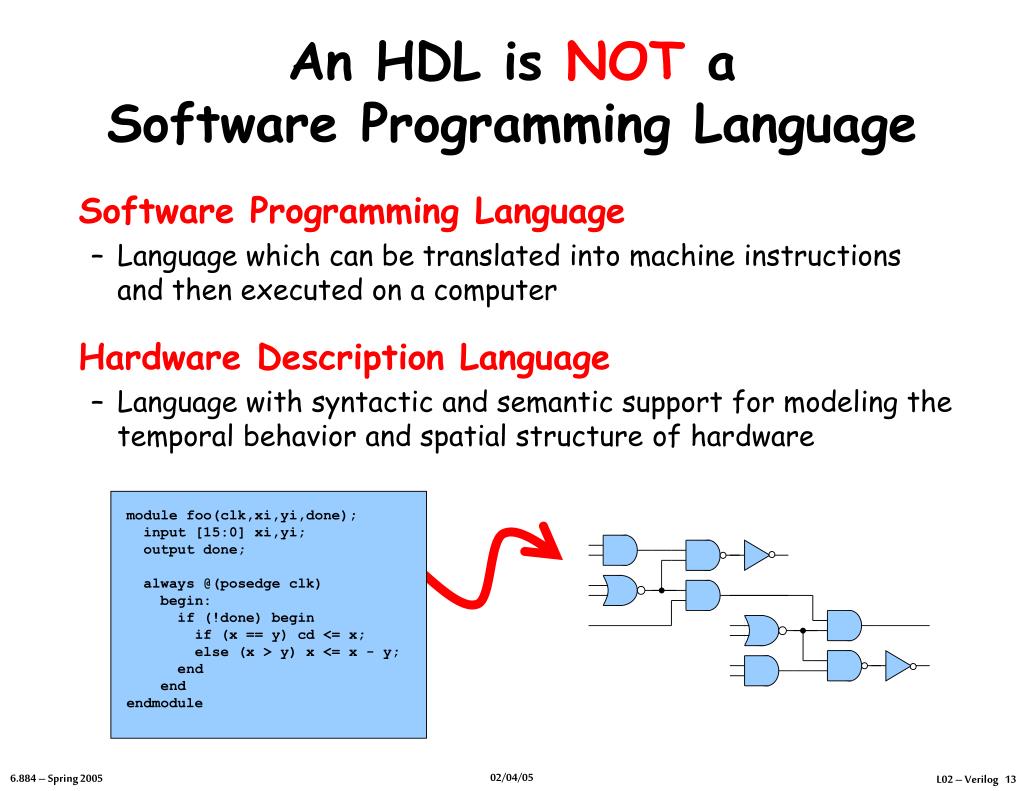
The process of converting HDL code into a gate-level netlist is called synthesis. You can think of it as "compiling for hardware."

3. Key Differences: Concurrency, Abstraction, and Timing
The different purposes of HDLs and SPLs lead to three critical differences in how they work. Understanding these is key to avoiding common mistakes.
For a detailed look at these differences, let's turn to an excellent article that compares them side-by-side.
HDLs Versus Other Programming Languages
This article by Chenna Reddy provides a detailed breakdown of the fundamental differences between HDLs and general-purpose programming languages.
Read the article starting from the section "HDLs vs Other Programming Languages". Focus on understanding these three core differences: Abstraction Levels: Note how HDLs are designed to represent physical components like wires and registers, operating at a lower level of abstraction than most software languages. Concurrency: This is a critical concept. Understand why hardware is inherently parallel and how HDLs are built to model this. Timing: Pay attention to how HDLs incorporate the concept of time and delay, which is mostly absent in software languages.
Let's summarize the key points from that reading.
| Feature | Hardware Description Language (HDL) | Software Programming Language (SPL) |
|---|---|---|
| Primary Purpose | To describe the structure and behavior of a hardware circuit. | To write a sequence of instructions for a CPU to execute. |
| Execution Model | Concurrent (parallel). All gates in the circuit operate simultaneously. | Sequential by default. Instructions run one after another. |
| Core Abstractions | modules, wires, registers (maps to physical hardware). |
variables, functions, objects (abstract computational concepts). |
| Concept of Time | Intrinsic. Used to model delays and synchronous behavior (clocks). | Abstracted by the OS. No built-in notion of hardware timing. |
| End Product | A gate-level netlist for a physical chip (Synthesis). | An executable file with machine code for a CPU (Compilation). |
The most significant mental leap for a programmer is getting used to concurrency. In a circuit, every gate is active at all times. The output of an AND gate doesn't wait for an OR gate somewhere else to finish. HDLs are designed to capture this parallel nature.
4. Common Pitfalls for Programmers
Because of these differences, programmers new to HDLs often fall into a few traps by trying to apply software concepts directly to hardware design. Let's watch another short clip that highlights two of the most common ones.
This follow-up clip from CompArchIllinois explains two common misconceptions programmers have when first learning Verilog.
Watch the clip from this section. Focus on the two key points: Why the order of statements describing connections doesn't change the circuit. This is a direct result of concurrency. How trying to "reuse" a wire is not like reassigning a variable in software; it physically connects multiple things to the same point.
Thinking in terms of physical connections (wires) rather than abstract storage (variables) will help you avoid these issues. When you write HDL code, always try to visualize the circuit you are describing.
Conclusion
This lesson introduced you to the world of Hardware Description Languages and established the crucial conceptual differences between describing hardware and programming software. This foundation is essential as you begin to write Verilog.
Here are the key takeaways:
- HDLs like Verilog are used to describe the structure and behavior of a hardware circuit, not to write a sequence of instructions.
- The end goal of writing synthesizable HDL code is to produce a physical circuit through a process called synthesis.
- The three most critical differences between HDLs and SPLs are:
- Concurrency: Hardware is inherently parallel, and HDLs reflect this.
- Abstraction: HDLs model physical entities like
wiresandregisters. - Timing: HDLs have built-in concepts of time, delay, and clock edges.
Now that you understand the what and why of HDLs, we'll dive into the how. In the next lesson, you will write your very first Verilog module, defining its inputs, outputs, and internal signals. This will be your first practical step in translating the digital logic circuits we've studied into code.