Introduction
In our last lesson, you conducted a competitor UX audit, applying your sharp analytical skills to evaluate existing products. That was an excellent exercise in secondary research—analyzing what's already out there. Now, we're making a crucial shift to primary research, where we learn directly from our users.
This lesson focuses on a cornerstone of user research: crafting a user interview discussion guide. The goal is to move from assumptions about what users want to concrete evidence based on their past experiences and behaviors. Your background in audit, which demands structured inquiry and meticulous documentation, provides an ideal foundation for this task. You'll be building a logical framework to guide a conversation toward uncovering valuable insights.
By the end of this lesson, you will be able to write an effective discussion guide filled with open-ended, unbiased questions that encourage users to share rich, detailed stories.
The Foundation: Objective and Structure
Before writing a single question, you need a clear objective. What, specifically, are you trying to learn from this interview? A well-defined objective acts as your North Star, ensuring every question you ask serves a purpose.
Equally important is understanding that a discussion guide is not a rigid script. It's a semi-structured framework that provides direction while allowing for flexibility. It ensures you cover your key topics but gives you the freedom to explore interesting tangents that the user might bring up.
Writing an Effective Guide for a UX Interview
This article from the Nielsen Norman Group (NN/G) introduces the concept of a semi-structured interview guide and emphasizes the importance of starting with clear research questions.
Read the Introduction and Step 1: Write Your Research Questions. Focus on how the guide provides a flexible structure and why defining your research questions upfront is the essential first step.
Let's watch a short clip that explains how to set an objective that is neither too broad nor too narrow.
How to Conduct a User Interview for UX Designers (in 10 Minutes) - FREE Template Provided
This segment from Mizko's "How to Conduct a User Interview" video clearly illustrates how to scope your research objective.
Watch the section on defining the objective. Notice the examples of objectives that are "too broad" (Do millennials want to make money?) and "too narrow" (What financial apps do millennials use?). The ideal objective sits in the middle, guiding your inquiry without overly restricting it.
The Art of the Unbiased, Open-Ended Question
The quality of your insights is directly tied to the quality of your questions. The best questions are open-ended, neutral, and focused on past behavior rather than future speculation.
1. Avoid Closed and Leading Questions
- Closed questions can be answered with "yes" or "no" (e.g., "Do you like using video recipes?"). They shut down conversation.
- Leading questions subtly push the user toward a specific answer (e.g., "How much do you love our new feature?"). This introduces bias and results in unreliable data.
2. Ask About the Past, Not the Future
- Avoid hypothetical questions like "Would you use a feature that...?" People are poor predictors of their own future behavior.
- Focus on concrete past experiences: "Tell me about the last time you tried a new recipe." This grounds the conversation in reality and uncovers actual behaviors, pain points, and motivations.
The following video does an excellent job of explaining these common pitfalls and how to avoid them.
UX Research: Asking The Right User Interview Questions
This video from the "UX in the Head" channel provides clear, actionable advice on how to ask the right kinds of questions.
Watch these key sections: Introduction: Introduces the power of open-ended questions like "Tell me about a time when...". Avoiding leading questions: This is a critical section. Pay close attention to the definition of a leading question and the strategy to counter one if you accidentally ask it. Avoiding hypothetical questions: This explains why asking about specific past events yields much more valuable data than asking about generalities or future possibilities.
To transform your questions from closed to open, the NN/G article provides some powerful examples.
Writing an Effective Guide for a UX Interview
This section gives you a practical method for crafting story-provoking questions.
Review Step 3: Broaden Your Questions. The examples starting with "Tell me about..." are a template you can use repeatedly to elicit detailed stories from your participants.
Self-Reflection: Checking Your Own Bias
As a researcher, it's crucial to be aware of your own assumptions and attitudes. These can unconsciously shape the questions you ask and how you interpret answers. The B.I.A.S. Framework is a quality control tool that can help you reflect on your own position.

Before finalizing your guide, ask yourself:
- Influence: What am I hoping to prove with this research? Am I subconsciously phrasing questions to confirm my own hypothesis?
- Attitudes: How do my personal experiences with this topic (e.g., as a crafter) shape my beliefs? Am I assuming the user thinks the same way I do?
This reflective step ensures your guide is a tool for genuine discovery, not just confirmation.
Structuring the Discussion Guide: The Funnel Approach
A well-structured interview flows like a natural conversation, moving from broad topics to specific ones. This is often called the "funnel" or "layered" approach. You start with easy, general questions to build rapport and then gradually dive deeper into the core research topic.
This sketchnote provides a great visual overview of an interview's structure and the key do's and don'ts.
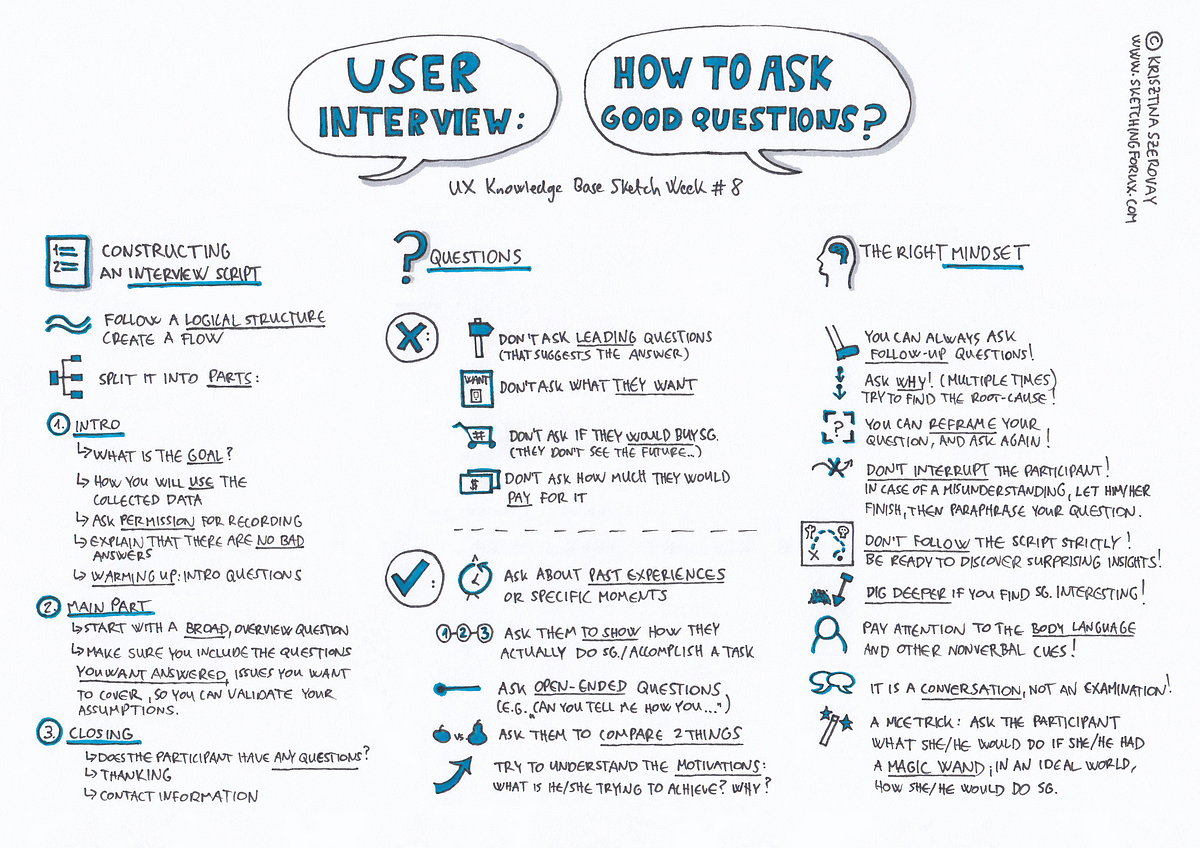
Mizko's video offers a memorable analogy for this funnel structure, comparing it to removing layers of a t-shirt to get to the core.
How to Conduct a User Interview for UX Designers (in 10 Minutes) - FREE Template Provided
This video provides a practical, layered framework for organizing your questions.
Watch these two parts to understand the flow of a guide: The five categories: Follow the "t-shirt" analogy as he moves from broad questions about the user to specific questions about the research topic (personal wealth). This illustrates the funnel structure perfectly. Closing questions: Learn which questions to ask at the end to wrap up the interview professionally and gather any final thoughts.
Here is a standard structure for your discussion guide:
-
Introduction & Warm-up (5 mins):
- Introduce yourself and the purpose of the session (without giving away too much).
- Explain logistics (recording, duration).
- Ask easy, rapport-building questions (e.g., "Tell me a bit about what you do for work/fun.").
-
Broad Context (10 mins):
- Explore the general topic area.
- Example (for your gifting business): "Can you tell me about the last event you helped plan or attended?"
-
Core Topic & Specific Behaviors (20 mins):
- This is the heart of the interview. Use "Tell me about a time when..." questions to explore specific past experiences related to your research objective.
- Example: "Tell me about the last time you bought a personalized gift for someone. Can you walk me through that process from start to finish?"
- Prepare follow-up and probing questions like "Why was that important to you?" or "Can you tell me more about that moment?"
-
Wrap-up & Closing (5 mins):
- Ask if they have any final thoughts or anything they think is important that you didn't cover.
- Ask if they have any questions for you.
- Thank them for their time.
Your Turn: Draft a Discussion Guide
It's time to put this all into practice. You'll draft a short discussion guide for a research study related to your bespoke gifting business.
Your Task (15-20 minutes):
-
Define Your Objective: Start by writing a clear, one-sentence research objective.
- Example Objective: To understand the process, motivations, and challenges people face when searching for and purchasing unique, personalized decor for a major life event (like a wedding or baby shower).
-
Draft Your Guide in a Figma file or document: Following the 4-part structure above, write a draft of your guide.
- Introduction: Write a short script for how you'll open the interview.
- Warm-up: Write one general, rapport-building question.
- Broad Context: Write one question to open up the general topic of event planning or gifting.
- Core Topic: Write three specific, open-ended questions related to your objective. Start them with "Tell me about..." or "Walk me through...".
- Closing: Write one question to wrap up the interview.
-
Review Your Questions:
- Read each question aloud. Does it sound natural?
- Check for bias: Is it open-ended? Does it assume anything? Is it focused on past behavior?
This exercise is about creating a solid first draft. Your guide will evolve as you conduct more interviews, but starting with a strong, unbiased foundation is essential.
Conclusion
Excellent work. You've now learned how to bridge the gap between analyzing a product and understanding the person who uses it. Crafting a user interview guide is a foundational skill that transforms you from a designer who makes things for users into a designer who builds things with users.
Key Takeaways:
- Start with a Clear Objective: Your research goal is the foundation of your entire guide.
- Ask Open-Ended Questions About Past Behavior: "Tell me about a time when..." is your most powerful tool for uncovering authentic stories and insights.
- Avoid Leading, Closed, and Hypothetical Questions: These introduce bias and lead to weak, unreliable data.
- Structure Your Guide Like a Funnel: Start broad to build rapport, then gradually focus on your core topic.
Preview of the Next Lesson:
You've written the script; now it's time to prepare for the performance. In our next lesson, "Conduct a mock user interview to practice active listening and probing techniques," you'll learn how to use your discussion guide in a live setting, focusing on how to listen effectively and ask insightful follow-up questions on the fly.