Introduction
In our previous lesson, you crafted a user interview discussion guide, establishing the foundational "script" for your research. This was a fantastic application of your structured thinking, turning a broad objective into a logical sequence of questions.
Today, we move from preparation to performance. A great discussion guide is essential, but the real magic of an interview happens in the moments between the questions. This lesson is about mastering the art of listening and reacting. Your goal is to learn and practice active listening and probing techniques, which will allow you to go beyond your script and uncover the rich, nuanced insights that lead to great design. Your experience in client management, where understanding spoken and unspoken needs is critical, will be a significant asset here.
The Art of Active Listening
Before you can ask a brilliant follow-up question, you must first truly hear what the user is saying. This is the essence of active listening. It's not just waiting for your turn to talk; it's a focused effort to understand the complete message being sent, including the emotions and context behind the words. Think of it like a client meeting or an audit review—you're listening not just for the facts, but for the hesitations, the emphasis, and the underlying concerns that reveal the true picture.
Let's start with a video that breaks down the core qualities of active listening.
This video from Communication Coach Alexander Lyon provides a clear and concise overview of what active listening is and why it's so important for building connection and understanding.
Please watch the following sections: What is active listening?: Understand the difference between active and passive listening. Non-verbal communication: Pay attention to how you can show engagement and "listen with your eyes." Verbal communication: Note the importance of asking good questions and using small affirmations. Keep the focus on them: This is perhaps the most critical rule for a user interview.
This diagram provides a helpful visual summary of the different facets of active listening you just saw in the video.
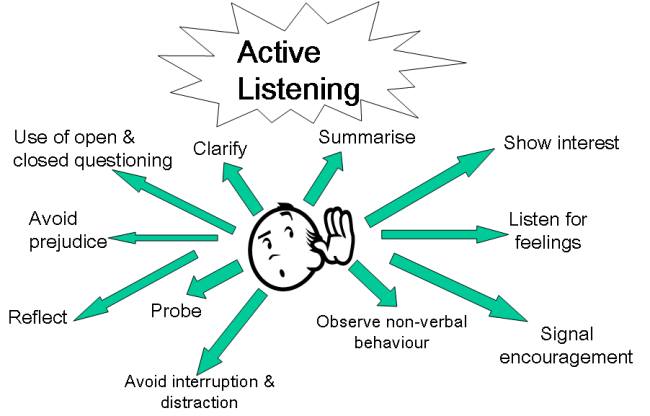
To build on this, let's explore a few key techniques that transform listening from a passive act into a strategic research tool.
The art of active listening - by Lauri Lukka - UX Collective
This article from UX Collective frames active listening as a practical skill for designers and business professionals. It provides a simple four-part framework.
Please read the introduction and the following sections: Start by reading from the beginning until you reach the image showing "The four key techniques in active listening." Then, read Technique 1: Focus your attention to understand the mindset required. Finally, read Technique 3: Paraphrase, which is a powerful method to confirm your understanding.
Paraphrasing, as the article mentions, is a crucial tool. By restating what you heard in your own words (e.g., "So, if I'm understanding correctly, the main issue was..."), you not only confirm your understanding but also show the participant you are truly engaged.
From Listening to Insight: Probing Techniques
Active listening allows you to notice when a user says something particularly interesting, vague, or emotionally charged. Probing is the skill you use to follow that thread and dig deeper. These are the follow-up questions that aren't in your script but often lead to the most valuable discoveries.
Think of this as the investigative part of an audit. When you see an anomaly in the data, you don't just move on; you probe with follow-up questions to understand its origin. The same principle applies here.
Powerful Probing Strategies
There are several effective ways to probe for more detail without biasing the user.
UX Research: Asking The Right User Interview Questions
This video from "UX in the Head," which you saw briefly in the last lesson, offers excellent, practical techniques for digging deeper during an interview.
Let's revisit this resource to focus specifically on probing: Watch from content mining to silence. Pay close attention to asking for specific examples and the strategic use of silence. A few seconds of quiet can prompt a user to elaborate in ways a direct question might not. Now watch the section on the LSD approach (Listen, Summarize, Dig Deeper). This is a simple but effective mental model for structuring your follow-ups.
The dscout article below provides a fantastic toolkit of specific phrases and mindsets for effective probing.
Dig Deeper on 1-1 Interviews with Insightful Follow-Up ...
This article by Nikki Anderson is a masterclass in the art of the follow-up question. It gives you both the mindset and the exact phrasing to use.
Read the following sections carefully: ✔ Develop a sense of curiosity: This is the foundational mindset for a great interviewer. ✔ Use active listening: Focus on the "mirroring" technique. It's a simple, powerful way to get someone to elaborate without asking a direct question. ✔ Probe subjective or vague words and phrases: This is one of the most important skills. When a user says something was "easy," "frustrating," or "confusing," you need to find out what that really means to them. ✔ Put these into practice: This section is your cheat sheet. Internalize phrases like "Tell me more about...", "Explain what you mean by...", and "In what sense?".
Your Turn: Conduct a Mock Interview
Now it's time for the "action-first" part you prefer. Let's simulate a short interview conversation. You will use the discussion guide you drafted in the previous lesson about your bespoke gifting business.
I will play the role of your user, Priya.
- Persona: Priya is a 32-year-old marketing manager who is planning her sister's baby shower. She wants the event to feel unique and personal, not like something from a party-supply store. She's feeling stressed because she's overwhelmed by generic options online and is worried about the quality and cohesiveness of items from different sellers.
Your Task:
Below, I will provide Priya's response to one of your core questions. Your job is to act as the interviewer and respond with an effective probing question.
You (Interviewer): "Tell me about the last time you were searching for decor for a special event."
Priya (User): "Oh, wow. It's what I'm doing right now for my sister's baby shower, and it's been a real headache. I spent all of Sunday scrolling through Pinterest and Etsy. I found a few things that were okay, I guess, but the whole process was just... frustrating."
1. Your first probing question:
Based on Priya's response, what would you ask next? Use a technique you've just learned (e.g., mirroring, probing a subjective word, "tell me more..."). Write your question below.
*(Take a moment to write your question before revealing the next part.)*
My Response as Priya
Excellent. Let's say you asked, *"You mentioned the process was 'frustrating.' Can you tell me more about what was frustrating for you?"*
Here is my response as Priya:
Priya (User): "Well, there are thousands of options, and they all start to look the same. But my main frustration is the uncertainty. You see these beautiful photos, but you have no idea what the quality is actually like. I'm worried about spending money on something that looks cheap when it arrives. It feels like a gamble."
2. Your second probing question:
Priya has given you more detail, mentioning "uncertainty" and "quality." What would you ask her now to dig even deeper into this specific pain point? Write your second probing question below.
*(Take a moment to write your second question.)*
Example of a strong second question
A great follow-up here might be: *"Walk me through what you did when you found an item you liked but felt that sense of 'uncertainty' about the quality."*
This question is effective because it asks for a specific past behavior, forcing Priya to recall a concrete story rather than speaking in generalities. This is how you get to the rich details of a user's experience.
Conclusion
Fantastic work. You've just taken the crucial step from writing questions to guiding a conversation. This mock exercise demonstrates how active listening and sharp probing techniques work together to uncover the "why" behind a user's actions and feelings. This is the heart of user research—it's not an interrogation, but a guided conversation built on curiosity and empathy.
Key Takeaways:
- Active Listening is Foundational: You must be fully present, focused, and observant to catch the cues that signal an opportunity to dig deeper.
- Probing Unlocks Insights: Your most valuable data will often come from follow-up questions that aren't in your script. Get comfortable with phrases like "Tell me more," "In what sense," and simply mirroring a user's words.
- Probe Vague and Emotional Language: Words like "easy," "frustrating," or "confusing" are signposts pointing toward important pain points or delights. Always ask for the story behind them.
Preview of the Next Lesson:
You've now learned how to gather raw data from a user. But what do you do with it? In our next lesson, "Extract key user insights, quotes, and pain points from a mock interview recording," we will focus on analysis and synthesis. You'll learn how to sift through an interview transcript to identify patterns and pull out the actionable insights that will inform your design decisions—a process that will feel very familiar to your background in audit and analysis.