Welcome back! In our first lesson, we established the fundamental properties of electric charge and distinguished between conductors, with their sea of mobile electrons, and insulators, where charges are fixed. This understanding of charge mobility is the key to our topic today.
This lesson will focus on the practical methods for charging objects. We will explore the three primary mechanisms of charge transfer and redistribution: friction, conduction, and induction. By the end of this session, you will be able to explain the physical process behind each method and, crucially, predict the resulting charge and its distribution on the objects involved. This is a core conceptual skill that underpins much of electrostatics.
1. Charging by Friction (Triboelectric Charging)
The simplest way to charge an object is often by rubbing it against another. You've experienced this when rubbing a balloon on your hair or shuffling your feet on a carpet. This process, known as triboelectric charging or charging by friction, is most effective between two different insulating materials.
When two materials are rubbed together, the friction provides energy to overcome the forces binding some electrons to their atoms. However, different materials have different affinities for electrons. One material will hold onto its electrons more tightly than the other. Consequently, electrons are transferred from the material with lower electron affinity to the one with higher affinity.
Electrostatics: Charging by Conduction, Induction, and Friction - StickMan Physics
This article from StickMan Physics explains the concept of electron affinity and how it governs charging by friction.
Please read the section titled Charging By Friction. Focus on the definitions of greater and lesser affinity and how this determines which object becomes negative and which becomes positive. Also, review the example problem to see how the principles of charge conservation and quantization, which we discussed last lesson, apply here.
As the reading highlights, this process perfectly adheres to the law of conservation of charge. No new charge is created. Electrons are simply moved from one object to the other. If a plastic comb gains electrons from your hair, the comb acquires a net charge of C, and your hair acquires an equal and opposite net charge of C. The total charge of the hair-comb system remains zero.
2. Charging by Conduction
While friction is common for insulators, charging a conductor typically involves direct contact with another charged conductor. This process is called charging by conduction.
Imagine you have a negatively charged metal sphere and a neutral metal sphere. Since they are conductors, they both contain mobile electrons. When you touch them together, the excess electrons on the charged sphere, repelling each other, will spread out over the combined surface of both spheres. Some electrons physically move from the charged sphere to the neutral one. When the spheres are separated, both are left with a net negative charge.
Key characteristics of charging by conduction:
- It requires physical contact.
- It works with conductors.
- The object being charged acquires the same type of charge as the object used to charge it.
If the two conductors are identical in size and shape, the total charge will be shared equally between them. Let's see this principle applied in a quantitative example.
Closer Look: Friction, Conduction, and Induction | Physics in Motion
This segment from GPB Education provides a clear walkthrough of charging by conduction, including a worked example involving two identical metal spheres.
Please watch the section on conduction from this timestamp. Pay close attention to the reasoning for why electrons move and how the final charge is calculated when the spheres are identical. Note the crucial point that protons are fixed in the metal lattice and do not move.
As the video demonstrated, if a sphere with charge touches an identical neutral sphere (charge 0), electrons flow from the neutral sphere to the charged one to partially neutralize the positive charge. The total charge is conserved and spread across both, leaving each with a final charge of .
3. Charging by Induction
The most subtle and conceptually rich charging method is induction. This method allows you to charge a conductor without touching it with the charging object. The result is that the conductor acquires a charge opposite to that of the object used to induce the charge.
The process relies on two key steps we've already discussed: the polarization of a conductor by a nearby charge, and the use of a ground connection.
The Principle of Induction
Let's break down the process. Imagine you bring a positively charged rod near a neutral, isolated conducting sphere.
- Polarization: The positive rod attracts the mobile electrons in the sphere. These electrons migrate towards the side of the sphere closer to the rod. This leaves the opposite side of thesphere with a deficit of electrons, and thus a net positive charge. The sphere is now polarized, but still has an overall net charge of zero.
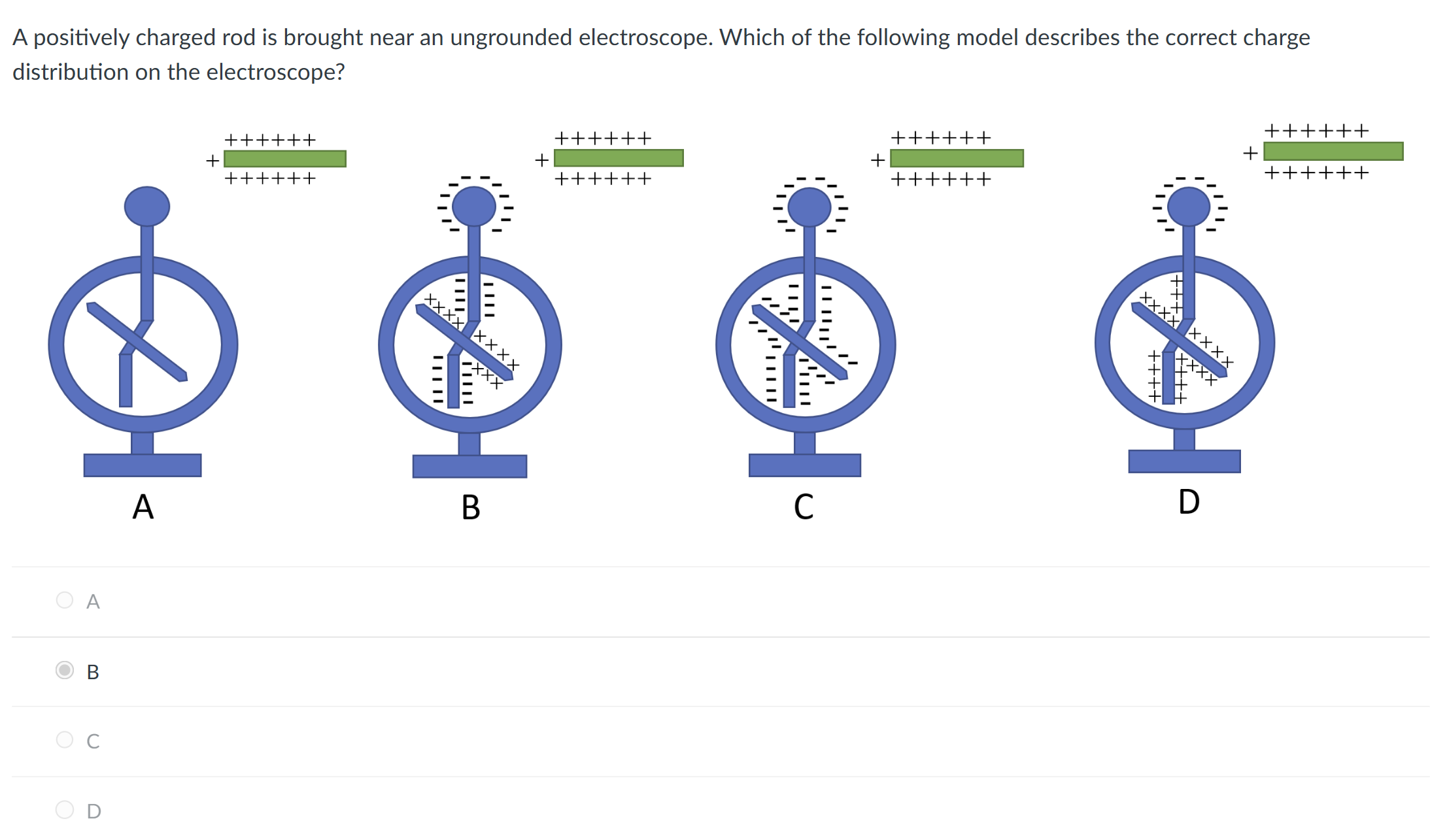
The correct model is B. The free electrons in the conductive electroscope are attracted toward the positive rod, accumulating in the top knob. This leaves the bottom leaves with a net positive charge, causing them to repel each other. This separation of charge is the essence of polarization.
To permanently charge the sphere, we need to add or remove electrons. This is where grounding comes in. A ground is an object so large (like the Earth) that it can act as a nearly infinite source or sink for electrons.
Charging a Single Conductor by Induction
Let's continue with our positive rod and neutral sphere.
2. Grounding: While the rod is held near the polarized sphere, we touch the far side of the sphere with a finger or a wire connected to the ground. The far side is positively charged and strongly attracts electrons. Electrons will flow from the ground, up through the wire/finger, and onto the sphere, neutralizing the positive charge on that side.
3. Removing the Ground: The ground connection is removed while the charged rod is still in place. The electrons that flowed from the ground are now trapped on the sphere, held there by the attraction of the positive rod. The sphere now has a net negative charge.
4. Removing the Rod: Finally, the rod is pulled away. The excess electrons, no longer attracted to the rod, repel each other and spread uniformly over the surface of the sphere, leaving it with a permanent net negative charge.
Charging a Two-Sphere System
A variation of this method uses a second conductor to act as the ground.
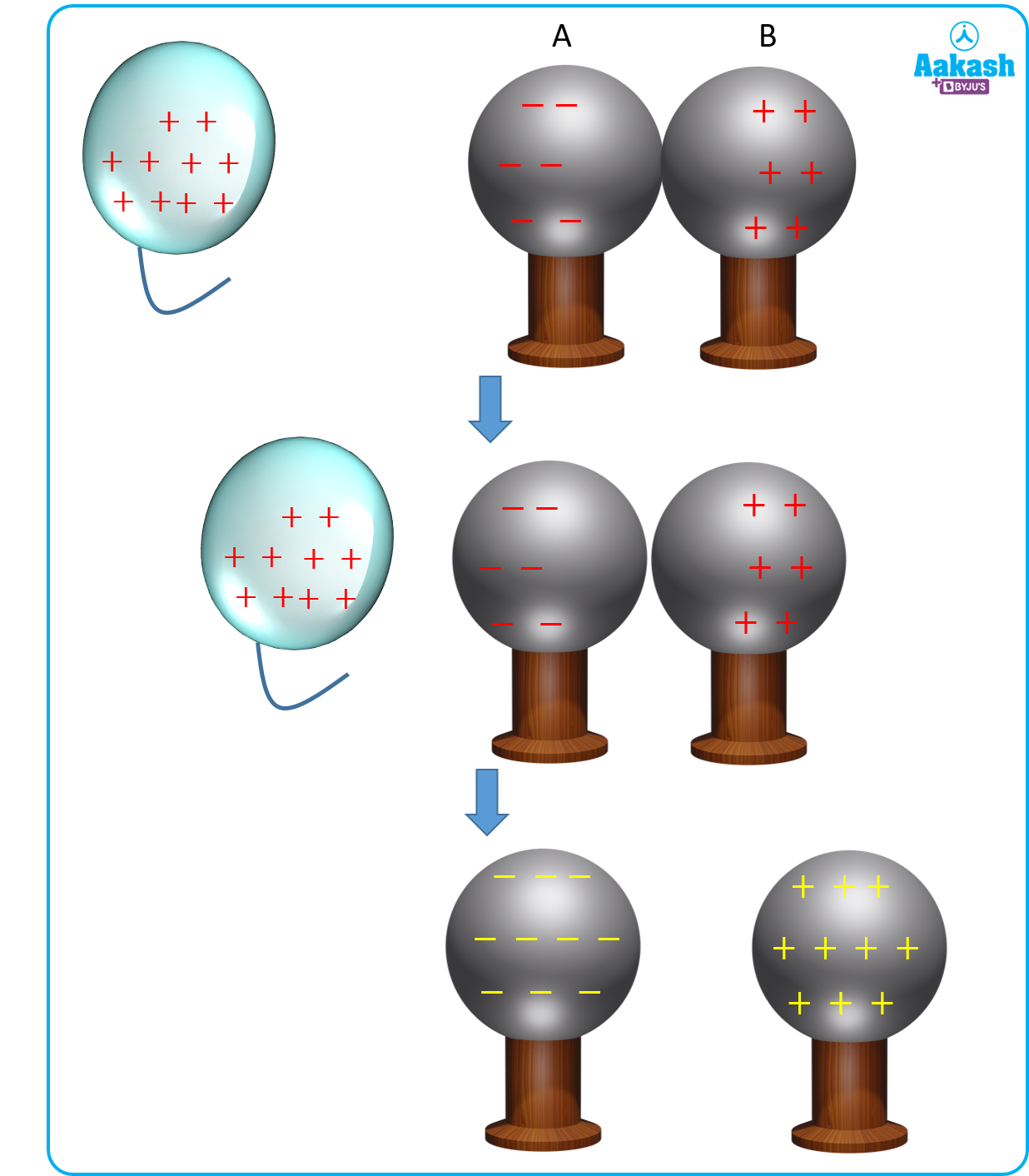
The process shown in the image is a classic demonstration.
- Two neutral conducting spheres are in contact.
- A charged object (e.g., a positive balloon) is brought near one sphere. This polarizes the entire two-sphere system, drawing electrons from the far sphere into the near sphere.
- While the balloon is held in place, the spheres are separated. The near sphere is now trapped with excess electrons (net negative), and the far sphere is left with a deficit of electrons (net positive).
- The balloon is removed. The charges on each sphere redistribute uniformly over their surfaces.
To master the details of these processes, the following reading is highly recommended. It provides a step-by-step breakdown with excellent diagrams for various scenarios.
Charging by Induction - The Physics Classroom
This comprehensive guide from The Physics Classroom details the process of charging by induction, covering both the two-sphere method and the single-sphere-with-ground method.
Start by reading about charging a two-sphere system, which matches the image we just saw. Then, read the section on what happens when using a positive object. Finally, and most importantly, study the section on the importance of a ground when charging a single sphere. Focus on the sequence of events and the direction of electron flow in each case.
Summary of Charging Methods
It's crucial to have a clear mental model for each charging method. The following table summarizes their key differences.
| Method | Mechanism | Materials | Contact | Final Charge |
|---|---|---|---|---|
| Friction | Electron transfer due to different electron affinities. | Typically insulators. | Yes (rubbing). | Objects become oppositely charged. |
| Conduction | Charge sharing upon contact. | Conductors. | Yes (touching). | Object acquires the same charge. |
| Induction | Polarization followed by grounding. | Conductors. | No (proximity). | Object acquires the opposite charge. |
Conclusion
In this lesson, we have moved from the static properties of charge to the dynamic processes of charging objects. We have dissected the three main methods:
- Charging by Friction: Transfer of electrons between two rubbed insulators, resulting in opposite charges.
- Charging by Conduction: Sharing of charge between two touching conductors, resulting in the same type of charge.
- Charging by Induction: Using a nearby charged object to polarize a conductor, which is then grounded to produce a permanent, opposite charge.
A firm grasp of these mechanisms, especially the electron movements involved, is essential for tackling conceptual problems in electrostatics.
In our next lesson, we will quantify the interaction between charged objects. Now that we know how to create and manipulate charge, we will introduce Coulomb's Law, the fundamental law that describes the magnitude and direction of the electric force between point charges.