Welcome back. In our previous lessons, we explored the nature of electric charge and the methods used to charge objects. Now that we understand how to create systems of static charges, the next logical step is to quantify the forces they exert on one another.
This lesson introduces one of the cornerstones of electromagnetism: Coulomb's Law. We will go beyond a simple formula and formulate the law in its full vector form, which is essential for accurately describing both the magnitude and direction of the electric force. We will then introduce the superposition principle, a powerful idea that allows us to calculate the net force on a charge even in the presence of many others. Your proficiency with vectors will be particularly useful here as we break down complex problems into manageable components.
1. Coulomb's Law: The Force Between Charges
The French physicist Charles-Augustin de Coulomb experimentally determined the law governing the force between two stationary point charges in the 1780s. In its simplest (scalar) form, it states that the magnitude of the force is directly proportional to the product of the magnitudes of the charges ( and ) and inversely proportional to the square of the distance between them.
The constant , known as Coulomb's constant, is approximately .
While this formula gives the magnitude, it doesn't specify the direction. Force is a vector, and a complete description requires vector notation. This is where the vector form of Coulomb's Law becomes indispensable.
The Vector Form
To express Coulomb's Law as a vector, we need to define the positions of our charges. Let's say charge is at a position given by the vector and charge is at position , both relative to some origin. The force exerted by on , which we denote as , depends on the displacement vector pointing from to , which is .

The vector form of Coulomb's Law is:
Here, is the magnitude of the displacement vector (the distance), and is the unit vector that points from to . It's defined as .
One of the most elegant aspects of this formulation is that the signs of the charges automatically determine the correct direction.
- If and have the same sign (both positive or both negative), their product is positive. The force is then parallel to , pointing away from . This is repulsion.
- If they have opposite signs, is negative. The force is antiparallel to , pointing back toward . This is attraction.
The following video provides an excellent animated breakdown of how to construct the vector form of Coulomb's Law from these principles.
coulomb's law in vector form | coulomb's law in vector form derivation class 12 | physics animation
This animation from the 'Physics and animation' channel derives the vector form of Coulomb's law step-by-step.
Watch the segments from the beginning up to the final derivation. Pay close attention to how the displacement vector (\vec{r}_{21}) and the unit vector (\hat{r}_{21}) are defined, and how they are used to build the final, complete vector equation for the force.
As the video shows, substituting the definition of the unit vector gives an alternative and very useful form:
This form is often more convenient for calculations, as you can work directly with the components of the displacement vector . Also, note that by Newton's third law, the force exerted by on is simply .
2. The Principle of Superposition
Coulomb's Law describes the interaction between two point charges. But what happens if we have three, four, or a million charges? The answer lies in the Principle of Superposition.
The principle states that the net electrostatic force on any given charge in a system of charges is the vector sum of the individual forces exerted on it by all the other charges.
Crucially, the force between any two charges ( and ) is calculated using Coulomb's Law as if the other charges were not there. This is a remarkable feature of the electric force.
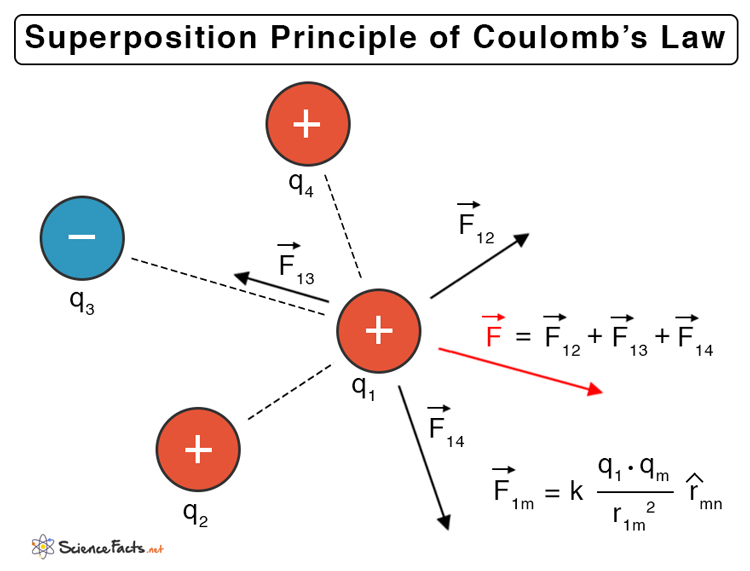
To solidify your understanding of the formal definitions of both Coulomb's Law and the superposition principle, please review the following text.
These notes from MIT OpenCourseWare provide a formal, university-level treatment of the topic.
First, read Section 2.2, Coulomb's Law, for a concise statement of the vector formula. Then, read Section 2.3, Principle of Superposition, and study the setup of Example 2.1, which illustrates how the vector sum is constructed.
3. Problem Solving with Superposition
The superposition principle provides a clear strategy for calculating the net force on a charge. Since you are comfortable with vector algebra, this process should feel systematic.
The Strategy:
- Draw a Diagram: Sketch the positions of all charges and label them. Identify the charge on which you want to find the net force.
- Calculate Individual Forces: For each other charge in the system, determine the force vector it exerts on your target charge using the vector form of Coulomb's Law. It's often easiest to find the magnitude first, then determine the direction (or vector components).
- Decompose into Components: Resolve each individual force vector into its x, y, and (if necessary) z components. This is the crucial step where you will use trigonometry.
- Sum the Components: Add the x-components of all the force vectors to get the x-component of the net force (). Do the same for the y- and z-components.
- Find the Resultant: Combine the components of the net force to find its final magnitude (using the Pythagorean theorem) and direction (using the arctangent function).
The following video provides an excellent, detailed walkthrough of this entire process for a common exam-style problem.
Coulomb's Law (7 of 7) Force on Three Charges Arranged in a Right Triangle
This video from 'Step by Step Science' solves for the net force on a charge in a right-triangle configuration.
Watch the full video. The first part focuses on determining the directions of the forces qualitatively (attraction vs. repulsion). The second part applies Coulomb's Law to find the magnitudes of the individual forces. The third part is key: it shows how to decompose the forces into components and sum them. The final part uses the net components to calculate the final magnitude and direction of the resultant force.
To challenge yourself further, you can apply this method to more complex geometries. The following reading provides worked examples for different arrangements of charges.
02. Coulomb force in 2D. Electric field. Superposition principle
These lecture notes from the University of Rhode Island contain several excellent, challenging problems solved in detail.
First, quickly review the two-charge example on pages 1-2 (the first two pages) to see the component method in action again. Then, focus on the problem on page 3 titled "Coulomb Force in Two Dimensions (4)". This is a classic problem involving four charges. Work through the logic of how the horizontal, vertical, and diagonal forces are calculated and combined. As an additional challenge, look at the equilibrium problem on page 4, "Coulomb Force in Two Dimensions (5)". This problem beautifully integrates electrostatics with mechanics (forces in equilibrium), requiring you to balance electric force, gravity, and tension. This is a very common type of ESSLCE question.
Conclusion
In this lesson, we have developed the tools to precisely calculate the forces within a system of static charges. The key takeaways are:
- Coulomb's Law in vector form () provides a complete description of the electric force, automatically handling both magnitude and direction.
- The Superposition Principle allows us to find the net force on a charge from a group of other charges by simply taking the vector sum of the individual forces.
- The practical method for solving these problems involves a systematic process of decomposing each force vector into components, summing the components, and then reconstructing the resultant vector.
We have described the electric force as an "action at a distance." In our next lesson, we will introduce a more powerful and profound concept: the electric field. We will see that charges don't interact directly; instead, they create an electric field in the space around them, and it is this field that exerts a force on other charges. This shift in perspective will be crucial for understanding all subsequent topics in electricity and magnetism.