Hello! In our last lesson, we mastered the use of Coulomb's Law and the superposition principle to calculate the net force on a charge from a collection of other charges. We treated this force as an "action at a distance," where charges interact directly with each other across empty space.
Today, we will introduce a more powerful and profound concept: the electric field. Instead of charges interacting directly, we will see that a charge creates an electric field in the space surrounding it. It is this field, a property of space itself, that then exerts a force on any other charge placed within it. This shift in perspective is fundamental to all of electromagnetism.
Our goal is to define the electric field vector, learn how to calculate the field produced by individual point charges, and then use the superposition principle—which you're already familiar with—to find the total electric field from a system of multiple charges.
1. From Force to Field: A New Perspective
The idea of a field helps us move away from the slightly mysterious notion of "action at a distance." The gravitational field is a concept you are likely familiar with. The Earth doesn't directly "pull" on the Moon; rather, the Earth's mass generates a gravitational field throughout space. The Moon then interacts with the field at its location, and that interaction is what we perceive as the force of gravity.
We can apply the exact same logic to electric charges.
An electric charge creates an electric field in the space around it. If we then place a small, positive "test charge" at some point in this field, it will experience an electric force . The electric field at that point is defined as the force experienced by the test charge divided by the magnitude of the test charge itself.
The unit of the electric field is newtons per coulomb (N/C). This definition is the cornerstone of our lesson. It tells us that the field at a point is the "force per unit charge" that would be experienced there. The field exists independently, whether we place a test charge there to measure it or not.
Conversely, and most usefully, if we know the electric field at a point in space, the force on any charge placed at that point is simply:
Notice that if the charge is positive, the force is in the same direction as the field . If is negative, the force is in the opposite direction to the field.
The following reading explains this concept clearly, drawing the parallel with the gravitational field.
This text from the Physics LibreTexts project provides a concise introduction to the electric field concept.
Read the first four paragraphs, from the start down to the equation for the force on a test charge. Focus on the definition of the electric field and how it relates force and charge.
2. The Electric Field of a Point Charge
Now that we have defined the electric field, let's find the field created by the simplest object: a single point charge .
We start with what we know from the last lesson: the force exerted by a source charge on a test charge at a distance is given by Coulomb's Law:
where is the unit vector pointing from to .
Using our new definition, , we simply divide by :
This is the electric field of a point charge . Notice that it only depends on the source charge and the distance ; the test charge has vanished, as it should.
Your strong background in vector calculus makes the alternative form, , a powerful tool. The following video provides a masterful and thorough breakdown of how to calculate the electric field vector from a point charge, covering both the intuitive trigonometric approach and the formal vector component approach.
Electric Field Vector Formula With R-Hat Vector and Position Vector - College Physics
This video from 'The Organic Chemistry Tutor' gives a detailed walkthrough of calculating the electric field vector.
This video is exceptionally clear, and I recommend watching it in segments to absorb the concepts. Old-Fashioned Way: First, watch how to find the field's magnitude and direction separately using the familiar E = kQ/r^2 and trigonometry. Component Form: Next, see how to express this result in terms of i and j unit vectors. Unit Vector Explained: This part is crucial. Pay close attention to the explanation of the unit vector \hat{r} and its role in defining direction. Calculating \hat{r}: Watch the two methods for calculating the unit vector, either from the position vector components or from the angle. Putting it Together: Finally, see how the formal vector formula is used to arrive at the same component-form answer as before. The final summary section starting at 18:43 is an excellent review of all the vector definitions involved.
3. The Superposition of Electric Fields
What if we have multiple source charges? Just as with electric forces, electric fields obey the principle of superposition.
The total electric field at any point in space is the vector sum of the electric fields produced by each individual source charge.
Each individual field is calculated using as if it were the only charge present.
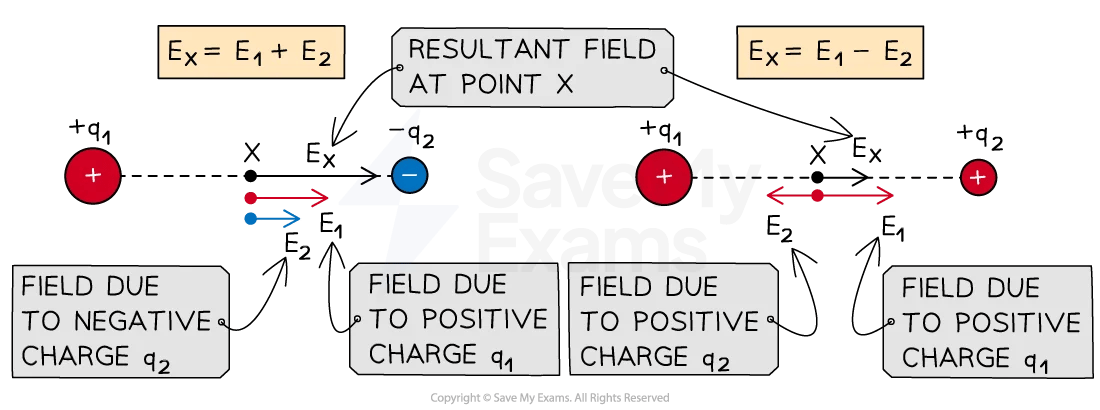
This means the problem-solving strategy you learned for calculating net force can be directly applied to calculating the net electric field.
4. Calculating the Net Electric Field
Let's put this all together to solve a typical problem. The strategy is:
- Draw a Diagram: Sketch the charge configuration and the point P where you want to find the field.
- Individual Fields: For each source charge , draw the electric field vector at point P. Remember, it points away from positive charges and towards negative charges.
- Components: Calculate the magnitude of each field, . Then, using trigonometry, find the x and y components of each field vector.
- Vector Sum: Add all the x-components to get and all the y-components to get .
- Resultant Field: Calculate the magnitude and direction of the net field using and .

Let's walk through a complete example.
Let's return to the Physics LibreTexts page and work through a quantitative example.
Find and study Example 16.3.1, which begins with the problem statement. Follow the solution carefully. Observe how it follows the exact strategy outlined above: The magnitudes E_1 and E_2 are calculated first. Each vector is broken down into its x and y components using cosine and sine. The components are summed to find the components of \vec{E}_{\text{net}}. Finally, it's shown how this net field can be used to find the force on any charge placed at that corner.
To see another excellent demonstration of this process, especially one that emphasizes the pure vector notation from the start, the following video is highly recommended. It tackles a similar problem but frames it entirely in terms of position vectors, which can be a very efficient and powerful method.
Electric field produced by 2 point charges (vector example)
This video by Craig W Looney shows how to solve a two-charge problem using formal vector methods.
Watch the entire video. Pay attention to how he: Outlines the plan based on the superposition principle. Calculates \vec{E}_2 for the simpler charge first. Calculates \vec{E}_1 using the more general vector form \vec{E} = kQ \vec{r}/r^3. This is a key part that connects directly to your vector skills. Combines the results to get the net field and emphasizes that it is a vector sum, not a sum of magnitudes.
For more practice, the document Physics 1100: Electric Fields Solutions provides numerous solved problems that follow this same component-based method. The first problem is a great one to review if you want to see the strategy applied one more time.
Conclusion
In this lesson, we have made a crucial conceptual leap from forces to fields. This is a more abstract but ultimately more powerful way of understanding electrostatic interactions.
Here are the key takeaways:
- The electric field is a vector field that permeates the space around charges. It is defined as the force per unit charge: .
- A point charge creates an electric field given by . The field points away from positive charges and towards negative charges.
- The superposition principle holds for electric fields: the net field at a point is the vector sum of the fields from all individual source charges.
- The process for calculating the net field is a direct application of vector addition: decompose individual field vectors into components, sum the components, and reconstruct the resultant vector.
In all the problems today, we've dealt with a handful of discrete point charges. What happens if you have billions of charges packed together, forming a continuous line, a flat sheet, or a solid sphere? You can't sum them one by one. In our next lesson, we will see how your knowledge of calculus allows us to transition from a discrete sum () to a continuous integral (), enabling us to calculate the electric field for continuous charge distributions.