Hello! Welcome to your first lesson on Electricity and Magnetism. We're starting a journey that will take us from the fundamental nature of electric charge all the way to the principles behind electric motors and power generation.
This initial lesson is all about building a solid foundation. We will explore the most fundamental concept in this field: electric charge. By the end of our session, you'll be able to describe the core properties of charge—specifically, that it is conserved and quantized—and you'll understand the crucial distinction between materials that conduct electricity and those that don't, known as insulators. Let's begin by getting an overview of these foundational concepts.
What is Electric Charge?
At its heart, electricity is all about the behavior of electric charges. These are not just abstract concepts; they are a fundamental property of the matter that makes up everything around us, including ourselves.
To get a bird's-eye view of the topics we'll cover today, take a look at the following infographic. It neatly summarizes the key ideas about electric charge, its properties, its carriers, and how it behaves in different materials.
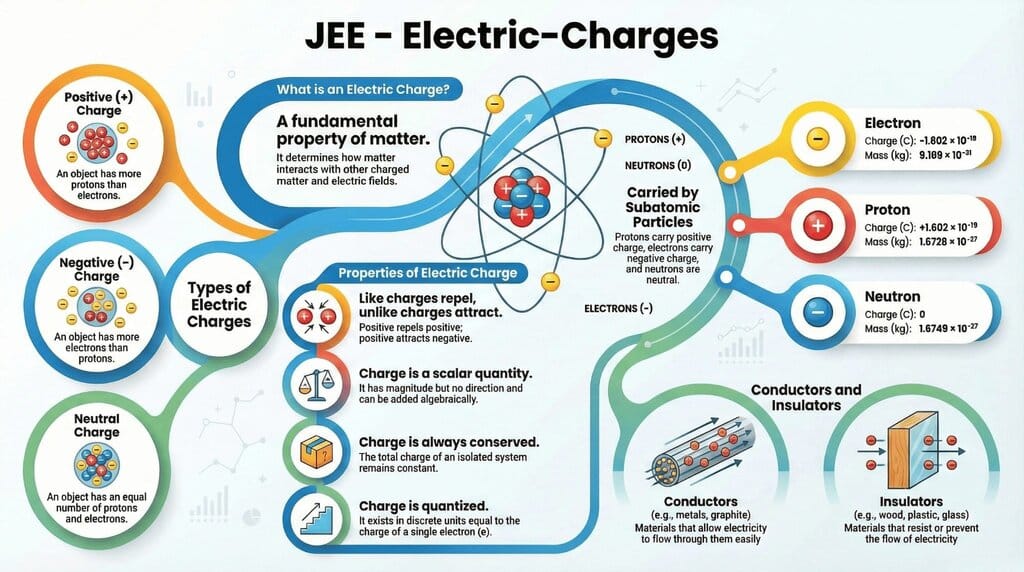
As the infographic shows, there are two types of electric charge: positive and negative. The most basic rule governing their interaction is that like charges repel and unlike charges attract. This simple principle is the starting point for all of electrostatics.
To see these principles in action and build some intuition, let's watch a short video with some engaging demonstrations.
Electric Charge, Law of Charges, and Quantization of Charge
This video from Flipping Physics uses simple household items to demonstrate the attraction and repulsion of charges.
Pay close attention to the interactions between the charged balloon, the rubber rod, and the glass rod from the beginning to the demonstration's end. This will help you visualize the "law of charges."
The video introduces the idea that rubbing objects together can transfer charge. An object becomes "charged" when it has an imbalance of positive and negative charge carriers. In most materials, the positive charges (protons) are locked within the atomic nuclei, while the much lighter negative charges (electrons) can sometimes move. An object with more electrons than protons has an excess negative charge, while one with fewer electrons than protons has an excess positive charge.
To delve deeper into the historical discovery of these charge carriers and formalize our understanding, the following reading is helpful.
18.1 Electrical Charges & Conservation of Charge
This text from Texas Gateway provides a brief history of the discovery of electric charge, from early observations to the identification of the electron and proton.
Please read the section titled "Electric Charge." Focus on how scientists deduced the existence of two charge types and identified the fundamental carriers of negative and positive charge.
The Two Pillars: Conservation and Quantization
Now that we have a feel for what charge is, let's examine two of its most fundamental and unwavering properties: charge is conserved, and charge is quantized.
1. Conservation of Charge
The law of conservation of charge is one of the bedrock principles of physics. It states that electric charge cannot be created or destroyed, only transferred from one object to another. In any closed system, the total amount of electric charge remains constant.
You can think of this like accounting for money. You can move money from your savings account to your checking account, but the total amount of money you have doesn't change (unless you make an external transaction). Similarly, rubbing a balloon on your hair doesn't create new charge; it just moves electrons from your hair to the balloon.
The following video provides an excellent, clear explanation of this law and works through a practical example.
Law of Conservation of Electric Charge
This video from The Organic Chemistry Tutor explains the law of conservation of charge with a clear, step-by-step problem.
Watch the first part of the video, from the introduction to the end of the first example. This will solidify the concept of charge conservation. Then, watch the follow-up explanation from this timestamp, where the narrator explains why electrons are the mobile charges in metals—a key idea we'll return to shortly.
The total charge before the interaction was . After the interaction, the total charge must be the same: . The charge is conserved.
2. Quantization of Charge
The second pillar is the principle of quantization. This means that electric charge exists in discrete packets, rather than in continuous amounts. The smallest unit of free charge ever observed is the charge of a single electron or proton. This fundamental amount of charge is called the elementary charge, denoted by the symbol .
Its value is approximately Coulombs (C), where the coulomb is the SI unit of charge.
The charge on any object, , must be an integer multiple of this elementary charge:
where is an integer (..., -2, -1, 0, 1, 2, ...). You can have an object with a charge of or , but you can never have an object with a charge of or . Charge doesn't come in fractions of .
The following video does an excellent job of explaining this concept.
Electric Charge, Law of Charges, and Quantization of Charge
Let's return to the Flipping Physics video to understand the elementary charge and the concept of quantization.
First, watch the segment that defines the elementary charge from this section. Then, jump to the part from this section, which poses a critical question about whether a certain charge is possible. This example beautifully illustrates what "quantized" means in practice.
As the video makes clear, because matter is made of an integer number of protons and electrons, the total charge must be an integer multiple of .
A Conceptual Challenge
Here is a question to test your understanding of quantization, a concept you'll frequently encounter in exam questions.
An experimenter claims to have measured a net charge of C on a small oil drop. Based on your knowledge of charge quantization, is this claim credible? Explain your reasoning.
Think about this for a moment. To check the claim, you would calculate the number of elementary charges this corresponds to:
Since is not an integer, the claim is not credible. An object can have one excess electron or two, but it cannot have one and a half.
Conductors and Insulators
Finally, let's connect these ideas to the familiar concepts of conductors and insulators. You already know that metals conduct electricity and materials like rubber or glass do not. The reason lies in the mobility of their charge carriers.
-
Conductors: These are materials, like copper and aluminum, in which electrons are loosely bound to their atoms and are free to move throughout the material. These "free electrons" act like a fluid, able to flow when an electric force is applied. This is why excess charge placed on a conductor will spread out over its entire surface, as the like charges repel each other as far as possible.
-
Insulators: These are materials, like glass, wood, and plastic, in which electrons are tightly bound to their atoms. There are very few, if any, free electrons. Because the charges cannot move freely, any excess charge placed on an insulator tends to stay in one spot.
To solidify these definitions, let's read a concise explanation.
18.1 Electrical Charges & Conservation of Charge
This section from the Texas Gateway resource clearly defines conductors and insulators and illustrates how charge behaves on them.
Please read the section "Conductors and Insulators" up to the end of the description of Figure 18.9. Focus on the core difference: the mobility of charge.
The idea that conductors possess mobile electrons is the microscopic explanation for their ability to conduct electricity.
Conclusion
In this introductory lesson, we have laid the groundwork for our study of electricity and magnetism. We established that electric charge is a fundamental property of matter and reviewed the core principles that govern its behavior.
Here are the key takeaways:
- Electric charge is a fundamental property of matter, carried by particles like protons (positive) and electrons (negative). Like charges repel, and unlike charges attract.
- The Law of Conservation of Charge states that the total electric charge in an isolated system remains constant. Charge is transferred, not created or destroyed.
- Charge is quantized, meaning it exists in discrete units of the elementary charge, . The net charge on any object must be an integer multiple of .
- Conductors are materials with mobile charge carriers (free electrons) that allow charge to move easily. In insulators, charges are tightly bound and cannot move freely.
In our next lesson, we will build directly on this foundation. We will explore the specific mechanisms by which charge is transferred between objects—namely, charging by friction, conduction, and induction. This will allow us to predict and explain how objects become charged in a variety of situations.