Introduction
In our last lesson, we delved into the intricate, syncopated world of breakbeats by deconstructing the Amen Break. We saw how immense rhythmic complexity can arise from displacement and micro-timing within a standard 4/4 meter. Today, we shift our focus from analysis to synthesis, moving from the chaotic energy of breakbeats to the hypnotic pulse that forms the bedrock of house and techno.
This lesson introduces the first element of electronic drum programming: the four-on-the-floor kick drum pattern. While rhythmically straightforward, its power lies in its relentless consistency and the psychoacoustic impact of the kick drum sound itself. Our goal is not just to learn how to program this pattern, but to understand why it is so effective by exploring the physics and perception of the kick drum, and how to construct its sound from first principles—an approach that should resonate with your background in physics and simulation.
The Foundational Pulse: Programming Four-on-the-Floor
The term "four-on-the-floor" is descriptive: in a 4/4 time signature, a kick drum is placed on every quarter note beat (1, 2, 3, and 4). This creates a powerful, driving pulse that is the defining characteristic of genres like house, techno, and trance.
The following video provides a clear, practical demonstration of how this pattern is built.
How To Write Drums for ANY Electronic Music Genre
The video "How To Write Drums for ANY Electronic Music Genre" by Matt Tinkler offers a great introduction to the fundamental building blocks of electronic drum patterns.
First, watch the brief refresher on bars and beats. This will re-familiarize you with the basic grid of a sequencer. Next, see how a foundational groove is established using a kick and snare. The snare on beats 2 and 4 is known as the backbeat, and it provides a crucial rhythmic counterbalance to the kick. Finally, watch the construction of the four-on-the-floor pattern. Notice how adding a kick to every beat and layering hi-hats on the off-beats instantly creates the recognizable feel of house music.
As you saw, the core pattern is simple. Here is what a typical one-bar four-on-the-floor house groove looks like in a piano roll editor. The lowest notes (HeavyKick) are on every beat, defining the pattern.
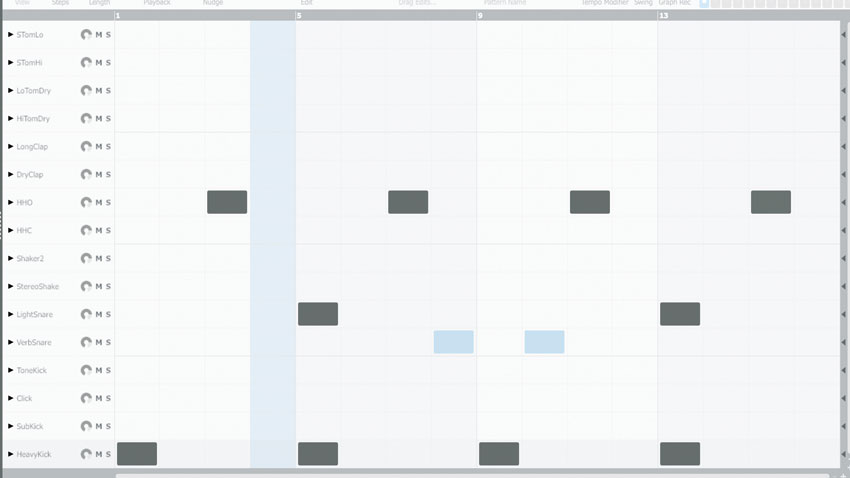
This pattern's simplicity is its strength. The constant pulse acts as a stable reference frame, against which other rhythmic and melodic elements can create syncopation and groove. As the MusicRadar article "How to program 6 different four-to-the-floor grooves" explains, this basic template is the starting point for countless variations across house and techno.
The Physics of the Kick: From Membrane to Perception
While the rhythm is simple, the sound of the kick drum is not. Its effectiveness is deeply rooted in its acoustic properties and how our bodies perceive them. For someone accustomed to analyzing physical systems, viewing the kick drum sound as a complex signal with distinct perceptual components is a useful framework.
The video below, by musicologist Bahadırhan Koçer, breaks down the kick drum's sound into three perceptual layers, connecting specific frequency ranges to distinct physiological responses.
Understand the Kick Drum ─ Explained by a Musicologist #ableton #electronicmusic #musicproduction
In "Understand the Kick Drum ─ Explained by a Musicologist," Koçer dissects the kick drum from a psychoacoustic perspective.
Watch the section from this point, where the kick is analyzed in three layers: The Sub (30-60 Hz): A low-frequency oscillation that is felt more than heard. This connects to your work with wave phenomena; these long wavelengths activate mechanoreceptors in the body, creating a visceral, physical sense of rhythm. The Thump (100-200 Hz): The frequency range where the sound gains audible impact and a sense of mass. It's the meeting point between tactile sensation and auditory perception. The Click (~2 kHz): A very short transient that defines the beat's precise timing. The explanation of phase-locking in the auditory brainstem, where neurons fire in sync with the transient, is a direct link between signal processing and neurobiology. It's this component that gives the rhythm its intelligibility.
This model—Sub, Thump, Click—provides a powerful analytical tool. It explains why a well-designed kick drum can anchor a track both physically and rhythmically.
Synthesizing the Kick: A First-Principles Approach
Understanding the perceptual components allows us to construct a kick drum sound from scratch using synthesis. This process is analogous to building a physical model. The classic "Synth Secrets" series from Sound on Sound magazine provides a rigorous, physics-based explanation for synthesizing drums.
Synthesizing Drums: The Bass Drum - Sound On Sound
This article by Gordon Reid delves into the physics of drum sounds, providing a theoretical foundation for their synthesis.
Read the following two sections: Start with "Bass Drums — Frequency Content." This section analyzes the sound of a bass drum as a system of coupled resonators (membranes and an air cavity). It explains how the interplay of these elements results in a spectrum that is nearly harmonic at low frequencies but densely packed with enharmonic partials in the mid-range. This corresponds directly to the "Sub/Thump" and "Click" components. Continue with "Bass Drums — Decays, Pitch Changes & Clicks." This section covers two crucial dynamic properties. First, it explains the downward pitch sweep characteristic of a kick drum. When the membrane is struck, its tension increases momentarily, raising the pitch. As the vibration decays, the tension returns to normal, and the pitch drops. This physical behavior is modeled in a synthesizer using a pitch envelope. Second, it describes the "beater click" as a burst of high-frequency partials at the very start of the sound, which we can model with noise or rapid filter modulation.
The synthesis patch described in the article can be visualized with the following block diagram. It's a model of the physical processes we're trying to simulate.

Now, let's connect this theory to practice. The same musicologist from before, Bahadırhan Koçer, provides an excellent step-by-step guide to building a kick drum in a synthesizer (Ableton's Operator), effectively implementing the principles from the Sound on Sound article.
Understand the Kick Drum ─ Explained by a Musicologist #ableton #electronicmusic #musicproduction
This part of "Understand the Kick Drum" puts the theory into practice.
Watch the synthesis demonstration from this section. He uses separate oscillators for the sub, thump, and click, and then applies a sharp pitch envelope to simulate the pitch drop explained in the Sound on Sound article. He also uses saturation to add harmonics, making the sound richer and more present on smaller speakers. Finally, watch the mixing process from this part. The techniques here are based on signal processing principles: using a utility to make low frequencies mono to avoid phase issues (a consequence of long wavelengths), and using compression and limiting to control dynamics and maximize perceived loudness.
By combining the rhythmic pattern, the perceptual model, and the synthesis principles, you now have a complete picture of the four-on-the-floor kick—from its role in a sequence to its construction at the waveform level.
Conclusion
In this lesson, we laid the rhythmic foundation for much of electronic dance music. We moved from the complex analysis of existing breakbeats to the ground-up construction of the four-on-the-floor pattern. More importantly, we delved into the "why" behind this simple pattern's power, exploring it from multiple perspectives that align with your scientific background.
Key Takeaways:
- Rhythmic Foundation: The four-on-the-floor pattern (a kick drum on every quarter note) is the simple, powerful rhythmic engine for house, techno, and related genres.
- Psychoacoustic Impact: A kick drum's effectiveness comes from its three perceptual layers: the body-moving Sub, the impactful Thump, and the timing-defining Click.
- Physics of Synthesis: A realistic kick drum sound can be synthesized by modeling the physics of a struck membrane. Key elements include a fundamental tone with a rapid downward pitch sweep (modeling changing membrane tension) and a noisy transient (modeling the beater impact).
- Practical Application: These principles are applied in a synthesizer using oscillators for the tone, a sharp pitch envelope for the sweep, and processors like saturation and compression to shape the final sound.
You've now built the floor. In our next lesson, we will continue to build our groove by programming characteristic hi-hat patterns. We'll explore how open and closed hi-hats, offbeat accents, and micro-timing adjustments add momentum and feel on top of the solid foundation you've established today.