Introduction
In our previous lesson, we constructed the rhythmic foundation of a track by programming the four-on-the-floor kick drum pattern. We explored this not just as a sequence of notes, but as a physical and perceptual phenomenon, delving into the synthesis required to create its characteristic impact. Today, we build upon that solid pulse by introducing hi-hats—the elements that provide high-frequency energy, define the groove, and add a crucial layer of rhythmic detail.
This lesson will guide you through programming characteristic hi-hat patterns, focusing on the interplay between open and closed sounds and the use of offbeat accents to create momentum. We'll begin, as before, by examining the sound itself from a synthesis perspective, which will inform our approach to programming its rhythmic behavior. You will learn to move beyond static, machine-like patterns and imbue your rhythms with the dynamic feel that drives electronic music.
The Anatomy of a Synthesized Cymbal
Before we program patterns, let's briefly consider the nature of the sound we're working with. Unlike the relatively clean, pitched decay of a kick drum, a hi-hat or cymbal has a complex, metallic, and inharmonic character. Its sound is not generated by a single vibrating membrane but by a chaotic mix of many high-frequency, non-integer-multiple partials.
Your background in physics and signal analysis is useful here. Consider the following block diagram for a simplified Roland TR-808 cymbal sound:
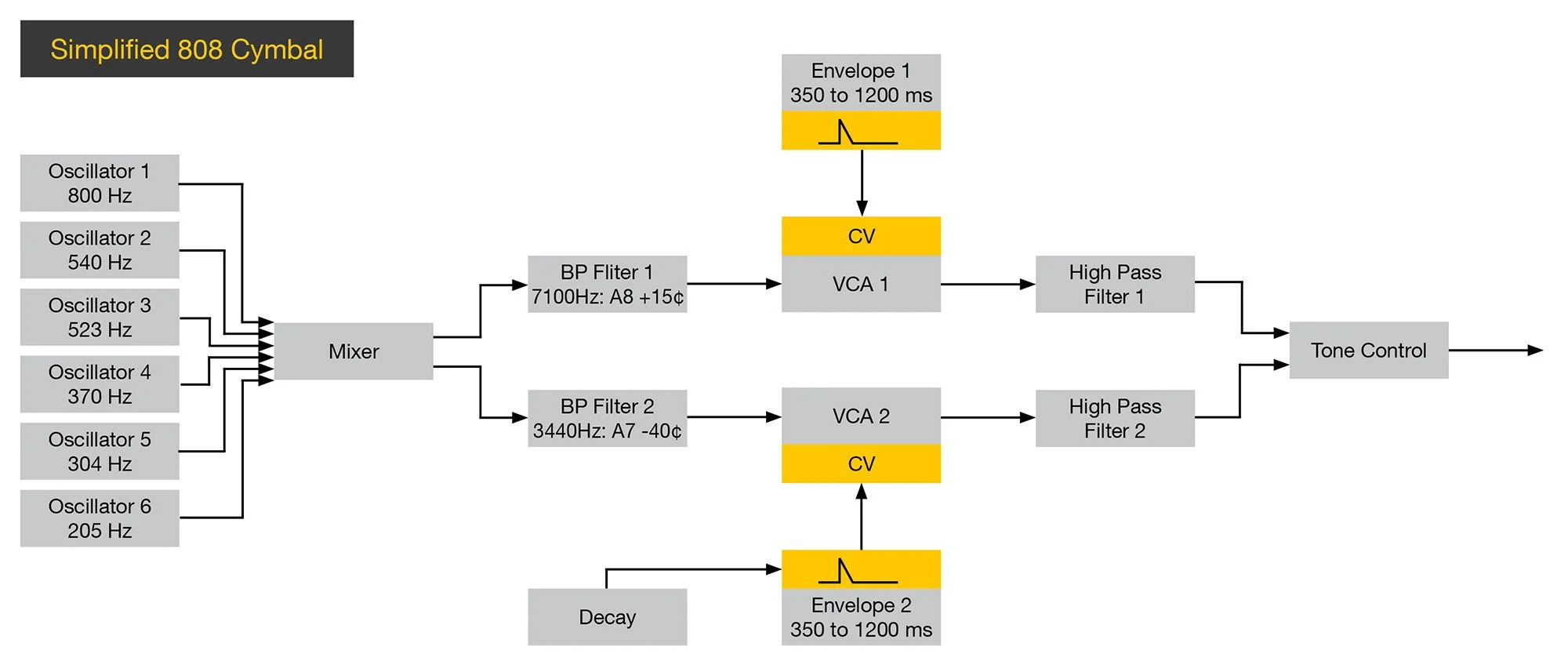
This diagram reveals a great deal. The sound originates from six different square wave oscillators with specific, non-harmonically related base frequencies (e.g., 800 Hz, 540 Hz, 523 Hz, etc.). This mixture of frequencies is then passed through two parallel band-pass filters, which isolate specific frequency bands to shape the metallic tone. Finally, two separate VCAs (Voltage-Controlled Amplifiers), each governed by its own envelope, control the amplitude contour. This complex architecture is what gives the 808's cymbals their signature shimmering, complex texture. It's fundamentally a burst of shaped noise.
This understanding—that a hi-hat sound is a complex, textured event—is key to appreciating the roles of its two primary articulations:
- Closed Hi-hat: A short, sharp, percussive sound. Its decay is cut off quickly. This is used for fast, precise rhythmic subdivisions.
- Open Hi-hat: A longer, sustained sound where the cymbal's shimmering decay is allowed to ring out. This is used to create accents and a sense of release.
The interplay between these two is central to creating dynamic hi-hat patterns.
Hi-hats 101: Expert Techniques to Help Your Tracks Shine - Unison
This article from Unison provides a clear, concise overview of the fundamental roles of open and closed hi-hats.
Please read the section "Closed Hi Hats vs. Open Hi-Hats." Pay special attention to the descriptions of their sounds and the Pro Tip regarding the use of open hi-hats on the off-beat in house music, a concept we will explore next.
Foundational Patterns: The Upbeat and 16th Notes
With the four-on-the-floor kick providing a steady pulse on the downbeats (1, 2, 3, 4), the most common and effective place to add hi-hats is on the upbeats (or off-beats)—the eighth notes that fall exactly between the kicks.
This creates a classic "push-pull" or "pendulum" motion that is the rhythmic engine of house and techno. The kick pushes on the beat, and the hi-hat pulls on the off-beat.
A great way to approach hi-hat programming is to think in terms of "gears" that you can engage to increase or decrease a track's energy. The following video introduces this concept perfectly.
Simple and effective hihat strategies
The video "Simple and effective hihat strategies" from Underdog Electronic Music School presents a practical, layer-based approach to programming hi-hats.
First, watch the setup from the beginning, which establishes the four-on-the-floor kick and backbeat clap we will build upon. Next, watch the demonstration of the first two "gears". Gear 1: The upbeat open hi-hat. Notice how this immediately creates that classic house groove. Gear 2: The 16th-note rolling hi-hat. This adds another layer of rhythmic density and energy.
The upbeat pattern is your fundamental tool for creating drive. Adding a running 16th-note pattern on top of it dramatically increases the energy, suitable for more intense sections of a track.
Creating Groove: Velocity, Swing, and Choking
A pattern programmed with static velocity and perfect timing will sound robotic. The groove and "human" feel come from three key techniques: velocity variation, micro-timing adjustments (swing), and the interaction between open and closed hats (choking).
1. Velocity:
Varying the velocity (or volume) of each hi-hat hit is crucial for creating accents. In a 16th-note pattern, accenting the upbeat eighth notes makes the pattern "breathe" with the underlying pulse.
2. Swing and Nudge:
Swing involves systematically delaying the off-beat notes (typically the second and fourth 16th notes in a beat) by a small amount. This creates a lopsided, "shuffled" feel that is characteristic of many genres. A related technique is to manually "nudge" notes slightly off the grid to introduce subtle timing imperfections.
3. Choking:
On a real drum kit, a drummer cannot play an open and a closed hi-hat simultaneously because they are the same two cymbals. Striking the hi-hat while closing the pedal "chokes" the sound of the open hit. Drum machines and DAWs simulate this. When a closed hi-hat is programmed immediately after an open one, the open hi-hat's long decay is cut short. This technique is essential for creating tight, funky, and "jacking" rhythms.
The next two videos provide excellent demonstrations of these techniques.
Complete guide to Techno Drums Pattern (Beginner to Pro) [+free project]
The video "Complete guide to Techno Drums Pattern" by Audioreakt offers a deep dive into the nuances of techno-focused hi-hat programming.
Watch the section on closed hats. The instructor demonstrates placing hats on the off-beat, using velocity to create accents, and using the "nudge" feature to introduce swing. Then, skip to the section on open hats and choking. This part clearly explains and demonstrates the choking mechanism, contrasting the sound with and without it.
Simple and effective hihat strategies
Let's return to the Underdog video to see a specific application of these techniques called "Jacking Hi-hats."
Watch the section on Jacking Hi-hats. This segment combines the use of open hats on the upbeat, swung closed hats in between, and the choking phenomenon to create a very energetic and groovy pattern.
Sound Shaping and Genre Variation
Beyond the pattern itself, the sonic character of the hi-hats is defined by their envelope and processing. A simple but powerful technique is to use a single hi-hat sample and adjust its decay time to create both open and closed variations.
Simple and effective hihat strategies
The Underdog video provides a fantastic tutorial on this sound-shaping technique.
Watch the section from this point. The key is to set the sampler's sustain to zero and then use the decay parameter to control the length of the sound. A short decay creates a closed hat, while a longer decay creates an open hat. The instructor also demonstrates using transposition to tune the hat to the track.
By combining these different rhythmic and sonic techniques, you can create patterns characteristic of various electronic music genres. The image below provides a useful visual reference for several common styles.

Look at the "House" pattern. It uses the simple upbeat open hi-hat we discussed first. Now look at "Techno." It uses a similar upbeat pattern but with closed hats, implying a tighter, more driving feel. "Funk" and "Hip Hop" use more complex syncopated patterns with both open and closed hats, demonstrating the "jacking" style.
Conclusion
You have now added the second critical element to your drum programming toolkit. While the kick drum provides the foundational power, the hi-hats provide the kinetic energy, rhythmic subdivision, and groove.
Key Takeaways:
- Function: Hi-hats occupy the high-frequency spectrum, adding energy and defining the rhythmic feel of a track.
- Core Patterns: The upbeat (off-beat) hi-hat creates a fundamental push-pull dynamic with the kick drum. Adding 16th-note layers increases rhythmic density and energy.
- Open vs. Closed: The interplay between short, percussive closed hats and long, sustained open hats is key. This is often controlled via choking, where a closed hat cuts off the decay of an open hat.
- Creating Groove: A pattern is brought to life through velocity variation (creating accents), swing (systematically delaying off-beat notes), and micro-timing adjustments ("nudging" notes off the grid).
- Sound Control: You can create both open and closed hi-hats from a single sample by manipulating the decay parameter in a sampler.
In our next lesson, we will complete the core drum trio by focusing on snare and clap patterns. We will explore their role in establishing the backbeat, how their distinct sonic textures contribute to a genre's identity (particularly for industrial music), and how to use ghost notes and variations to add further rhythmic sophistication.