Introduction
In our last lesson, we investigated how rhythmic complexity can be built using odd and mixed time signatures, even exploring computational models that try to quantify their perceptual effects. Today, we turn our attention to a genre you're particularly interested in, breakbeat, to see how an extraordinary degree of rhythmic complexity can be achieved within the common 4/4 meter. This lesson will focus on deconstructing what is arguably the most famous drum loop in history: the Amen Break.
Our goal is to analyze its rhythmic structure to concretely identify the sources of its complexity, namely syncopation and rhythmic displacement. We will approach this from several angles: a step-by-step musical deconstruction, an analysis of the performance's micro-timing, and finally, a look at formal models that describe the logic behind breakbeat manipulation, connecting directly to the analytical and computational mindset you bring from your physics and programming background.
The Anatomy of the Amen Break
The Amen Break is a four-bar drum solo performed by G.C. Coleman in the 1969 track "Amen, Brother" by The Winstons. Its journey from an obscure B-side to the rhythmic foundation of entire genres like Drum & Bass and Jungle is a fascinating story. To understand its rhythmic power, we will begin by dissecting it layer by layer.
The video below by 12tone provides an excellent historical overview and a systematic deconstruction of the break.
The video "The Most Sampled Song Ever" offers a compelling narrative and a clear analytical breakdown of the Amen Break.
First, watch the introduction from the beginning to appreciate the historical context and immense influence of this single drum loop. Next, focus on the core analysis from this section. The video builds the beat from a simple skeleton, which allows us to pinpoint exactly where the complexity is introduced. Pay attention to the framework of: The Beat (Kick): The grounding element. The Engine (Snare): The cross-rhythm that drives momentum. The Constant (Ride Cymbal): The metronomic reference. As you watch, notice how each modification—removing kicks, adding ghost notes, and crucially, shifting the snare hits—contributes to the overall rhythmic tension.
The key takeaway from this deconstruction is how the pattern evolves over its four bars. The first two bars establish a relatively stable, though syncopated, groove. The real magic happens in bars 3 and 4, where the rhythmic stability is deliberately undermined.
This "undermining" is achieved primarily through rhythmic displacement. While syncopation places notes on weak subdivisions of the beat, displacement takes an expected rhythmic figure and shifts it forward or backward in time. In the Amen Break, this is most prominent in bar 3: the kick drum on beat 4 is pulled forward to the "and" of 3, while the snare that should be on beat 4 is pushed back to the "and" of 4.
The producer Captain Pikant describes this effect perfectly in his own analysis.
The Amen Break - An analysis of the most important sample in history | Drum Patterns Explained
In "The Amen Break - An analysis...", Captain Pikant demonstrates how to program the break, focusing on the specific rhythmic shifts that create its signature feel.
Watch the segment on bar 3 from this part. He describes the combination of the early kick and late snare as creating a "stumbling" feel. This is a perfect description of the perceptual effect of rhythmic displacement.
The Physics of "Feel": Microtiming and Crystallized Nuance
So far, our analysis has treated the break as a series of notes on a quantized grid. However, as you know from your work in physics, no real-world event is perfectly discrete or instantaneous. The character of the Amen Break is defined as much by G.C. Coleman's performance nuances as by the notes themselves.
The 12tone video you watched earlier introduces this as the "three T's": Timbre, Touch, and Timing.
- Timbre: The specific sound of the drum kit, microphone, and recording room.
- Touch: The variation in velocity and angle of each drum hit.
- Timing: The subtle, human deviations from a perfect metronomic grid, often called microtiming or groove.
When a live performance is sampled and looped, these ephemeral details become "crystallized." The tiny deviation that made one snare hit unique is now repeated every four bars, becoming a predictable and integral part of the rhythm.
Musicologist Ethan Hein provides a fantastic visualization of this microtiming. For someone accustomed to analyzing data plots, these graphs will be immediately insightful. He maps the timing of each hit and compares it to a rigid sixteenth-note grid.
This section of Ethan Hein's blog post moves beyond standard notation to analyze the groove's microstructure.
Read the section beginning from here. The author presents two "tempo maps" that visualize the timing deviations in the performance. The first shows the tempo fluctuation over the entire four-bar loop, while the second zooms in on the first bar to show how each hit lands slightly ahead of or behind the perfect grid lines. This is the data-driven view of what producers call "feel" or "humanization."
These visualizations show that the groove isn't just about which notes are played, but precisely when they are played, down to the millisecond. This continuous, analogue aspect of rhythm is a critical component of its perceived complexity.
Formalizing Complexity: Generative and Structural Models
Having deconstructed the beat musically and analyzed its physical performance, we can now, true to your background, seek more formal, structural models to describe its complexity.
Model 1: Displaced Clave Patterns
One way to frame the Amen Break's structure is by viewing it as an overlay of simpler, fundamental rhythmic cells. Ethan Hein's analysis proposes that the break's syncopation arises from layering several displaced versions of the tresillo rhythm—a pattern we've encountered before, closely related to the E(3, 8) Euclidean rhythm.
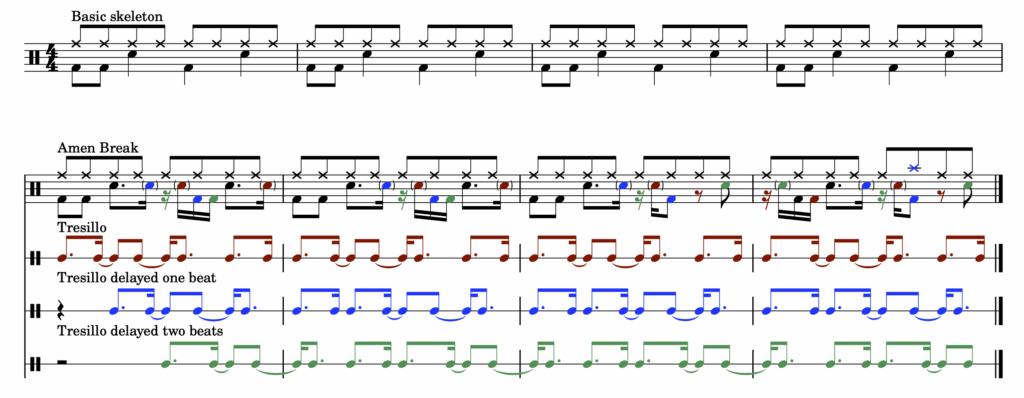
This model is powerful because it connects the seemingly chaotic pattern to an underlying, repeating motive, much like identifying a recurring mathematical structure within a complex signal.
Model 2: An Algorithmic Approach to Breakbeat Science
The practice of chopping up breakbeats and rearranging them, central to Drum & Bass, can also be modeled algorithmically. This approach should resonate strongly with your experience in writing simulations. Nick Collins' paper on the topic provides a formal method for generating complex, breakbeat-style rhythms.
[PDF] Algorithmic Composition Methods for Breakbeat Science - Nick Collins
This paper formalizes the process of "breakbeat cutting" as an algorithmic procedure. It treats a bar of music as a block of time to be subdivided, or "partitioned."
First, read Section 3.1, "The model- partitions and repetitions." The core idea is to create rhythmic excitement by partitioning a measure into syncopated 'odd' integer durations. The example given, 3+3+2 over 8 eighth notes, is precisely the tresillo rhythm we just saw. This provides a generative rule: complex syncopation arises from partitions favoring odd numbers. Next, read the paragraph that describes the heart of the algorithm, found in the latter half of Section 3.1: "choosing the cut length." The algorithm favors short, odd-numbered cuts. This is a formal rule derived from analyzing what producers do by hand: they retrigger short, interesting snippets of the break on offbeats to create rhythmic virtuosity. The parameters mentioned, like RepeatChance and MaxRepeats, allow for the "stutter" effects common in the genre. For a deeper look, you can also skim the pseudo-code in the Appendix, which lays out the entire logic.
This algorithmic model provides a powerful framework. It recasts the art of breakbeat manipulation as a set of computational rules for partitioning time. This process of slicing and re-sequencing a break is the practical application of this model. Producers who "chop" a break are, in effect, manually executing this kind of partitioning algorithm.
To see this in action, the final part of Captain Pikant's video demonstrates exactly this process.
The Amen Break - An analysis of the most important sample in history | Drum Patterns Explained
This last segment shows the creative potential unlocked by analyzing and deconstructing the break.
Watch from this section, where the sampled break is sliced into individual drum hits ("fragments") and then re-sequenced to create entirely new patterns. This is the essence of "breakbeat science."
Conclusion
Today, we've dissected the rhythmic complexity of breakbeats using the Amen Break as our specimen. We've seen that its power derives not from an unusual time signature, but from the masterful use of syncopation and rhythmic displacement within a standard 4/4 framework.
Key Takeaways:
- Syncopation and Displacement: Breakbeat complexity is driven by placing notes on weak subdivisions (syncopation) and shifting expected patterns in time (displacement), creating a "stumbling" or "tumbling" feel.
- Performance as Code: The nuances of a human performance—micro-timing, velocity, and timbre—are "crystallized" when sampled, becoming a fixed and essential part of the loop's identity. These can be visualized and analyzed like any physical data.
- Formal Models of Complexity: The intricate patterns in breakbeats can be understood through structural models, such as overlays of displaced clave patterns (tresillo), or through generative algorithms that partition time using odd-numbered durations.
- Analysis to Synthesis: The techniques of "chopping" or "cutting" breakbeats are a practical application of this analysis, allowing producers to deconstruct and reconstruct rhythms to create new variations.
In our next lesson, we will transition from analyzing these highly complex, pre-existing rhythms to building our own grooves from the ground up. We will begin the Electronic Drum Programming module by learning how to program the foundational "four-on-the-floor" kick drum pattern, the rhythmic bedrock of house and techno.