Introduction
In our last lesson, we explored how cross-rhythms create evolving, complex patterns by layering a rhythmic phrase against a conflicting meter, with the Least Common Multiple governing their resolution. We saw how the Euclidean algorithm, E(k, n), provides a powerful way to generate many of these fundamental rhythms. Today, we'll build directly on that foundation to tackle one of the most exciting areas of experimental music you've expressed interest in: composing in odd time signatures.
This lesson is designed to help you program and analyze beats in meters like 5/4 and 7/8. Instead of layering patterns on top of a 4/4 grid, we will construct the entire rhythmic framework using these non-standard meters. We will begin by understanding the simple principle that makes odd meters feel intuitive, then see how to implement them in a DAW. Finally, leveraging your background, we will delve into the computational and perceptual reasons why these rhythms are considered "complex" and why simple analytical models can sometimes fall short.
The Core Principle: Grouping into 2s and 3s
The key to internalizing and working with odd time signatures is to stop thinking of them as a single, indivisible block (e.g., counting "1, 2, 3, 4, 5") and instead break them down into smaller, familiar groups of duple (2) and triple (3) pulses. An odd number is simply a sum of 2s and 3s. For example:
- 5 = 2 + 3 or 3 + 2
- 7 = 2 + 2 + 3 or 2 + 3 + 2 or 3 + 2 + 2
- 11 = 2+2+2+2+3 (and its permutations)
This subdivision creates an uneven or "limping" pulse that gives these meters their unique character. Musician and educator Adam Neely provides an excellent overview of this concept, comparing the process to learning a new language.
How to "speak" in odd time signatures
In his video "How to 'speak' in odd time signatures," Adam Neely explains how to conceptualize and feel these rhythms.
Watch the section from this segment where he introduces the idea of breaking down meters into groupings of 2s and 3s. Then, to see this applied, watch the demonstration from this part where he illustrates how the accent pattern in 5/8 can be felt as either 2+3 or 3+2, creating subtle but distinct grooves from the same rhythmic "word."
This principle is visualized clearly in the following diagram, which shows how a measure of 5/8 can be felt with two primary pulses: one short (two eighth notes) and one long (three eighth notes).

This directly connects to the inter-onset intervals of the Euclidean rhythms we studied. For example, E(5, 13), a rhythm in 13/8, produces the pattern [x . . x . x . . x . x . .], which has an interval structure of (3, 2, 3, 2, 3). It is literally constructed from groupings of 2 and 3.
Programming Odd and Mixed Meters in a DAW
Now let's translate this theory into practice within a digital audio workstation. While you can manually program these rhythms in a 4/4 grid, it's far more intuitive to change the DAW's master time signature. This adjusts the grid lines, the metronome click, and the loop boundaries to match the meter you're working in.
The following video provides a clear, step-by-step guide to setting up odd and mixed meters in Ableton Live, but the principles apply to any modern DAW.
HOW to MAKE Music in Mixed Meter or Odd Time in Ableton (7/4 5/4 etc)
This tutorial by GARDNSOUND, "HOW to MAKE Music in Mixed Meter or Odd Time in Ableton," is a practical guide to implementation.
First, watch the basics of changing the time signature from the beginning. Next, see how to create mixed meter by inserting multiple time signature changes from this part, for example, alternating between measures of 7/4 and 5/4. Pay close attention to the section on conceptualizing and counting 7/4 as 4+3 from this section. This reinforces Neely's point. The subsequent beat-making demonstration here puts it into action. Finally, watch the very useful workflow tip from this segment. If you have a repeating rhythmic cycle composed of multiple meters, like one bar of 6/4 followed by one bar of 7/4, you can simplify your workflow by setting the project's time signature to the sum, in this case, 13/4. This is an application of the LCM principle from our previous lesson.
Analyzing Rhythmic Complexity: A Deeper Look
You have a strong inclination to understand the "why." So, why do odd meters feel complex, and how can we analyze this complexity in a way that aligns with human perception?
A simple approach might be to use a syncopation index, like the one implicitly used in Toussaint's metrical hierarchies. However, this method has significant limitations when applied to odd meters, particularly those with a prime number of pulses (like 7, 11, or 13). The metrical hierarchy is built by factoring the total number of pulses. For a prime number p, the only factors are 1 and p, which results in a nearly "flat" hierarchy where almost all beats have the same metrical weight. This makes it impossible to distinguish between a simple and a complex rhythm.
A Master's thesis from Politecnico di Milano delves into this exact problem, providing a critique of existing models and proposing a more sophisticated approach.
[PDF] RHYTHM COMPLEXITY ANALYSIS FOR ODD TIME SIGNATURES
This research paper by Jacopo Foglietti offers a rigorous, computational perspective on why odd meters challenge simple complexity metrics and what a better model might look like. Given your background, you'll appreciate the analytical depth here.
First, read the introduction in this section to understand the problem statement. Also read the specific definition of odd time signatures and their cognitive complexity in Section 2.1.4, "Odd Time Signature." The most crucial part for our discussion is in Chapter 3. Read the section "Motivation," which demonstrates precisely why simple measures like metrical weight (syncopation) and standard deviation of intervals fail to adequately capture the perceived complexity of rhythms in 13-pulse and 14-pulse meters. To see the proposed solution, you can skim the description of the new model in Section 3.2, "Complexity Model Architecture." The key insight is a two-stage process: Non-Constant Clock (NC-Clock) Model: Instead of assuming the brain imposes a steady, isochronous beat, this model finds the best-fitting aperiodic beat structure, composed of unequal intervals (like our 2s and 3s). Almost Even Hierarchy (AEH) Evaluation: It then measures the complexity of this induced aperiodic beat, not against a standard metrical grid, but against a hierarchy built from "almost maximally even" subdivisions. You don't need to absorb all the details, but recognize the core idea: our perception of complex rhythms might rely on inducing a non-constant, flexible internal pulse, and the difficulty of a rhythm relates to the structure of that induced pulse. The final results in Table 4.5 show that this AEH_NC model correlates much better with human perception data than simpler models.
A Library of Odd Meter Patterns
In our previous lesson, we introduced Euclidean rhythms as a way to generate cross-rhythms. Many of these E(k, n) patterns are, in fact, fundamental odd-meter rhythms used in music across the globe. By using a Euclidean sequencer plugin or the built-in functions in your DAW, you can instantly generate a vast vocabulary of authentic odd-meter patterns.
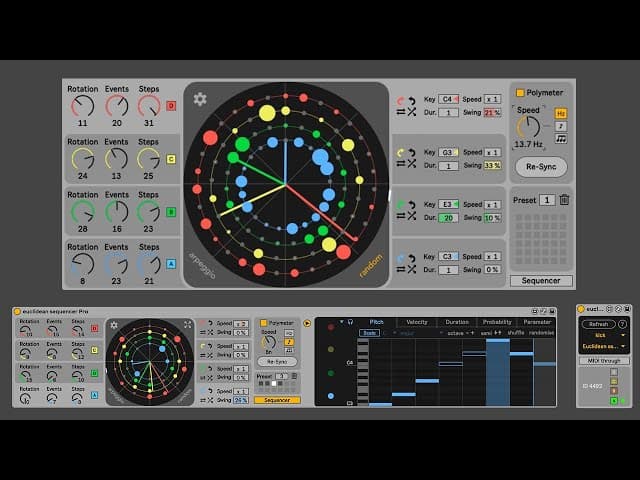
Let's revisit Toussaint's paper, this time focusing on the examples that use an odd number of pulses.
The paper [PDF] The Euclidean Algorithm Generates Traditional Musical Rhythms (ID: LINK), which we studied previously, contains an extensive catalogue in Section 4.2. Here are a few notable examples based on odd meters:
- E(3, 7) =
[x . x . x . .](intervals: 2, 2, 3). This is a core rhythm in Balkan music and famously used in Pink Floyd's "Money." - E(4, 9) =
[x . x . x . x . .](intervals: 2, 2, 2, 3). This is the Turkish Aksak rhythm. - E(5, 7) =
[x . x x . x x](intervals: 2, 1, 2, 1, 1). A popular Arab rhythm known as Nawakhat.
Exploring E(k, n) where n is an odd number is a fantastic way to generate novel rhythmic ideas that are mathematically grounded and perceptually strong.
Conclusion
Today we have demystified odd time signatures, showing they are built from simple, intuitive blocks. You now have both a conceptual framework (grouping by 2s and 3s) and a practical method (changing the DAW time signature) for composing with them. Furthermore, we've explored the deeper question of rhythmic complexity, seeing why odd meters challenge simple analytical tools and how more sophisticated computational models can better align with human perception.
Key Takeaways:
- Odd meters are best understood and felt by grouping their pulses into combinations of 2s and 3s.
- Programming in odd time signatures is most effectively done by changing the master time signature in your DAW, which adjusts the grid and metronome accordingly.
- Mixed-meter passages (e.g., alternating 7/4 and 5/4) can be programmed using time signature changes, or simplified by setting a single, longer time signature for the entire cycle (e.g., 12/4).
- Standard syncopation measures are often insufficient for analyzing the complexity of odd meters. More advanced models, like the AEH_NC, suggest that we perceive these rhythms by inducing a non-isochronous internal beat.
- Euclidean rhythms
E(k, n)wherenis odd provide a rich, generative source for odd-meter patterns.
In our next module, we'll shift our focus from these advanced rhythmic structures to the practical craft of Electronic Drum Programming. We'll start with the foundational patterns of house and techno, like the four-on-the-floor kick, and learn how to build compelling grooves from the ground up.