Introduction
In our last lesson, we explored rhythmic displacement and phasing, seeing how shifting a pattern's starting point relative to the beat creates rhythmic tension. We ended by looking at how two loops of different lengths—like a 12-beat pattern against an 8-beat one—interact over a longer cycle. Today, we will formalize and expand upon this concept by examining cross-rhythms.
This lesson directly addresses the learning outcome of defining and programming cross-rhythms, which occur when a repeating rhythmic phrase has a length that conflicts with the established meter. This technique is a cornerstone of the complex, groove-oriented music you're interested in, from breakbeat to techno, and provides a systematic way to generate the evolving, off-kilter patterns we discussed previously. We'll start by clarifying some often-confused terminology, then delve into the mathematical principles that govern these rhythms, and finally explore a powerful algorithmic approach to generating them that should resonate with your background in physics and mathematics.
Polyrhythm, Polymeter, and Cross-Rhythm: A Clarification
The terms used to describe layered rhythmic complexity are often used interchangeably, which can cause confusion. Let's establish some clear working definitions.
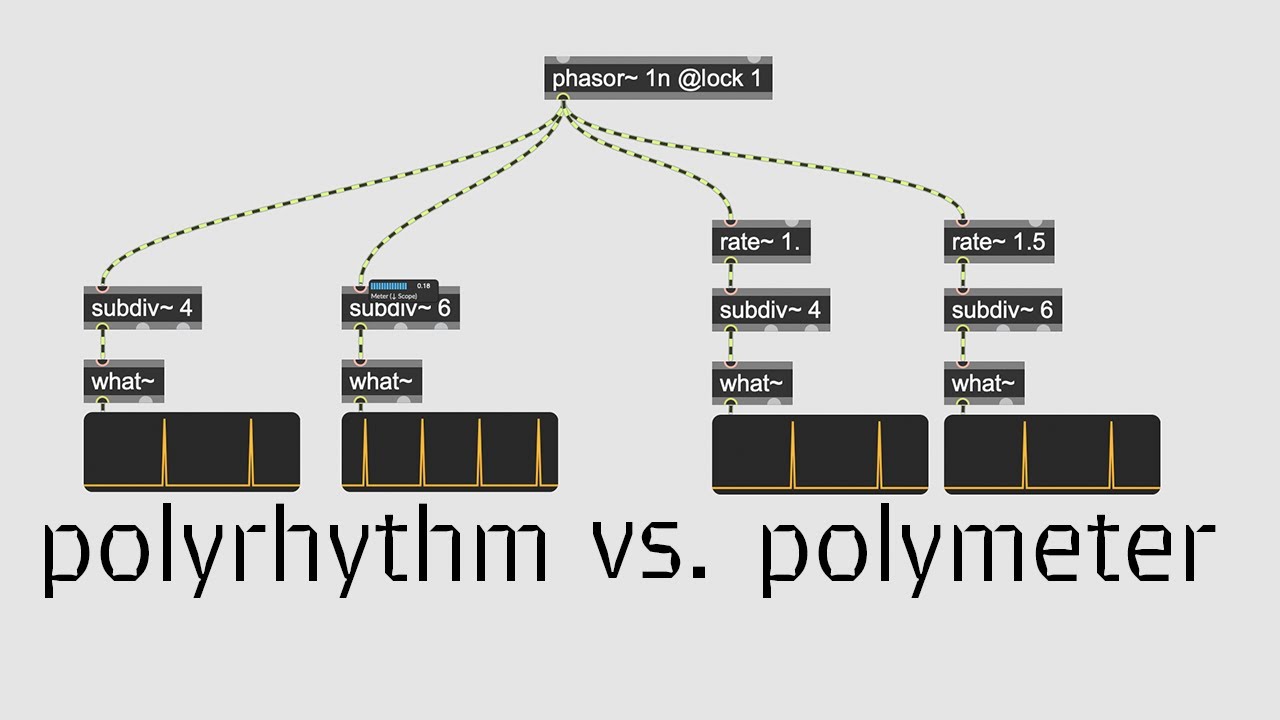
A short video will help clarify the formal music theory distinction between polyrhythm and polymeter.
[Music Theory in 5m #18] Polyrhythm vs polymeter, layering several rhythms
The video "Polyrhythm vs polymeter" by Woochia - Charly Sauret provides concise definitions for these two key concepts.
Watch the explanation of polyrhythm from the beginning. The key idea is dividing a single unit of time (like one bar of 4/4) into two different numbers of beats simultaneously, such as playing four quarter notes against three half-note triplets. The notes themselves are of different durations. Next, watch the explanation of polymeter from the next section. Here, two different time signatures are layered, but the underlying pulse (e.g., the quarter note) remains constant. A pattern in 3/4 repeats every three beats, while a pattern in 4/4 repeats every four beats. Their starting points drift apart and then realign. Finally, the summary at the end succinctly captures the difference.
For our purposes as electronic musicians, the term cross-rhythm is most useful for describing the situation outlined in your learning outcome: a rhythmic pattern whose length conflicts with the bar length. This is functionally very similar to a polymeter. You might program a 7-beat synth line over a standard 4/4 drum beat. The synth line isn't in a 7/4 time signature in the formal sense; rather, it's a 7-beat phrase creating rhythmic tension against the 4-beat container.
The article "An Introduction To Cross-Rhythms" from ModeAudio gives a perfect, practical example of this. It demonstrates creating a cross-rhythm by simply shortening a one-bar (4-beat) MIDI clip to be three beats long, and then looping it against a 4/4 drum pattern. This 3-against-4 interaction is a foundational cross-rhythm.
An Introduction To Cross-Rhythms | ModeAudio
This article provides a simple, hands-on definition and example of creating a cross-rhythm in a DAW.
Read the section titled "Crossing the Streams." Focus on how a simple melodic phrase is transformed by changing its loop length from four beats to three, creating an evolving pattern that only repeats every three bars.
The Mathematical Machinery: Least Common Multiple
When you layer a rhythm of length X against a meter of length Y, how long does it take for them to realign on the downbeat? The answer lies in a fundamental concept from number theory: the Least Common Multiple (LCM).
The total duration of the full cycle before realignment, measured in the smallest rhythmic unit (or pulse), is LCM(X, Y).
For example, in the 3-beat synth pattern against a 4/4 bar (which is 4 beats long), the patterns will realign after LCM(3, 4) = 12 beats. Over this 12-beat cycle, the 3-beat synth pattern will have played 4 times, and the 4-beat bar structure will have occurred 3 times.
The following video uses the fascinating system of Konnakol (South Indian rhythmic solfege) to demonstrate this principle with physical and vocal precision.
Lesson 3 - Cross Rhythms - #MathScienceMusic
This lesson from the NYU MusEDLab's "MathScienceMusic" series explores cross-rhythms and their connection to the LCM.
Watch the demonstration of a 4-beat "surface rhythm" against a 3-beat "underlying structure" from this section. Notice how the presenter explains that the patterns resolve after 12 pulses (LCM of 3 and 4). Next, observe the 3-against-5 example from the following segment, which resolves after 15 pulses. Finally, pay close attention to the more complex example of 8 against 10 from this part. Here, the product of the numbers is 80, but the LCM is 40. This is because both numbers share a common divisor (2). The cycle resolves in 40 pulses, not 80. This highlights that LCM is the precise tool, not simple multiplication.
Your experience with signal processing, particularly with concepts like beat frequencies arising from the superposition of two waves with different frequencies, provides a strong parallel here. The interaction of two rhythmic cycles with frequencies and creates a larger "beat" cycle with a period corresponding to their LCM.
A Generative Approach: Euclidean Rhythms
Now for a perspective that elegantly unifies mathematics, computation, and music. Many of the most fundamental and widespread cross-rhythms in world music share a remarkable property: their beats are distributed as evenly as possible across a cycle. For example, how would you distribute 3 beats within an 8-pulse cycle as evenly as possible?
The answer is [x . . x . . x .], a pattern with intervals of (3, 3, 2). This is the famous tresillo rhythm, a cornerstone of Latin American and African music. Distributing 5 beats in 8 pulses gives [x . x x . x x .], the cinquillo.
In a landmark paper, Godfried Toussaint demonstrated that these "maximally even" rhythms can all be generated by an algorithm that mirrors the structure of the Euclidean algorithm used to find the greatest common divisor (GCD).
[PDF] The Euclidean Algorithm Generates Traditional Musical Rhythms
This paper provides a rigorous and fascinating look at the deep connection between a classical mathematical algorithm and the structure of world music rhythms.
I recommend you start by reading Section 2, "Timing Systems in Neutron Accelerators," which introduces Bjorklund's algorithm for distributing pulses. This problem, originally from nuclear physics, is exactly the one we are trying to solve. Then read Section 3, "The Euclidean Algorithm," which explicitly connects Bjorklund's method to the classic Euclidean algorithm. With that foundation, read Section 4, "Euclidean Rhythms in Traditional World Music," up to the end of the first paragraph on E(3,4). This section formally defines Euclidean Rhythms as E(k, n), where k is the number of beats (onsets) and n is the total number of pulses, and gives the key examples of E(3, 8) (tresillo) and E(5, 8) (cinquillo). Finally, skim through the extensive list of rhythms in Section 4.2, "Relatively Prime Euclidean Rhythms." You don't need to read it all, but appreciate the sheer number of culturally significant rhythms that are generated by this simple rule, from E(2,3) to E(15,34).
The concept of Euclidean rhythms, E(k, n), provides you with a powerful generative tool. Instead of just thinking in terms of "3 against 4" or "7 against 8", you can think abstractly about generating interesting cross-rhythms by choosing k and n. For example, E(5, 12) produces the West African Bemba pattern, and E(7, 16) produces the Brazilian Samba necklace. Many DAWs and MIDI plugins have Euclidean sequencers built in, allowing you to explore these patterns instantly.
Programming Cross-Rhythms
Let's ground this theory in DAW production. There are two primary ways to program cross-rhythms:
-
The Loop Brace Method (Polymeter Style): This is the method shown in the ModeAudio article. You create a MIDI clip containing a rhythmic pattern and then adjust the length of the MIDI clip's loop brace so it's shorter or longer than one bar.
- Example: In a 4/4 project, create a one-bar MIDI clip. Program a pattern inside it. Now, drag the loop end marker from the end of beat 4 to the end of beat 3. Your 3-beat pattern will now loop against the 4/4 grid, creating a 3-against-4 cross-rhythm. Similarly, you could program a 7-beat pattern (e.g., filling 7/8 of a 2-bar clip) and loop that.
-
The Euclidean Sequencer Method: Many modern sequencers (in Ableton Live, Logic, FL Studio, or via plugins) have a dedicated Euclidean mode. You simply dial in the number of steps (n) and the number of desired hits (k), and the sequencer automatically generates the corresponding maximally even pattern. This is the most direct way to apply the theory from Toussaint's paper.

Conclusion
Today we've formalized the concept of rhythmic conflict, moving from the general idea of displacement to the specific, powerful technique of cross-rhythm. By understanding the underlying mathematical principles, you can move beyond simple trial-and-error and start designing complex, evolving rhythmic structures with intention.
Key Takeaways:
- Cross-rhythm (in a practical electronic music context) involves layering a rhythmic pattern whose length conflicts with the bar length, creating an effect similar to a polymeter. This is distinct from polyrhythm, which involves different subdivisions of the same duration.
- The length of the full cycle before two conflicting rhythms realign is determined by their Least Common Multiple (LCM).
- Many of the most important rhythmic patterns in world music are Euclidean rhythms, which distribute k beats as evenly as possible over n pulses. These can be generated algorithmically and are denoted
E(k, n). - You can program cross-rhythms in a DAW by adjusting loop lengths or by using dedicated Euclidean sequencers.
In our next lesson, we will take this one step further. Instead of just layering a conflicting pattern over a 4/4 grid, we will explore how to build entire tracks using non-standard meters from the ground up, programming in odd time signatures like 5/4 and 7/8, many of which you saw as the basis for Euclidean rhythms today.