Introduction
In our last lesson, we delved into swing and shuffle, focusing on the micro-level adjustments that give rhythms their characteristic bounce—the systematic delay of off-beat notes within a beat. This was our first step in moving beyond a rigid, quantized grid. Today, we expand this concept from the micro to the macro scale by exploring rhythmic displacement.
This lesson addresses how to define and apply rhythmic displacement by shifting an entire rhythmic pattern forward or backward in time relative to the bar. Instead of nudging individual notes, we will be moving whole musical phrases. This technique is a cornerstone of syncopation and a powerful tool for creating rhythmic tension, interest, and surprise. It's particularly prevalent in the complex, groove-oriented genres that interest you, such as breakbeat and industrial. We will begin with a clear definition, examine its application in musical contexts, and, leveraging your background, explore a more formal mathematical framework for understanding it as a change in rhythmic phase.
Defining Rhythmic Displacement
At its core, rhythmic displacement involves taking a musical motif—a short rhythmic or melodic idea—and repeating it, but starting it at a different position within the measure. The pattern itself remains identical, but its relationship to the underlying pulse is altered. This immediately creates a sense of rhythmic tension and subverts the listener's expectations.
A fantastic, clear demonstration of this concept comes from the world of jazz improvisation, where it is a common expressive device.
The video "Rhythmic Displacement In Jazz" by JazzSkills provides a perfect introduction to the fundamental mechanics of this technique.
First, watch the initial definition and demonstration of displacing a rhythm later in the bar, from the start of the explanation. The instructor takes a simple "one, two-and" pattern and shows how it feels when started on beat 2, then beat 3, and so on. Next, watch the segment on displacing a rhythm earlier, from the subsequent section. Here, the pattern is shifted backward, so a phrase that originally started on beat 1 now starts on beat 4 of the preceding measure, pulling the rhythm forward across the bar line.
As you can see, the effect is dramatic. A pattern that feels grounded when it starts on the downbeat can feel syncopated and energetic when displaced to an off-beat or across a bar line. This is the primary tool for creating large-scale syncopation.
Anticipation: Displacement at the Micro-Scale
While we're focusing on shifting entire patterns, it's worth noting that displacement can also happen on a much smaller scale. This serves as a bridge from our previous lesson on micro-timing. A common technique in drum programming is anticipation, where a single important note is shifted slightly earlier.
How to Write Drum Parts (for non drummers)
The video "How to Write Drum Parts (for non drummers)" from 8-bit Music Theory explains this concept clearly.
Watch the section defining and demonstrating rhythmic anticipations from this segment. The key idea is shifting a note, like a kick drum on beat 3, to the 16th note just before it (the 'e' of 2). This creates a feeling of forward momentum and pulls the listener into the beat. Then, see how it's applied in a practical example from the following demonstration.
Anticipating a beat is a subtle but effective form of forward displacement. For example, in many breakbeat and drum & bass tracks, snares or kicks that would normally land on a strong beat are anticipated by a 16th note to increase urgency and drive.
Displacement Dissonance and Phasing
When a rhythmic pattern is displaced against a steady pulse or another, non-displaced pattern, the resulting rhythmic friction is sometimes called displacement dissonance. This term, borrowed from the work of music theorist Harald Krebs, perfectly describes the edgy, unsettled feeling that displacement can create.
A classic example can be found in the work of breakbeat pioneer Goldie.
[PDF] RHYTHM AND FORMAL STRUCTURE IN ELECTRONIC DANCE ...
This academic paper on rhythm in EDM provides a fantastic analysis of a Goldie track that uses displacement as a core compositional element.
Read the section analyzing Goldie's "I'll Be There For You," starting from the beginning of the analysis. The author points out that an eight-measure melody is constructed from two four-measure phrases, where the second is an almost exact copy of the first but "displaced by the distance of an eighth rest."
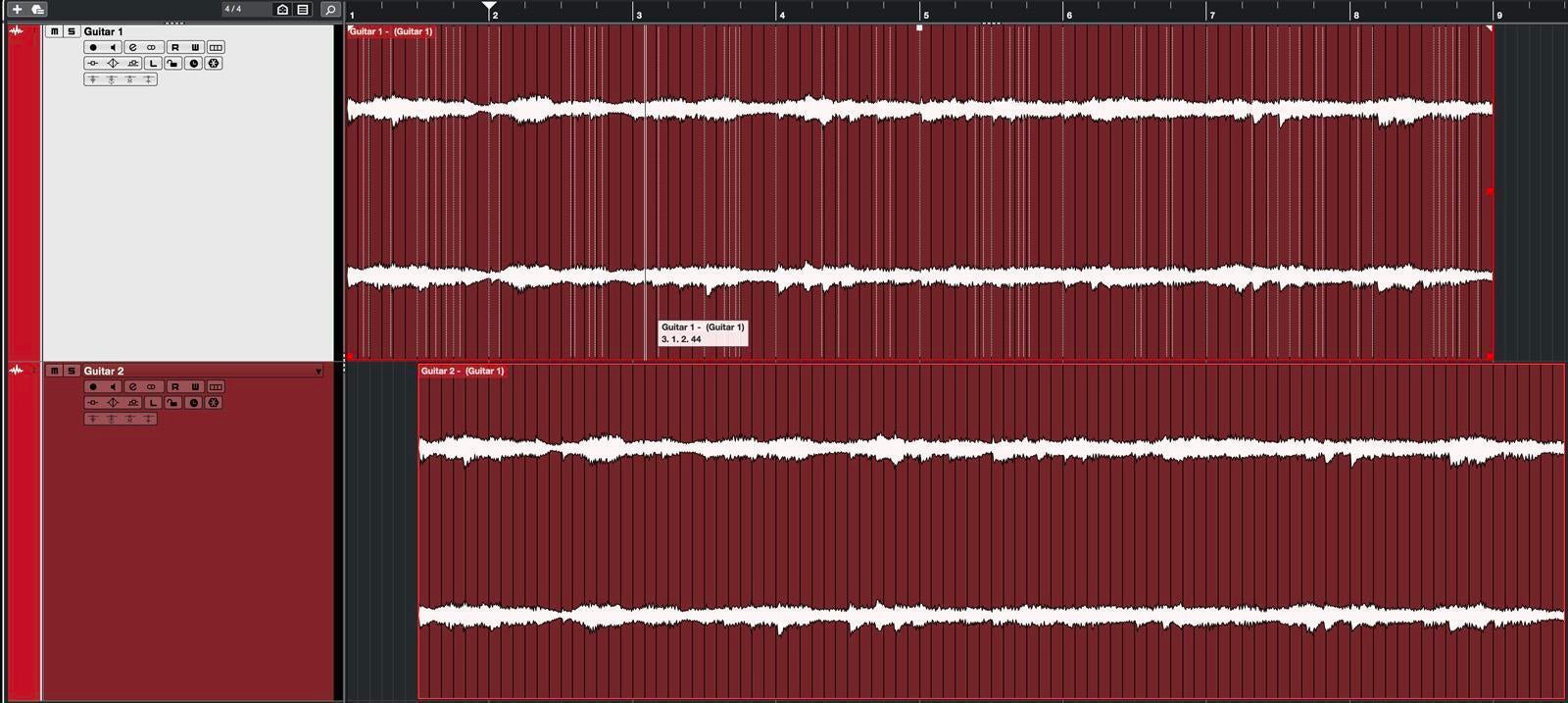
This is a perfect illustration of the concept. The repetition is clear, but the offset placement creates a subtle rhythmic ambiguity that is characteristic of more experimental electronic music. You can visualize this effect easily in a DAW. Imagine two identical guitar riffs recorded on separate tracks. One starts on the downbeat, while the second starts an eighth note later.
A Formal Framework: Displacement as Phase Shift
Given your background in physics and mathematics, we can formalize rhythmic displacement using a powerful analogy from wave mechanics and signal processing: phase. Just as a sine wave can be shifted in time relative to another, a rhythmic pattern can be phase-shifted relative to the metrical grid.
An advanced approach to rhythmic analysis, pioneered by theorists like Jason Yust, uses the tools of Fourier analysis to represent rhythms in a "frequency space." While the full mathematics is extensive, the core concept is elegantly simple and directly relevant to displacement.
[PDF] Rhythmic Regularity Beyond Meter and Isochrony
This highly rigorous paper proposes viewing rhythm through a continuous, frequency-based lens. We will focus on the conceptual model it introduces.
Read the section titled "Simple periodic functions, frequency spaces, and spectra." The central proposal here is that we can measure how much a rhythm aligns with a certain periodicity (like a quarter-note pulse) by using two fundamental measuring functions: a cosine wave (which is maximal on the beat) and a sine wave (which is zero on the beat, but maximal a quarter-cycle later). By plotting the rhythm's correlation with the cosine function on one axis and with the sine function on another, we can place any rhythm as a point in a 2D "frequency space." In this space: The distance from the origin represents the rhythm's strength or "energy" at that specific frequency. The angle of the point represents the rhythm's average temporal position within the cycle, or its phase.
This model provides a powerful way to think about displacement. A rhythm that is perfectly on-beat will have a phase angle of 0°. An off-beat rhythm (like a syncopated hi-hat pattern) will have a phase angle of 180°. Rhythmic displacement is, in this model, simply the act of rotating the rhythm's vector in this frequency space. Shifting a pattern forward or backward in time is equivalent to changing its phase angle.
This also elegantly explains the concept of phasing, made famous by composer Steve Reich. When two identical patterns are played at very slightly different tempos, they begin to slowly drift apart. One pattern is continuously displacing, or phase-shifting, relative to the other. This creates a slow, evolving cycle of displacement dissonance and consonance. In our frequency space model, this corresponds to two vectors slowly rotating at different angular velocities, creating a beat frequency equal to the difference between their rhythmic frequencies, precisely analogous to acoustic beats.
Practical Application and Tools
This concept of interacting cycles creating complex phasing patterns is not just theoretical; it's a key component of sophisticated electronic music.
[PDF] RHYTHM AND FORMAL STRUCTURE IN ELECTRONIC DANCE ...
Returning to the EDM thesis, let's look at a concrete example of this phasing in action.
Read the section titled "Out of Phase Cycles in EDM." The analysis of DJ Shadow's "...Meets His Maker" shows how a 12-beat guitar pattern (in triple time) interacts with an 8-beat percussion layer (in duple time). Because the least common multiple of 12 and 8 is 24, the two patterns only re-align every 24 beats, creating a long cycle of shifting vertical alignments—a slow, controlled phasing pattern.
Modern DAWs and plugins often provide tools specifically designed to manipulate rhythmic displacement. Sequencers in programs like Ableton Live or dedicated Max for Live devices often include a "Rotate" or "Shift" parameter.

By automating such a parameter, you can create dynamic, evolving rhythms where a pattern continuously shifts its relationship to the beat, adding a layer of complexity and movement to your tracks.
Conclusion
Today, we've moved from the small-scale timing shifts of swing to the larger structural impact of rhythmic displacement. This technique is fundamental to creating syncopation, tension, and rhythmic evolution in your music.
Key Takeaways:
- Rhythmic displacement is the act of repeating a rhythmic pattern but shifting its starting point relative to the metrical grid.
- Shifting a pattern can create displacement dissonance, a form of rhythmic tension that subverts listener expectation.
- The concept is scalable, from micro-level anticipations of single notes to macro-level phasing of entire loops over many bars.
- From a mathematical perspective, displacement can be rigorously defined as a change in the rhythmic phase of a pattern within a given periodic cycle.
- This principle is used extensively in experimental electronic music to create complex, interacting cycles and evolving grooves.
In our next lesson, we will focus on a very specific and powerful form of displacement: cross-rhythm. We've touched on it today with the phasing examples, but next time we will formally define it as the systematic use of a rhythmic pattern whose length is in conflict with the meter of the piece (e.g., a 7-beat pattern in a 4/4 bar), leading to predictable and compelling rhythmic cycles.