In our previous lesson, we explored non-functional harmony, particularly planing, where chords are treated as movable textural blocks rather than cogs in a functional progression. This opened the door to using harmony for colour and atmosphere. Today, we will push this idea further by focusing on how to intentionally harness dissonance and chromaticism not as side effects, but as primary tools for building tension, a crucial skill for crafting compelling builds and drops in electronic music.
This lesson directly addresses the dynamic core of genres like techno, industrial, and breakbeat, where the masterful manipulation of tension and release is paramount. By the end, you'll be able to analyze and apply specific dissonant and chromatic techniques to create powerful, anticipatory moments in your arrangements.
The Nature of Dissonance: From Physics to Perception
Before we can effectively manipulate dissonance, it's essential to understand what it is. Your background in physics provides a unique advantage here, as the foundations of dissonance are rooted in wave mechanics and psychoacoustics.
When two or more notes are played simultaneously, their sound waves interfere. If their frequencies are very close but not identical, they produce a phenomenon called "beating"—a noticeable fluctuation in amplitude. As the frequency difference increases, these beats become faster, eventually merging into a quality we perceive as "roughness." This sensory roughness is a primary physical component of dissonance.
Furthermore, real-world sounds, like those from synthesizers, are not pure sine waves. They are complex tones composed of a fundamental frequency and a series of overtones (the harmonic series). Dissonance arises not just from the interaction of the fundamental frequencies, but from the roughness generated by all the interacting partials of the notes being played together.
The following video provides an excellent quantitative look at this phenomenon, explaining how "dissonance graphs" can be constructed to visualize the roughness between notes.
The video "The Physics Of Dissonance" from the minutephysics channel provides a clear, physics-based explanation of dissonance.
Please watch these two key sections: The first part explains the core concepts of beating and the ear's imperfect resolution, which together create a "zone of discomfort" for closely spaced pure tones. The second part explains the crucial role of overtones. It demonstrates how the total dissonance of an interval is the sum of the dissonances between all the partials of the two notes. This is what creates the "valleys" of consonance and "peaks" of dissonance.
The video introduces a visual tool known as a dissonance curve, which maps the perceived dissonance against the frequency ratio of two notes.
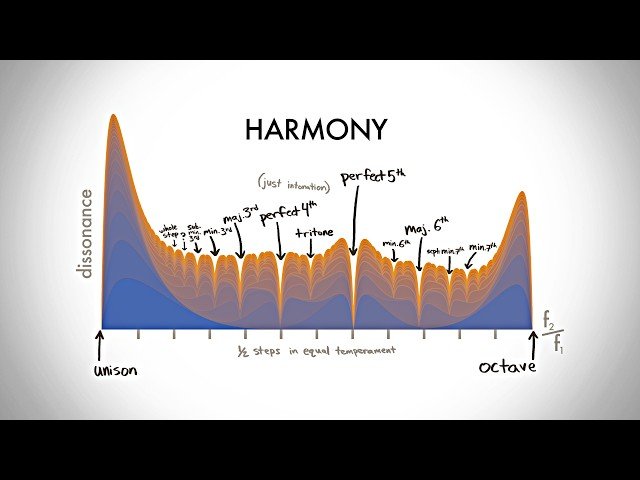
This physical understanding forms the basis, but it's not the whole story. Our perception of dissonance is also shaped by cultural and musical context. The research paper "On Musical Dissonance" introduces a dual-process theory, arguing that our experience of dissonance is a combination of two factors:
- Sensory Dissonance: The bottom-up psychoacoustic "roughness" we just discussed.
- Tonal Dissonance: A top-down cognitive factor based on our learned, implicit knowledge of musical conventions. A chord is "tonally dissonant" if it violates the norms of the musical system we're accustomed to.
[PDF] On Musical Dissonance - Yuan Chang Leong
This paper by Johnson-Laird, Kang, and Leong offers a formal, scientific perspective on dissonance that integrates physics and cognition.
You don't need to read the entire paper, but focus on the core argument: Start with the introduction to understand the two main approaches to dissonance. Read the section "Our present enterprise" to solidify the idea of dissonance as a subjective, psychophysical phenomenon. Skim the section "Psychoacoustics and Sensory Dissonance" which formalizes the concept of roughness that the video introduced. Finally, read the summary of the dual-process theory and the General Discussion, which conclude that both sensory roughness and learned tonal principles are essential.
This dual model is crucial for us as producers. We can create tension using intervals that are inherently "rough" (like a minor second) and also by subverting harmonic expectations built through cultural learning.
A Producer's Guide to Dissonant Intervals
In many musical styles, the goal is to create tension only to resolve it. However, in techno, industrial, and related genres, the objective is often to create and sustain a high level of tension, never fully offering the comfort of resolution. This requires a different approach to harmony—one that embraces dissonance.
Let's classify intervals by their tension potential, specifically for the context of electronic music production.
Music Theory for Techno Production: Dissonance and Intervals for catchier Synth Lines
The video "Music Theory for Techno Production: Dissonance and Intervals" by SINEE Global is a perfect practical guide to this mindset. It explicitly advocates for avoiding "cheesy" consonant intervals to maintain tension.
Watch the following segments to get a feel for how to categorize and use intervals for tension: The introduction frames dissonance as a "superpower" for techno, distinguishing its use from that in pop music. Perfectly Consonant Intervals: The octave, perfect fifth, and perfect fourth. These provide stability and resolution. In our context, they are tension killers. Imperfectly Consonant Intervals: Major/minor thirds and sixths. These add colour and some emotional ambiguity but are not inherently tense. The major second and minor seventh are also in this category and are particularly useful for creating a sense of space without strong tension. Dissonant Intervals: The minor second (and its inversion, the major seventh) and the tritone. These are our primary tools for creating strong, palpable tension. They have high sensory roughness and strongly imply movement.
To summarize, for building tension, we are most interested in:
- Minor Second (m2): A one-semitone interval (e.g., C to C#). It is highly dissonant and "grating."
- Major Seventh (M7): An eleven-semitone interval (e.g., C to B). It is also highly dissonant and creates a strong "pull" back to the octave.
- Tritone: A six-semitone interval (e.g., C to F#). Historically dubbed diabolus in musica (the devil in music), it has a famously unstable and ambiguous sound.
Building Tension in Practice: Macro vs. Micro
Tension in a track operates on multiple timescales. The resource "The Advanced Guide to Tension and Energy in Electronic Music" provides a useful framework by distinguishing between two types of tension:
- Macro-tension: Large-scale tension built over many bars, characteristic of build-ups leading into a drop or major transition. This involves layering sounds, filtering, and evolving harmony.
- Micro-tension: Small-scale tension created over short durations (e.g., one or two beats) to keep the listener engaged and the track moving forward. This includes things like short fills, reverse cymbals, and momentary harmonic dissonances.
The Advanced Guide to Tension and Energy in Electronic ...
This article from EDMProd provides a practical framework for thinking about tension in an arrangement.
Read the introduction and the sections on macro- and micro-tension. This will help you contextualize where and how to apply the harmonic techniques we're about to discuss.
Harmonic Techniques for Tension
Now, let's combine our understanding of dissonant intervals with the concept of musical tension. Here are specific techniques you can use to create builds and drops.
1. Chromatic Movement
Moving a melody or a chord by semitones is one of the most effective ways to build tension. This is because chromatic motion inevitably involves the highly dissonant minor second interval.
- Chromatic Risers: A classic technique where a synth line or pad chromatically ascends, often over one or two octaves, during a build-up. In the previous lesson, we called this chromatic planing.
- Chromatic Basslines: In genres like acid techno, a bassline that moves chromatically creates a relentless, hypnotic tension.
- "Wrong" Notes: Introducing a note one semitone above or below a stable chord tone creates a powerful, localized dissonance that begs for resolution. You can let it resolve for a moment of micro-tension, or leave it unresolved to build macro-tension.
2. Exploiting the Tritone: The Dominant 7th Chord
The dominant 7th chord (V7) is a cornerstone of functional harmony precisely because it contains a powerful dissonance that drives the music forward. The interval between the 3rd and the 7th of a dominant 7th chord is a tritone. For example, in a G7 chord (G-B-D-F), the interval between B and F is a tritone. This inherent instability creates a strong pull towards the tonic (I) chord.
In a build-up, you can:
- Introduce a V7 chord: If your loop is based on a simple modal progression, introducing the V7 chord will dramatically increase the tension and create the expectation of a drop.
- Repeat the V7 chord: Instead of resolving it, you can loop the V7 chord, frustrating the listener's expectation and amplifying the tension before the drop finally provides the release (or transitions to a new state of tension).
3. Suspension and Dissonant Clusters
Suspension is the technique of holding a note from a previous chord over a new chord with which it is dissonant, before resolving it.
- Example: In a C major chord (C-E-G), holding the G and then changing the underlying harmony to an F major chord (F-A-C) makes the G a dissonant suspension over the F chord. It "wants" to resolve down to F.
For building tension, you can simply not resolve the suspension. A pad holding a suspended note that never resolves throughout a build-up can create a subtle but growing sense of unease. Extending this idea, you can intentionally create dissonant clusters—chords built from adjacent notes, like C-C#-D—to create maximum sensory roughness. These are staples of noise and industrial music.
4. The Context of Dissonance
As the dual-process theory suggests, context is key. A dissonant chord can sound less tense in a logical progression, while a consonant chord can sound tense in a chaotic one. Experiment 3 in the "On Musical Dissonance" paper demonstrated this empirically:
"...chords that are readily construed as tonal sound less dissonant in tonal sequences..., whereas chords that are not construed as tonal do not differ reliably in their dissonance depending on their context."
This means you can manipulate perceived tension by controlling the harmonic context. In a build-up, you could gradually shift from a clear, repeating modal loop to a more random or chaotic sequence of chords. This breakdown of harmonic logic itself creates a powerful form of cognitive tension, even if the individual chords aren't maximally dissonant.
Conclusion
Today we've deconstructed dissonance, tracing it from the physical interference of sound waves to a powerful compositional tool for managing energy in electronic music. You now have a multi-layered understanding of how to generate and control tension.
Key Takeaways:
- Dissonance has a physical basis: Sensory dissonance, or "roughness," is caused by the beating of closely-spaced frequency components (fundamentals and overtones) in complex sounds.
- Dissonance is also cognitive: Our perception of dissonance is influenced by our learned expectations of a musical system. Violating these expectations creates "tonal dissonance."
- Intervals have a tension hierarchy: For building tension, the most potent intervals are the minor second, major seventh, and tritone.
- Chromaticism is a direct path to tension: Moving by semitones naturally incorporates the highly dissonant minor second interval, making it ideal for risers and tense melodic lines.
- Harness harmonic devices: Use dominant 7th chords for their strong pull, suspensions to create unresolved dissonance, and dissonant clusters for maximum roughness.
- Tension is a primary element of arrangement: Use these harmonic techniques to create both large-scale macro-tension (in builds) and small-scale micro-tension (to maintain interest).
For your next production session, try creating an 8-bar build-up. Start with a simple bassline and pad loop. Then, layer these techniques:
- Introduce a chromatically ascending synth line (planing).
- Automate a synth pad to hold a suspended note over the last 4 bars.
- In the final bar, replace the existing harmony with a single, sustained V7 chord or a dissonant tone cluster.
- Drop back into your original loop.
Pay close attention to how the energy and anticipation build with each added layer of harmonic tension.
In our final lesson of this module, we will apply these concepts to a genre-specific context: analyzing how harmonic ambiguity and tension are manipulated in industrial and noise music, taking your understanding of dissonance to its practical extreme.