Welcome back. In our last lesson, we explored how pedal tones and drones can provide a powerful harmonic anchor, a "safety net" that allows for extensive melodic and chordal freedom. We saw that even highly dissonant chord movements can sound coherent when grounded by a persistent bass note. This naturally leads to a new question: what happens when we remove that safety net entirely?
This lesson delves into that very question. We will investigate non-functional chord movement, a technique where the logic of chord progressions shifts from creating tension and release to creating color, texture, and atmosphere. Specifically, we'll focus on planing, or parallelism, a foundational technique in modern harmony and a staple in the experimental and atmospheric genres you're interested in. By the end of this lesson, you will understand how to apply planing to create unique textural shifts in your own electronic music productions, moving beyond the confines of traditional harmony.
What is Non-Functional Harmony?
Before we dive into planing, it's important to clarify what "non-functional harmony" means. As we've seen, functional harmony is a specific system built on the relationships between tonic, subdominant, and dominant chords. It's a model with rules and expectations designed to create a sense of journey and arrival.
"Non-functional harmony," by contrast, isn't a single system. It's a broad descriptor for any harmonic practice that doesn't adhere to this functional model. It tells us what the music isn't, but not necessarily what it is.
To get a clear overview of this concept, let's watch a video from the 12tone channel.
Why Non Functional Harmony Isn't A Thing (Sort Of)
This video, "Why Non Functional Harmony Isn't A Thing (Sort Of)," does an excellent job of positioning functional harmony as just one of many possible systems for organizing chords.
Please watch the first two sections: The recap provides a concise summary of the functional harmony principles we've discussed. The core argument explains why "non-functional harmony" is a category, not a specific model, and sets the stage for exploring alternative harmonic systems.
As the video points out, non-functional pieces are not without structure. They simply rely on different organizing principles. Today, we'll focus on one of the most prominent: the parallel movement of chords.
Planing: Chords as Textural Blocks
Planing, also known as parallelism, is the technique of moving a single chord shape up or down a scale or chromatically. In this approach, the chord is treated as a single textural object, and the traditional rules of voice leading—which prioritize the smooth movement of individual notes—are disregarded. The focus shifts from the relationships between individual pitches to the sonic effect of the moving block of harmony.
This technique was a hallmark of Impressionist composers like Debussy and Ravel and has since become a vital tool in film scoring and many genres of electronic music.
Composition 102: Harmonic Planing
The video "Composition 102: Harmonic Planing" by composer Anne-Kathrin Dern offers an excellent introduction to this concept, framing it as a "coloring effect."
Please watch the introductory segment from the beginning of the video. Pay close attention to how she contrasts planing with traditional counterpoint and functional harmony. Note her point that planing "removes itself from functional harmony" and "completely disregards voice leading."
As Dern explains, the effect is atmospheric rather than functional. It doesn't need to "go" anywhere or resolve; its purpose is to create a specific mood or texture.
Types of Planing
There are two primary types of planing, distinguished by whether the chord shape is modified to fit a scale.
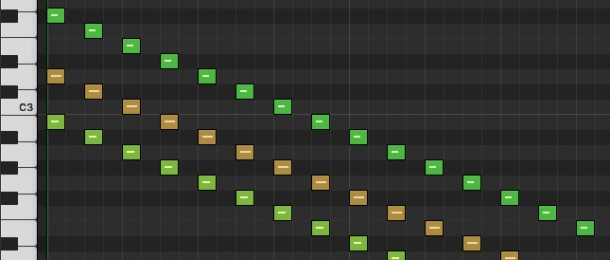
1. Diatonic Planing: The chords move in parallel, but all notes conform to a specific key or mode. This means the quality of the chord (major, minor, diminished) changes as it moves, but the progression feels rooted in a single scale. For example, planing a C major triad up the C major scale would produce: C maj, D min, E min, F maj, G maj, etc.
2. Chromatic Planing: A chord with a fixed intervallic structure is moved in parallel, typically by semitones. The notes do not adhere to any single key. For instance, moving a C major triad chromatically upwards results in a sequence of all major triads: C, C♯, D, D♯, etc. This creates a more disconnected, "otherworldly," and often dissonant effect, a texture frequently exploited in industrial and noise music.
Of course, these two can be combined in what is called mixed planing.
Composition 102: Harmonic Planing
Let's return to Anne-Kathrin Dern's video, where she clearly demonstrates these types.
Watch the section from her explanation of the different kinds of planing. She provides clear definitions and musical examples of diatonic, chromatic, and mixed planing, which will solidify your understanding.
Here is a visual representation of diatonic versus chromatic planing on a piano roll.
Theoretical Frameworks for Parallel Motion
While planing seems simple on the surface, its effects can be understood through more rigorous theoretical lenses, which will appeal to your physics and math background. These frameworks help explain why certain parallel movements feel "smoother" or more connected than others.
Neo-Riemannian Theory: The Geometry of Chords
One powerful model is Neo-Riemannian Theory. Instead of focusing on root movements around a circle of fifths, it conceives of chords as points in a geometric space. Transformations between chords are defined by the most efficient voice leading—that is, by changing the fewest notes possible.
The three primary transformations connect major and minor triads that share two common tones:
- P (Parallel): Changes a chord's quality but keeps the same root (e.g., C major ↔ C minor). One note moves by a semitone.
- R (Relative): Connects a major chord to its relative minor, or a minor chord to its relative major (e.g., C major ↔ A minor). One note moves by a whole step.
- L (Leading-Tone Exchange): Connects a major chord to the minor chord built on its third, or a minor chord to the major chord built on its fifth (e.g., C major ↔ E minor). One note moves by a semitone.

This theory provides a precise way to measure the "distance" between chords based on the number of transformations needed to get from one to another. Progressions that use these transformations, like C major → E minor → G major, often involve parallel motion but feel smooth because of the efficient voice leading.
Why Non Functional Harmony Isn't A Thing (Sort Of)
The 12tone video provides a concise introduction to this fascinating topic.
Watch the segment on Transformational Harmony. It explains the P, R, and L operations and how they define a new kind of harmonic "closeness."
Pitch-Class Sets and Tone-Clock Theory
For an even more abstract and generalizable approach, we can turn to theories that treat any collection of notes as a mathematical set. Pitch-Class Set (pc-set) Theory provides tools for analyzing and relating chords of any structure, not just traditional triads.
A related framework, Tone-Clock Theory (TCT), developed by composers Peter Schat and Jenny McLeod, formalizes parallel motion in a way that should resonate with your interest in simulations and models. In TCT, planing is described as "steering."
- Steering: The process of transposing one pitch-class set (the "steered" set) by the intervals of another pitch-class set (the "steering" set).
For example, "steering" a C major triad {0, 4, 7} by a whole-tone dyad {0, 2} would produce two triads: the original {0, 4, 7} and one transposed up by a major second, {2, 6, 9} (a D major triad). This is a formal way of describing planing.
This framework allows for the systematic generation of complex, non-functional textures by applying a consistent transpositional logic to any harmonic object.
[PDF] MMASS Lecture 1 — Tone-clock theory.key - Michael Norris
This lecture summary by Michael Norris provides a glimpse into this advanced theoretical world. It's dense, but the core concepts are directly relevant to generalizing the idea of planing.
Focus on these key ideas: Read the introduction on the first two pages to understand the context. Note the explicit mention of chromatic planing as a precursor. The key insight is on page 4: TCT extends pc-set theory by examining transpositional patterns. On page 7, read the definition of Steering. This is the formal concept behind planing. On page 8, the concept of Tone-clock steering is introduced as a process that generates all 12 pitch classes, linking it to the geometric idea of "tessellation" or "tiling."
While you don't need to master TCT to use planing, understanding that it can be formalized as a systematic, generative process opens the door to creating highly structured yet non-functional music, which is a cornerstone of many experimental styles.
Applications in Composition and Production
Now, let's bring this back to practical application. How can you use planing in your electronic music?
The thesis paper on Wayne Shorter's music provides excellent, specific examples of how planing is used in a sophisticated harmonic context.
[PDF] Functional and Non-Functional Harmonic Devices in the Music of ...
This paper analyzes the non-functional harmony of jazz innovator Wayne Shorter, with a dedicated section on chordal planing.
Read the section titled <span data-type="resource_reading_textrange" data-resource-subitem-id="5e93aced" data-range-start="Chordal Planing" data-range-end="root motion.">"Chordal Planing" through the end of the "Minor Chord Planing" subsection. The author breaks down planing by chord quality (Major Chord Planing, Minor Chord Planing) and by the interval of transposition (major 2nds, minor 3rds, etc.). This provides a catalog of specific planing techniques and their effects.
Inspired by these examples and the techniques we've discussed, here are some direct applications for your productions:
- Atmospheric Pads: Use diatonic planing on a pad sound to create a lush, evolving harmonic bed that stays within a specific mode. This is common in ambient techno and deep house.
- Dissonant Industrial Textures: Use chromatic planing with distorted, aggressive synth sounds. Planing minor chords or dissonant clusters (like those from TCT) chromatically creates the jarring, mechanical, and powerful textures central to industrial music.
- Transitions and Risers: A series of chromatically ascending or descending planed chords is an incredibly effective way to build tension and create a transition between sections of a track.
- Harmonizing Melodies: Instead of using functional chords, harmonize a melody by simply moving a single chord shape in parallel with the melodic line. Experiment with different chord voicings (major, minor, sus4, power chords) to see how the texture changes.
Composition 102: Harmonic Planing
Finally, let's revisit Anne-Kathrin Dern's video for concrete production examples.
Watch the final, extensive section from her demonstration of practical applications. She shows how to use planing for creating atmospheres, for action music, and for scene transitions. Notice how she manipulates chord quality (major vs. minor) and orchestration to achieve completely different moods with the same underlying technique.
Conclusion
Today, we've stepped outside the world of functional harmony to explore planing, a technique that treats chords as movable textural blocks. By ignoring traditional voice leading and moving entire chord shapes in parallel, you can shift the focus from harmonic progression to harmonic color.
Key Takeaways:
- Non-Functional Harmony is a category of systems that don't rely on tonic-dominant relationships.
- Planing (Parallelism) is a key non-functional technique where a chord shape is moved up or down, treating it as a single textural unit.
- Diatonic Planing moves chords within a key, creating a modal, cohesive sound.
- Chromatic Planing moves a fixed chord shape by semitones, creating a disconnected, often dissonant texture ideal for experimental and industrial music.
- Advanced frameworks like Neo-Riemannian Theory and Tone-Clock Theory provide rigorous models for understanding and generating these parallel movements.
- Planing is a versatile production tool for creating atmospheres, transitions, and harmonizing melodies in a non-traditional way.
For a practical exercise, create a new project in your DAW. Take a simple melodic phrase. First, harmonize it using diatonic planing within the C Dorian mode. Then, create a new version where you harmonize the same melody using chromatic planing of a simple C minor triad. Pay close attention to the dramatic shift in mood and texture. This direct comparison will be invaluable for internalizing the different effects of these powerful techniques.
In our next lesson, we will continue this exploration of modern harmony by focusing on how to harness chromaticism and dissonance to build tension for builds and drops, a critical skill for structuring dynamic electronic music.