Introduction
In our previous lesson, we explored the mathematical foundations of Frequency Modulation (FM) synthesis, discovering how the interplay between a carrier and a modulator can generate rich, complex timbres from simple sine waves. We saw how the modulation index and the carrier-to-modulator ratio provide precise control over the spectral content, allowing us to create both harmonic and inharmonic sounds.
This lesson transitions from theory to application. Our goal is to use these principles to design percussive sounds. The process of synthesizing a drum hit is remarkably similar to modeling a physical event: we will analyze the distinct acoustic components of a percussive sound—the initial impact, the tonal decay, the noisy rattle—and construct a model for each using envelopes, noise, and the power of FM synthesis. Your experience in analyzing complex physical systems will be a great asset here as we deconstruct and then reconstruct sounds from first principles.
The Anatomy of a Percussive Sound
Percussive sounds are primarily defined by their evolution over time and their spectral character. The key ingredients are:
- A Sharp Transient: The initial "hit" is extremely brief and often rich in high-frequency content.
- Rapid Amplitude Decay: The sound's energy dissipates quickly. In an ADSR envelope, this translates to a very fast attack, a short decay, zero sustain, and a short release. The classic percussive envelope is often just an AD (Attack-Decay) shape.
- Inharmonic Spectrum: Unlike pitched instruments, many drums, cymbals, and metallic objects produce spectra where the overtones are not integer multiples of a fundamental frequency. This gives them their characteristic metallic or noisy quality.
- Pitch Sweep: For instruments with a vibrating membrane, like a kick drum or tom, the initial strike increases the membrane's tension, causing a rapid rise in pitch followed by a quick decay to its resting pitch. This is modeled with a fast-decaying pitch envelope.
Let's begin with the simplest percussive sound: a burst of noise. A hand clap, for instance, can be convincingly synthesized by shaping white noise with a very fast envelope.
Chapter 5. Percussion Synthesis
This section from a book on modular synthesis provides a concise example of creating a hand clap sound.
Read the short section on hand clap synthesis. Notice that the core idea is simply to apply a fast envelope to a white noise source to create the percussive burst.
This establishes the foundational role of the envelope. Now, let's incorporate FM to add the tonal complexity needed for sounds like kicks and snares.
Case Study 1: The Kick Drum – FM with Noise
A kick drum sound can be deconstructed into a low-frequency "thump" and a high-frequency "click" from the beater striking the drumhead. We can model both elements simultaneously using FM synthesis where noise acts as the modulator.
This approach is highly effective because it treats the click and thump as originating from the same event, just as they do in reality. The sine wave carrier provides the body or "thump," while briefly modulating its frequency with noise creates the sharp, complex "click" at the very beginning of the sound.
Let's watch a video that demonstrates this technique clearly.
Synthesize Kick drums that sound REAL using the power of FM
This video, "Synthesize Kick drums that sound REAL," presents an excellent method for creating the punchy, close-mic'd sound of a kick drum using noise and FM.
Please watch the section explaining the synthesis of the 'nearfield' kick sound, from the start of the tutorial. Pay close attention to the two separate envelopes being used: one for the overall amplitude of the sine wave, and a much shorter one controlling the FM amount from the noise source.
To summarize the technique from the video:
- Carrier: A sine wave oscillator provides the low-frequency energy of the kick.
- Pitch Envelope: The carrier's pitch sweeps downwards very quickly. This mimics the drumhead's change in tension and creates the characteristic "thump."
- Modulator: A white noise generator.
- Amplitude Envelope: A standard percussive envelope (
A:0, D:short, S:0, R:short) is applied to the sine wave's amplitude, shaping its overall duration. - FM Envelope: A second, extremely short envelope (
A:0, D:very short, S:0, R:short) is applied to the FM amount (i.e., the level of the noise modulator). This ensures the complex, noisy spectrum generated by the FM process only occurs for a few milliseconds at the start, creating the beater's "click."
This method of using noise to frequency-modulate a sine wave is a classic technique for generating what's known as "pitched noise," a sound that has both noisy and tonal characteristics. It's the perfect tool for creating the attack portion of many percussive sounds.
Case Study 2: The Snare Drum – Building with Multiple Operators
A snare drum is acoustically more complex than a kick. It consists of at least three distinct components:
- The fundamental tone and related vibrations of the drumheads.
- A set of inharmonic partials that give the drum its metallic "ring" or "body."
- The sharp, noisy "snap" or "rattle" of the snares against the bottom head.
To synthesize this, we can adopt a layered approach, dedicating different oscillators to each component. This is where the power of a multi-operator FM synth truly shines.
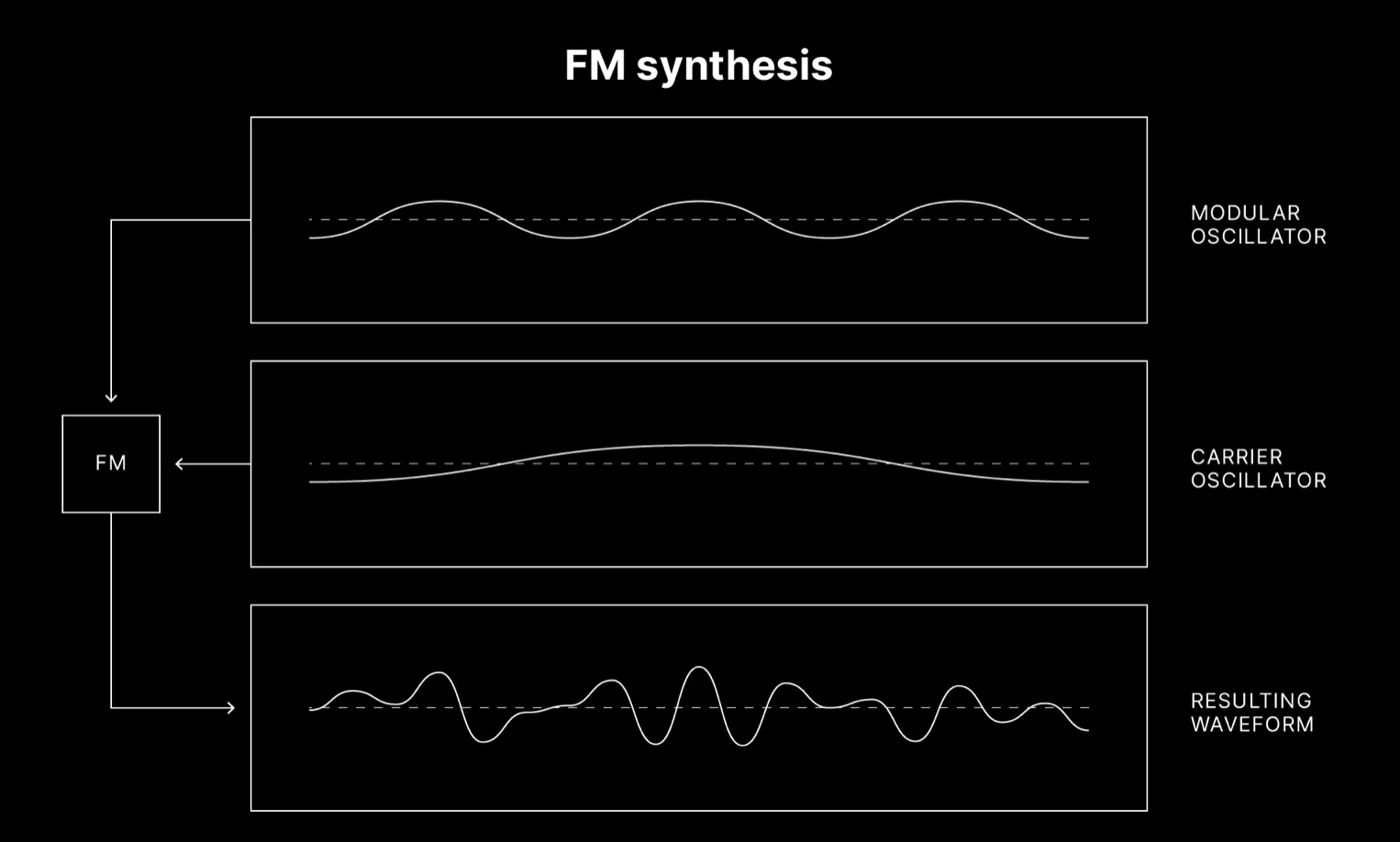
The following video provides an in-depth walkthrough of building a snare from scratch, meticulously creating each layer. This process is a fantastic practical application of the FM theory we covered in the last lesson.
FM Snare Drum Synthesis [Sound Design // Tutorial]
The video "FM Snare Drum Synthesis" by Venus Theory takes a scientific approach, first analyzing a real snare and then synthesizing its constituent parts in FM8.
Watch the following segments to see how the snare is constructed layer by layer: The Fundamental: Notice the use of a fixed frequency (determined from spectral analysis) and a simple, short decay envelope to create the basic tone. The Partials: This is the most crucial part. Observe how multiple operators are set to non-integer frequency ratios to generate the inharmonic metallic timbre. Each operator has its own short envelope, and the higher-frequency partials are given slightly shorter decays—a detail that mimics the natural behavior of physical objects. The Noise: Here, a dedicated noise operator is filtered to create the characteristic 'clappy' part of the snare. The Pitch Envelope: Finally, a subtle, fast pitch decay is applied to the tonal components to add a final touch of realism and 'snap'.
The key takeaway here is the modularity of the approach. A complex sound is built by summing simpler, purpose-built components. The FM routing matrix allows for intricate interactions between these components, creating a cohesive whole.

Expanding the Palette: Experimental Percussion
The principles we've used—shaping sound with envelopes and creating texture with FM—are not limited to recreating acoustic drums. Your interest in industrial and noise music opens the door to more experimental applications. The source of your percussive sound doesn't have to be a simple sine wave; it can be anything. By forcing a percussive envelope and aggressive processing onto unconventional source material, you can create entirely new textures.
Let's return to the kick drum video, which has an excellent section on "breaking the rules."
Synthesize Kick drums that sound REAL using the power of FM
This final section of the kick drum synthesis video explores how to move beyond realism into experimental sound design.
Please watch the segment from where the creator discusses "breaking the rules". The core idea presented is that any sound source—a detuned supersaw, ambient traffic noise, a field recording—can be turned into a percussive element by applying the right dynamic and spectral processing.
This mindset is central to genres like industrial and noise. The process becomes one of transformation: taking a sound with its own inherent character and forcing it into a new rhythmic and timbral role. By applying a fast amplitude envelope, a sharp filter sweep, and heavy distortion, you can find percussive potential in almost any audio source.
Conclusion
In this lesson, we bridged the gap between the theory of FM synthesis and the practical art of sound design. We've seen that creating convincing and novel percussive sounds is a process of deconstruction and reconstruction, grounded in an understanding of acoustic principles.
Key Takeaways:
- Percussive sounds are primarily defined by their envelopes: fast attack, quick decay, and zero sustain are typical.
- Pitch envelopes are crucial for emulating the sound of vibrating membranes like drumheads.
- FM synthesis is an ideal tool for generating the complex, inharmonic spectra characteristic of most percussion. Using non-integer carrier-to-modulator ratios is a key technique.
- Using noise as a modulator in an FM context is a powerful way to create sharp, textured transients and "pitched noise."
- Complex percussive sounds like snares can be built in layers, synthesizing the fundamental, partials, and noise components separately and then combining them.
- The principles of percussive synthesis can be applied experimentally to any sound source, not just simple waveforms, to create unique textures for industrial and noise music.
In our next lesson, we will explore the other end of the synthesis spectrum. We'll move from creating short, transient sounds to designing long, evolving pads, where slow envelopes and LFOs become our primary tools for creating movement and texture.