Introduction
In our last lesson, we focused on the synthesis of percussive sounds, mastering the art of creating brief, transient events defined by fast envelopes and complex, often inharmonic, spectra. We learned how to model the sharp impact and rapid decay characteristic of drums. Now, we turn our attention to the opposite end of the sonic spectrum: creating sustained, evolving pad sounds. Where percussion is about the single point in time, a pad is about the passage of time itself.
This lesson will equip you with the fundamental techniques for designing these lush, atmospheric textures. We will explore three core pillars of pad synthesis, each building upon the last:
- Slow Envelopes: To give the sound its sustained, swelling character.
- Multiple Detuned Oscillators: To create harmonic richness and a sense of width.
- LFO Modulation: To impart subtle, continuous movement and prevent the sound from being static.
Your background in physics, particularly with wave phenomena, will provide a unique advantage in understanding how these elements interact. We will see how concepts like interference and beating are not just textbook physics but are the very heart of creating a "thick" and "rich" synthesized sound.
The Foundation: Slow Envelopes for Sustain
The most fundamental difference between a percussive sound and a pad lies in its amplitude envelope. A percussive hit uses a fast attack and rapid decay to create a short burst of energy. A pad, by contrast, is designed to provide a continuous textural background. To achieve this, we invert the envelope's characteristics.
- Slow Attack: The sound doesn't start instantly but swells in gradually. This removes any percussive "hit" and allows the sound to emerge smoothly.
- High Sustain: The sound maintains its volume as long as a key is held, providing the continuous "bed" of the pad.
- Slow Release: After the key is released, the sound doesn't stop abruptly but fades out over a longer period, creating a lingering sonic tail.
This creates a "trapezoidal" shape, as opposed to the sharp triangle of a percussive sound.
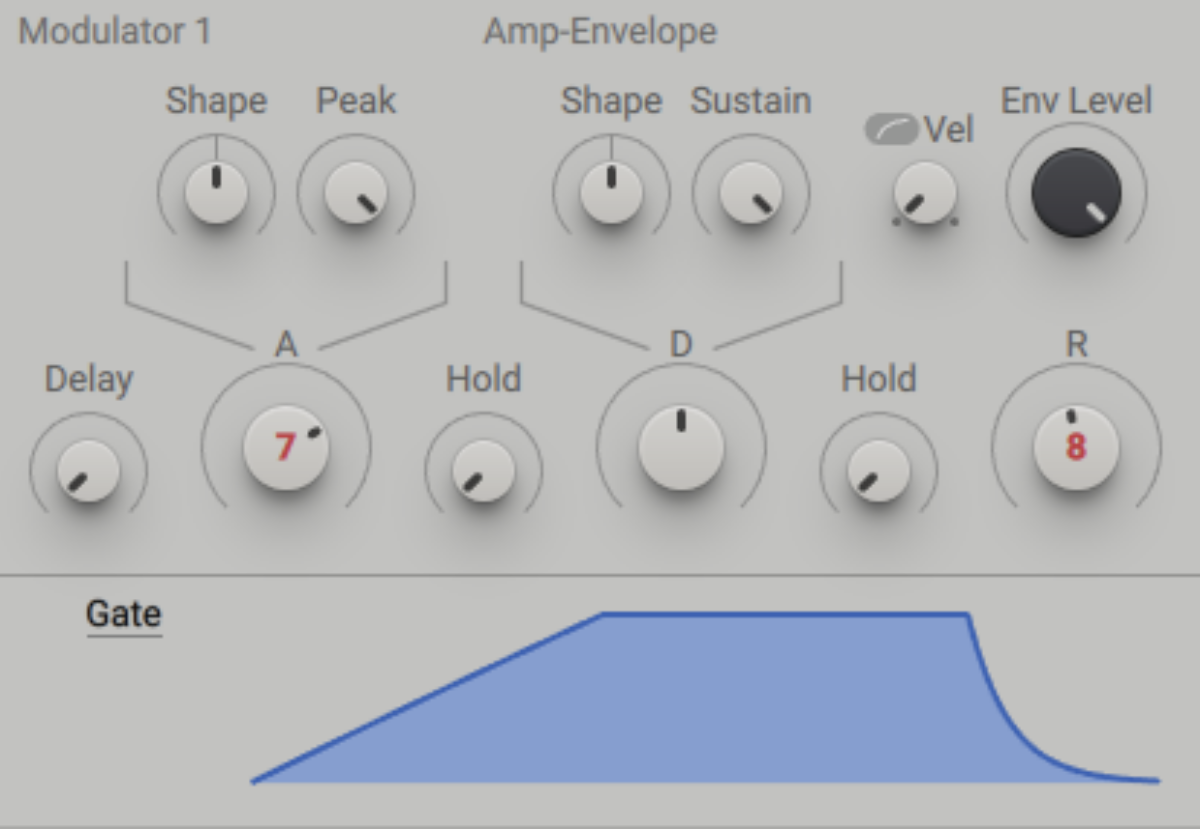
Let's watch a clear demonstration of setting up such an envelope for a pad sound.
Roland Gaia Tutorial 1 - A BIG Synth Orchestra - Subtractive Synthesis
This segment from the "Roland Gaia Tutorial 1" provides a focused look at shaping the amplitude envelope for a sustained string-like sound.
Watch from where the presenter adjusts the amplifier envelope. Pay close attention to how manipulating the Attack, Sustain, and Release knobs transforms an instant, sharp sound into one that swells in and fades out gracefully.
This slow envelope is our canvas. It provides the temporal space needed for the more complex textural elements to unfold.
Creating Richness: Multiple Detuned Oscillators
A single oscillator, even with a slow envelope, can sound thin and sterile. To create the classic "lush" pad sound, we need to introduce more harmonic complexity and a sense of width. The most common and effective technique is to use multiple oscillators and detune them slightly against each other.
From a physics perspective, this is a direct application of the principle of interference. When you sum two waves of slightly different frequencies, say and , they move in and out of phase. This creates a periodic variation in the resulting amplitude, a phenomenon known as "beating," with a beat frequency equal to the difference in the source frequencies, .
In synthesis, when the frequency difference is small (a few Hz), we don't perceive two separate pitches. Instead, we perceive this amplitude modulation as a rich, shimmering, "chorused" effect. The sound becomes thicker and more animated.
The following article from Sound On Sound provides an excellent explanation of this principle.
Synthesizing Strings: String Machines
This article breaks down the components of classic string synthesizer sounds, starting with the foundational concept of detuning.
Please read the section Detuning Multiple Oscillators. The author provides a clear, physics-grounded explanation of how detuning sine and sawtooth waves creates beating and a 'thicker' timbre.
Now let's see this principle in action. The following video demonstrates both detuning and the related technique of layering oscillators in different octaves to create a fuller sound.
How To Make Ambient Pads 100% From Scratch (Vital Tutorial)
This tutorial, "How To Make Ambient Pads 100% From Scratch," shows how to build a complex pad by layering multiple sound sources.
Watch the section on layering from the beginning of step two. Notice how the creator adds a saw wave and a triangle wave to the initial sine wave. He then pitches the third oscillator up an octave and, crucially, gives each layer its own unique ADSR envelope. This technique of having different timbral layers fade in at different rates is a powerful way to make a pad evolve over time.
Most modern synthesizers have a "Unison" function, which automates this process by creating multiple copies of the oscillator's waveform and detuning them automatically.
Creating Movement: Low-Frequency Oscillator (LFO) Modulation
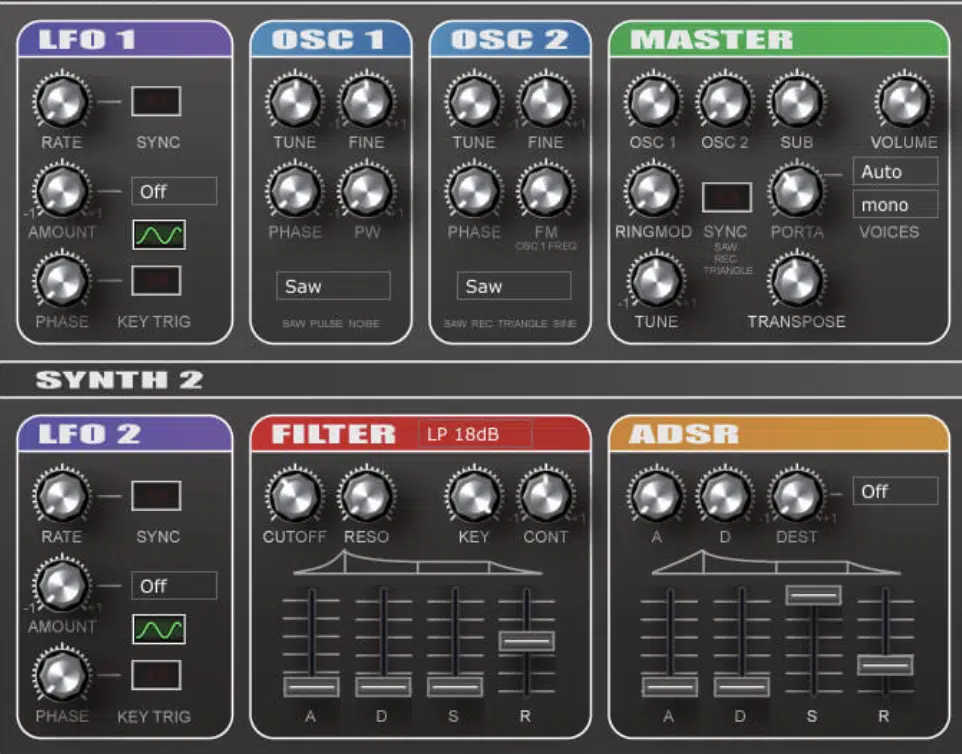
Our pad is now sustained and rich, but it's still static. If you hold a chord, the timbre remains the same. To make the sound truly engaging and "alive," we need to introduce continuous, evolving change. This is the primary role of the Low-Frequency Oscillator (LFO).
An LFO generates a periodic waveform (like a sine, triangle, or square wave) at a sub-audio frequency, typically below 20 Hz. We don't hear the LFO itself; instead, we use its output as a control signal to modulate other parameters of the synthesizer. For pads, common modulation targets include:
- Filter Cutoff: Modulating the filter cutoff with a slow sine or triangle LFO creates a gentle "sweeping" or "breathing" effect as the sound gets brighter and darker over time.
- Pitch: Applying a very small amount of LFO modulation to the oscillators' pitch creates vibrato, a subtle wavering that emulates the instability of acoustic instruments and adds life.
- Panning: Modulating the pan position creates stereo movement, making the sound feel wider and more immersive.
For pads, the key is subtlety. We use very slow LFO rates so that the changes unfold over many seconds, creating a sense of gradual evolution.
Roland Gaia Tutorial 1 - A BIG Synth Orchestra - Subtractive Synthesis
The "Roland Gaia Tutorial" offers a superb demonstration of applying subtle LFO modulation to create an animated sound.
Please watch the segment from where the LFO is introduced. The presenter does two crucial things: he uses a very slow rate and a fade-in time, so the modulation isn't present at the start of the note but gradually appears. This is an essential technique for creating pads that evolve over longer durations.
To create less predictable, more organic movement, we can use a "Random" or "Sample & Hold" (S&H) LFO shape. As you know from your work with noise in physical systems, a noise signal is aperiodic. A Sample & Hold circuit takes "snapshots" of a noise source at regular intervals (the LFO rate), producing a sequence of random stepped values. Modulating a parameter with this signal avoids simple periodic repetition, making the sound feel more natural and complex. The Sound On Sound article provides a great explanation.
Synthesizing Strings: String Machines
This section of the article introduces a more advanced modulation source to create a more "human" sound.
Read the section titled Humanising The Sound. This explains how using a "Random" LFO setting (S&H on a noise source) can remove the unnatural regularity of simple LFOs, leading to a sound that feels more "analogue" or "unstable."
Conclusion
In this lesson, we have constructed the essential architecture of a sustained pad sound, moving from the static to the dynamic. We've seen that what we perceive as a single, rich, evolving texture is in fact a carefully orchestrated interplay of multiple simpler components.
Key Takeaways:
- Sustained Character: Pad sounds are built on slow amplitude envelopes, with a long attack to swell in and a long release to fade out.
- Richness and Width: The core timbral richness comes from layering multiple oscillators and detuning them. This uses the physical principle of wave interference to create a "beating" effect perceived as a chorus.
- Movement and Evolution: LFOs are used to create continuous, subtle changes over time. Modulating the filter cutoff, pitch, and pan with slow or random LFOs transforms a static sound into a living, breathing texture.
- Layering Complexity: Advanced pads often use independent envelopes for different oscillator layers, causing the timbre to evolve as different elements fade in and out at different rates.
Where percussive synthesis was about precision in a moment, pad synthesis is about managing change over long durations. You are not just defining a sound, but the journey it takes over time.
In our next and final lesson of this module, we will put all our synthesis knowledge to the test. You will learn how to approach a sound you hear in a track and work backward to deconstruct its components, a process known as reverse-engineering a synth patch.