Introduction
Welcome to your next lesson in the "Dinacharya: Classical Principles and Practices" module. In our previous lesson, we conducted a comparative analysis of Dinacharya across the Brihat Trayi, noting that while all texts agree on the core practices, they offer unique emphases. We specifically highlighted that Sushruta Samhita, with its focus on Shalakya Tantra, gives particular importance to practices that maintain the health and clarity of the sense organs.
Building on that, today's lesson focuses on a cornerstone of ocular hygiene and therapy: Anjana. The goal is to analyze the principles, types, and benefits of Anjana, evaluating its clinical indications and contraindications.
We will dissect this practice from multiple angles: its classical rationale, its detailed classifications, its precise clinical application, and its potential mode of action from a modern scientific viewpoint. This granular approach will equip you with the deep conceptual and practical knowledge required for effective clinical implementation.
1. The Core Principle: Why Anjana?
The fundamental purpose of Anjana is rooted in the unique physiological environment of the eyes. The eyes are the primary seat of Alochaka Pitta, the subdosha of Pitta responsible for vision, which is associated with the Tejas Mahabhuta (fire element). However, the eyes are located in the head (Urdhvajatru), a region naturally dominated by Kapha Dosha.
This creates a dynamic where the clarity of the "fire" of vision can be obscured by the accumulation of "moisture and earth" (Kapha). As Acharya Vagbhata poetically notes, just as metals derive their sharpness from rubbing and become dull with inactivity, the eyes, which are made of Tejas, maintain their sharpness through proper conduct. Daily Anjana acts as this "rubbing" or cleansing mechanism, preventing the accumulation of Kapha and ensuring that Alochaka Pitta functions without obstruction.
The classical definition itself, "Anakti iti Anjanam", implies a substance that reveals, clarifies, or makes manifest, highlighting its primary action of promoting visual clarity.

2. A Multifaceted Classification
To apply Anjana effectively, you must understand its various classifications, which determine its specific therapeutic action.
First, watch this video which provides a concise overview of Anjana as described in Ashtanga Hridayam. We will build upon the concepts it introduces.
Chapter 23 ASCHOTANAM AND ANJANA VIDHI - ASHTANGA HRIDAYA SUTRASTHANA
The video 'Chapter 23 ASCHOTANAM AND ANJANA VIDHI' by Ayurveda Smart Eclasses offers a detailed explanation based on Ashtanga Hridayam. Pay close attention to the sections on the types, forms, and timing of Anjana.
Please watch from 04:15 to 08:49, and also from 08:49 to 10:13. This covers the indications, types (Lekhana, Ropana, Prasadana), forms (Pinda, Rasakriya, Churna), applicators, and appropriate timing for Anjana.
As the video explained, Anjana can be classified based on its action, form, and intended use.
A. Classification by Action (Karma)
This is the most critical classification for clinical decision-making.
| Type | Dominant Tastes & Qualities | Action |
|---|---|---|
| Lekhana (Scraping/Cleansing) | Katu, Amla, Lavana, Kashaya, Tikta (Pungent, Sour, Salty, Astringent, Bitter); Tikshna Guna (Sharp quality) | Drains and scrapes out vitiated Doshas (especially Kapha and Ama) from the eyelids, lacrimal system, and channels. |
| Ropana (Healing) | Kashaya, Tikta (Astringent, Bitter) + Sneha (Unctuous substances like ghee/oil) | Promotes healing of ocular tissues, improves colour and clarity post-inflammation. |
| Prasadana / Snehana (Soothing/Nourishing) | Madhura (Sweet) + Sneha (Unctuous substances) | Pacifies Vata and Pitta, lubricates, nourishes, relieves fatigue, and clarifies vision. |
B. Classification by Form (Kalpana)
The physical form of the Anjana determines its potency and contact time with the ocular surface.
- Gutika / Varti: A solid pill or wick, which is mixed with a liquid medium (like water, honey, or breast milk) before application. It generally has a longer shelf life.
- Rasakriya: A semi-solid herbal concentrate or gel. This form can be correlated with modern aqueous solutions/gels.
- Churna: A fine powder applied with a Shalaka (applicator). It often has the strongest and most immediate action.
According to Sushruta, the potency increases from Gutika to Rasakriya to Churna. This understanding helps in selecting the appropriate form based on the severity of the Dosha vitiation.
C. Classification by Use (Prayoga)
- Nitya Prayoga (Daily Use): This refers to Sauviranjana, a mild collyrium (traditionally Antimony sulfide), which is Prasadana in nature. Its purpose is preventive—to daily clear the subtle accumulation of Kapha and protect the eyes from environmental stressors. This is the Anjana mentioned as part of Dinacharya.
- Prayogika / Chikitsa Prayoga (Therapeutic Use): This involves stronger formulations, such as Rasanjana (an extract of Berberis aristata), which has a potent Lekhana (scraping) action. It is used periodically (e.g., once a week as per Vagbhata) for a more profound cleansing or as a treatment for specific eye diseases.
3. Clinical Application: Indications and Contraindications
Your skill as a clinician lies in discerning precisely when and when not to use Anjana.
Indications (Anjana Arha)
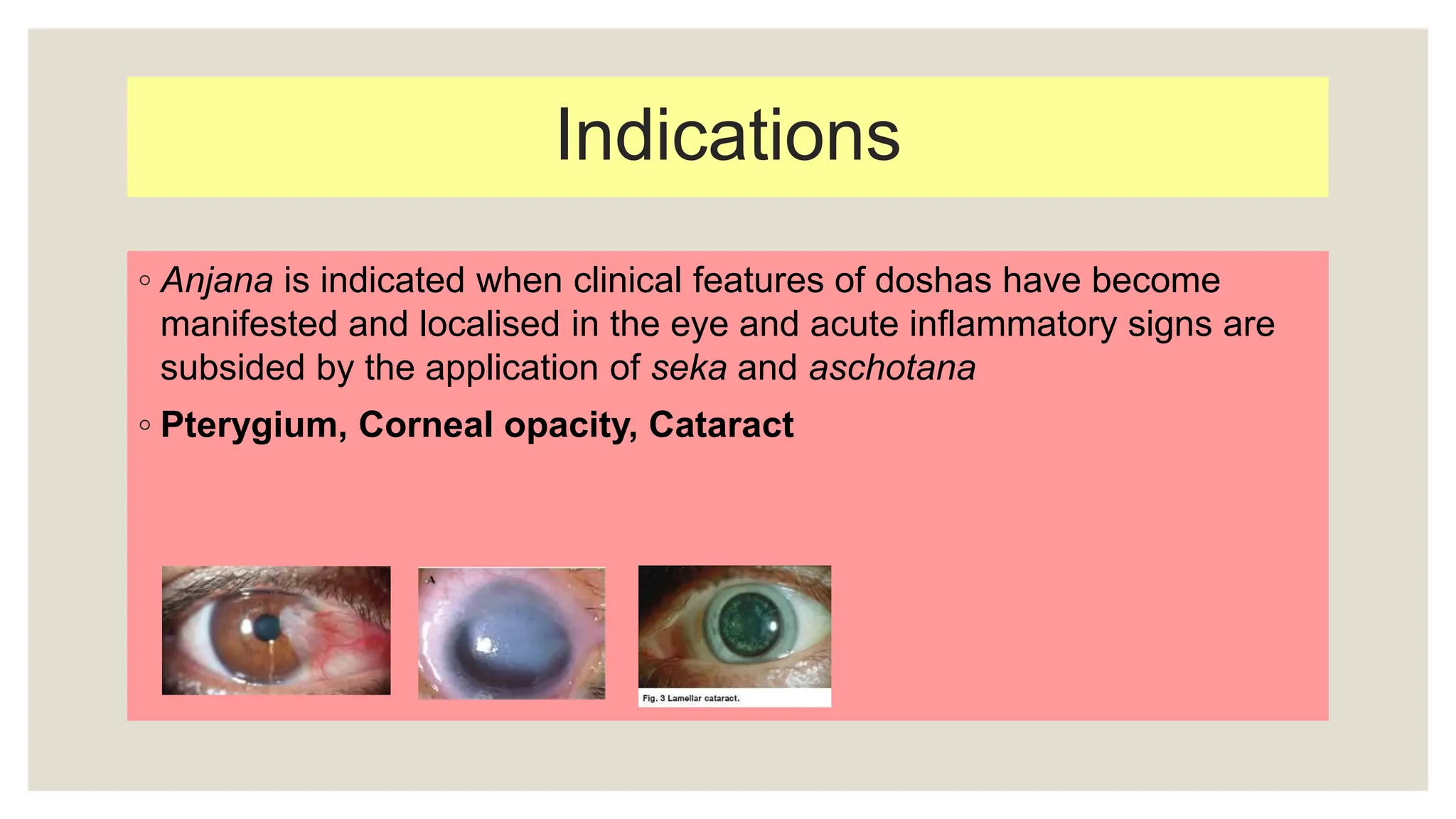
The single most important prerequisite for therapeutic Anjana is the Pakva Dosha Avastha—the "cooked" or mature stage of a disease. It should not be used in the acute, inflammatory (Ama) stage, which is characterized by intense pain, redness, and watery discharge.
Anjana is indicated when:
- Symptoms of the acute stage have subsided.
- There is mild swelling (Alpa-shopha), mild itching (Na-ati-kandu), and thick, slimy discharge (Picchila srava).
- The body has been purified by appropriate Panchakarma procedures.
- The Doshas are localized primarily in the eyes.
Contraindications (Anjana Anarha)
Applying Anjana in contraindicated states can lead to serious complications (Vyapad). It should be avoided in the following situations:
- Systemic States: Fever (Jwara), indigestion (Ajirna), fear (Bhaya), grief (Shoka), anger (Krodha), after consumption of alcohol (Madya), and during suppression of natural urges (Vegadharana).
- Post-Procedural: Immediately after Vamana (emesis), Virechana (purgation), Basti (enema), or a head bath.
- Environmental/Temporal: During extreme cold, on windy days, before sunrise, or during the intense heat of midday.
- Acute Ocular Conditions: In the presence of severe pain (Ruk), severe redness (Raga), or acute conjunctivitis (Abhishyanda).
Test your understanding!
A 45-year-old software professional presents with gritty, tired, and dry eyes with slight redness that worsens by the evening. They have no significant discharge or pain. Based on this presentation, which type of Anjana (by action) would be most appropriate as a therapeutic intervention, and why?
Show answer
The symptoms—grittiness, dryness, fatigue, and mild redness—strongly point towards an aggravation of Vata Dosha in the eyes, likely exacerbated by their profession. The most appropriate choice would be Prasadana or Snehana Anjana.
Rationale: This type of Anjana is formulated with Madhura Rasa (sweet taste) and Sneha (unctuous) substances. These properties directly counteract the Ruksha (dry), Chala (mobile/strained), and Khara (rough) qualities of vitiated Vata. It will lubricate the eyes, soothe the strain, and nourish the ocular tissues, directly addressing the root cause of the patient's discomfort. A Lekhana Anjana would be contraindicated as it would worsen the dryness.
4. The Procedure (Vidhi) and Its Scientific Rationale
For a deeper analysis that bridges classical procedure with modern pharmacology, please study the following research article.
REVIEW OF ANJANA (CORRYLIUM) PROCEDURE AND ...
The paper 'REVIEW OF ANJANA (CORRYLIUM) PROCEDURE AND ITS PROBABLE MODE OF ACTION' by Kankanan Gamage Surangi et al. provides an excellent synthesis of classical knowledge and modern scientific understanding.
Please read the sections 'How to Perform Anjana Therapy', 'PROBABLE MODE OF ACTION OF ANJANA', and 'DISCUSSION AND CONCLUSION'. Focus on how the classical procedure enhances bioavailability and how modern science explains its absorption pathways.
As you read, consider these key points connecting the classical Vidhi with modern pharmacokinetics:
- Application Method: Applying the medicine to the lower palpebral conjunctiva or cul-de-sac and asking the patient to rotate the eyeballs ensures the drug spreads evenly and increases the contact time with the ocular surface. This enhances bioavailability.
- Absorption Pathways: The article discusses how Anjana is absorbed.
- Lipophilic (fat-soluble) components absorb through the cornea via the transcellular pathway.
- Hydrophilic (water-soluble) components absorb through the conjunctiva via the paracellular pathway.
- Drug Forms and Bioavailability: The classical forms of Anjana have modern analogues. Gutika and Churna act like ophthalmic suspensions, where micro-particles deposit in the cul-de-sac, allowing for sustained release. Rasakriya is similar to aqueous solutions or gels.
- Paschat Karma (Post-Procedure Care): The act of washing the eyes (Prakshalana) after the therapeutic effect is achieved prevents prolonged irritation and removes the expelled Doshas, preventing their re-entry or local aggravation. The application of a mild Pratyanjana (counter-collyrium) is akin to using a soothing agent after a strong treatment.
5. A Glimpse into Therapeutic Formulations (Yogas)
The classical texts are a treasure trove of Anjana formulations designed for specific conditions. To appreciate the breadth of these therapeutic options, you can refer to the following resource. You are not expected to memorize these, but to recognize the clinical richness available.
Review of Anjana as per Ayurvedic classics
The review article 'Review of Anjana as per Ayurvedic classics' compiles an extensive list of Anjana formulations from the Brihatrayi.
Briefly scan the tables from Table 7 to Table 17. Note the variety of ingredients and the specific indications listed for different eye diseases (Netra Rogas). This will serve as a valuable clinical reference for you in the future.
This compilation demonstrates how the principles of Dravya Guna (pharmacology) are applied to create targeted therapies, from Vataja Abhishyanda to Timira and Arma, reinforcing the concepts of Lekhana, Ropana, and Prasadana with concrete examples.
Conclusion
Today, we have moved from a general overview of Dinacharya to a deep analysis of Anjana. We have established that it is a sophisticated practice with a clear rationale, a detailed classification system, and precise clinical guidelines.
Key Takeaways:
- Core Principle: Anjana serves to cleanse the ocular environment, preventing the accumulation of Kapha from obscuring the function of Alochaka Pitta.
- Clinical Selection: The choice of Anjana is guided by its action (Lekhana, Ropana, Prasadana), which must be matched to the specific Dosha imbalance and the stage (Avastha) of the disease.
- Safety First: A thorough understanding of the indications (Pakva Dosha) and contraindications is paramount for safe and effective clinical practice.
- Integrated Perspective: Classical procedures for Anjana are intuitively designed to maximize drug bioavailability, a concept that can be further understood and optimized through the lens of modern pharmacology.
Preview of the Next Lesson:
Having focused on the eyes, we will now turn our attention to the next major portal of the head: the nose. In the upcoming lesson, we will analyze the principles, types, and benefits of Pratimarsha Nasya, differentiating it from therapeutic Nasya Karma. We will explore how this practice complements Anjana in maintaining the health of the entire Urdhvajatru region.