Introduction
Welcome to the first lesson of our second module, "Dinacharya: Classical Principles and Practices." In our previous module, we established the advanced foundations of Swasthya, culminating in our exploration of Prana, Tejas, and Ojas as the subtle essences of vitality. We learned that Prana is the animating life force, Tejas is the fire of metabolic intelligence, and Ojas is the ultimate reservoir of immunity and stability.
Today, we transition from theory to practice. Dinacharya, the codified daily regimen, is the primary tool Ayurveda provides to protect, cultivate, and enhance these very essences of life. The goal of this lesson is to: Compare and synthesize Dinacharya guidelines across multiple classical texts, analyzing variations and their clinical implications.
We will survey the core practices of Dinacharya as described in the Brihat Trayi—Charaka Samhita, Sushruta Samhita, and Ashtanga Hridayam. By understanding their common principles and subtle variations, you will build a robust framework for applying these timeless practices in a clinical setting.
1. The Classical Foundations: A Comparative View
The principles of Dinacharya are a cornerstone of the Sutrasthana in all major classical texts. However, each Acharya presents them with a unique emphasis, reflecting the overarching philosophy of their Samhita.
To begin our comparative analysis, let's examine a structured overview of the practices as mentioned across the texts.
WORLD JOURNAL OF PHARMACEUTICAL RESEARCH
The article 'WORLD JOURNAL OF PHARMACEUTICAL RESEARCH' provides an excellent comparative table that juxtaposes the Dinacharya practices mentioned in Charaka Samhita, Sushruta Samhita, and Ashtanga Hridaya. This will serve as our starting point for analysis.
Please study the table titled 'Dinacharya According to Classical Texts' and read the subsequent section 'Key Observations and Differences'. Focus on identifying which practices are common to all and where the emphasis differs.
As you've noted from the reading, while there is broad consensus on the sequence of activities, the emphasis varies:
- Charaka Samhita: The focus is primarily on systemic health, strength-building (Bala), and the maintenance of homeostasis. Practices like Dhoomapana (for Kapha disorders) and Vyayama are detailed with a view towards internal purification and promoting longevity. This aligns with Charaka's position as the foremost text on internal medicine (Kayachikitsa).
- Sushruta Samhita: Given its focus on surgery (Shalya Tantra) and associated specialities like ophthalmology and ENT (Shalakya Tantra), Sushruta places a greater emphasis on the hygiene and protection of the sense organs (Indriyas). Practices like Anjana (collyrium) and meticulous cleanliness are highlighted to prevent infections and maintain sensory acuity, which is critical from a surgical standpoint.
- Ashtanga Hridayam (Vagbhata): True to its name, this text provides a concise and highly practical synthesis of the preceding traditions. Vagbhata presents Dinacharya in a systematic, easy-to-follow manner, making it the most accessible guide for daily application. It serves as an excellent clinical reference that harmonizes the views of Charaka and Sushruta.
Understanding these different perspectives is key. They are not contradictions but complementary views that enrich our clinical understanding. For instance, when treating a patient with recurring eye strain, Sushruta's detailed guidance on Anjana becomes particularly relevant. For a patient with a constitutional Kapha imbalance, Charaka's rationale for Dhoomapana offers a specific therapeutic direction.
2. A Chronological Synthesis of Dinacharya Practices
Now, let's synthesize these guidelines into a single, chronological flow, integrating the "how" and "why" of each practice. This will provide a comprehensive overview before we dissect each practice in future lessons.
The video below offers a detailed walkthrough of the key procedures. We will use it as a guide, supplementing it with insights from our other resources.
02 | Dinacharya | Basics of Ayurveda Part - 1 | Dr. Gitanjali S
This video, 'Dinacharya | Basics of Ayurveda Part - 1' by Dr. Gitanjali S, provides a clear and practical demonstration of the main Dinacharya activities. As you watch the selected segments, pay attention to the procedures, benefits, and contraindications mentioned for each practice.
Watch the video from 04:45 to 51:34. This covers the sequence from waking up (Brahma Muhurta) through bathing (Snana). We will refer back to specific points as we discuss each step.
Drawing from the video and our readings, let's build a synthesized understanding.
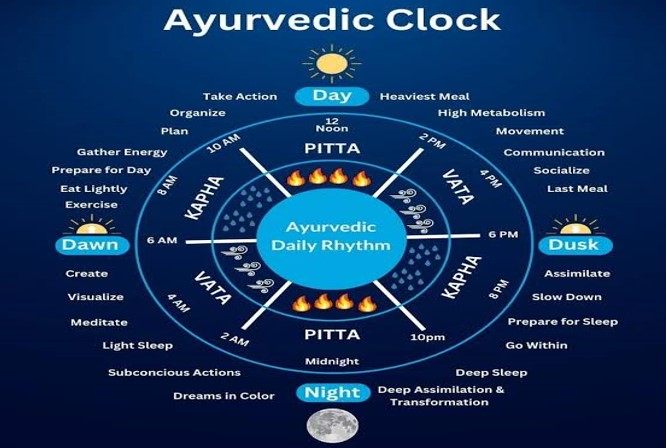
The Ayurvedic Clock and Morning Routines
The timing of Dinacharya is not arbitrary. It is designed to align our bodily functions with the natural rhythms of the cosmos, which Ayurveda describes through the cycles of the Doshas.
-
Brahma Muhurta Jagranam (Waking Before Dawn):
- Principle: All texts advocate waking in the Brahma Muhurta (roughly 96 minutes before sunrise). As the image shows, this period (2 AM - 6 AM) is dominated by Vata Dosha. Vata governs movement and clarity, making this the ideal time to awaken the nervous system and mind for activities like learning and meditation. The mind is also naturally more Sattvic at this time.
- Clinical Implication: Modern chronobiology validates this, noting that cortisol levels naturally peak in the early morning, promoting alertness. Aligning our wake-up time with this rhythm enhances energy and mental clarity throughout the day.
-
Malotsarga (Evacuation): The downward-moving energy of Apana Vayu is naturally active in the morning. Aiding this process by evacuating the bowels first thing in the morning prevents the reabsorption of toxins and vitiation of Vata.
-
Dantadhavana & Jihvanirlekhana (Oral Hygiene):
- Principle: The use of twigs with Kashaya (astringent), Katu (pungent), and Tikta (bitter) tastes is recommended. These tastes have Lekhana (scraping), Krimighna (antimicrobial), and cleansing properties, which remove the overnight accumulation of Kapha and bacteria in the oral cavity.
- Clinical Implication: This practice is not just for oral hygiene. By clearing the tongue (Jihva), which is a mirror to the digestive system, we enhance taste perception (Ruchi) and stimulate digestive enzymes, thereby preparing the Agni for the day.
-
Anjana & Nasya (Sensory & Head Care):
- Anjana (Collyrium): The daily use of Sauviranjana (a mild collyrium) and weekly use of Rasanjana (a stronger, cleansing collyrium) is advised. The head and sense organs are the primary sites of Kapha. Anjana helps to clear accumulated Shleshma (a form of Kapha) from the eyes, which are the seat of Alochaka Pitta but are located in a Kapha dominant region.
- Pratimarsha Nasya (Nasal Oiling): Instilling 2 drops of Anu Taila or sesame oil into the nostrils lubricates the nasal passages, clears the sinuses, and pacifies Vata in the head region (Urdhvajatru). The classical quote "Nasa hi shiraso dwaram" ("The nose is the gateway to the head") underscores its importance for mental clarity, hair health, and preventing diseases of the head and neck.
-
Gandusha/Kavala & Dhoomapana (Oral & Respiratory Cleansing):
- Gandusha (Oil Pulling): Holding medicated oil (like sesame oil) in the mouth strengthens the teeth and gums, improves the voice, and draws out Kapha and Ama from the oral cavity.
- Dhoomapana (Medicated Smoke): This is a more therapeutic procedure, often indicated post-Nasya, to dry up any residual Kapha in the head and chest. Charaka emphasizes its use for preventing Kapha-Vata disorders of the head and neck.
Test your understanding!
A patient complains of chronic morning congestion, a dull headache, and a thick coating on their tongue upon waking. Which specific morning Dinacharya practices would you prioritize to address the underlying Dosha imbalance, and what is your rationale?
Show answer
This clinical picture strongly suggests an aggravation of Kapha Dosha, which naturally accumulates overnight. The key practices to prioritize would be:
- Jihvanirlekhana (Tongue Scraping): To directly remove the accumulated Kapha and Ama from the tongue, which improves taste and stimulates Agni.
- Pratimarsha Nasya: To clear Kapha from the sinuses and head channels, addressing the congestion and dull headache.
- Gandusha: To liquefy and expel Kapha from the oral cavity and upper respiratory tract.
The rationale is that these practices specifically target and eliminate excess Kapha from its primary sites (Urdhvajatru - the region above the clavicle) before it can cause further imbalance during the day.
-
Abhyanga (Oil Massage):
- Principle: Daily oil massage is described as Jarahara (anti-aging) and Vatahara (Vata-pacifying). The skin is a primary seat of Vata. Applying warm oil counteracts the dry (Ruksha), cold (Sheeta), and rough (Khara) qualities of Vata.
- Clinical Implication: Beyond pacifying Vata, Abhyanga nourishes all Dhatus, improves circulation, promotes lymphatic drainage, calms the nervous system, and induces good sleep (Nidrajanana). Special emphasis is given to the head (Shiras), ears (Shravana), and feet (Pada).
-
Vyayama (Exercise):
- Principle: Exercise should be done to half one's capacity (Balaardha). The signs of reaching this limit are sweating on the forehead and armpits, and breathing through the mouth.
- Clinical Implication: This is a crucial point of differentiation from many modern exercise regimens that encourage working to exhaustion. Ayurveda warns that excessive exercise aggravates Vata and can deplete Ojas, leading to long-term damage. The paper "Ayurveda daily regimen practices" (resource LINK) highlights research on the U-shaped curve of exercise benefits, scientifically validating the Ayurvedic principle of moderation.
-
Snana (Bathing):
- Principle: Bathing is considered purifying, an appetizer (Deepanam), an aphrodisiac (Vrishyam), and life-promoting (Ayushyam). It removes sweat and grime, bringing a feeling of freshness.
- Guideline: It is advised to use warm water for the body (which gives Bala or strength) and cool/tepid water for the head, as hot water is considered detrimental to the health of the eyes and hair.
Conclusion
In this lesson, we have laid the groundwork for our study of Dinacharya. We've seen that it is not a mere list of hygiene tips, but a sophisticated system for aligning our physiology with nature's rhythms to promote health and prevent disease.
Key Takeaways:
- Textual Variations: The Brihat Trayi provide a unified framework for Dinacharya, with variations in emphasis: Charaka focuses on systemic health, Sushruta on sensory and surgical hygiene, and Vagbhata on practical synthesis.
- Chronobiological Rationale: Dinacharya practices are timed to counteract the natural accumulation of Doshas (e.g., clearing morning Kapha) and leverage periods of Dosha strength (e.g., eating when Pitta/Agni is high).
- Clinical Goal: The overarching clinical purpose of Dinacharya is proactive Dosha management, preservation of Agni, nourishment of the Dhatus, and maintenance of sensory and mental clarity, ultimately leading to the preservation of Ojas.
Preview of the Next Lesson:
Having established this comparative overview, we will now begin our deep dive into each practice. In our next lesson, we will focus exclusively on a practice strongly emphasized by Sushruta: "Analyze the principles, types, and benefits of Anjana, evaluating its clinical indications and contraindications." We will explore its preparation, application, and therapeutic use in detail.