Introduction
Welcome to your next lesson in the "Dinacharya: Classical Principles and Practices" module. In our last session, we explored Anjana, a vital practice for maintaining the health of the eyes. We established its role in clearing accumulated Kapha to ensure the clarity of Alochaka Pitta. This underscored the Ayurvedic principle of targeted daily maintenance for the sense organs.
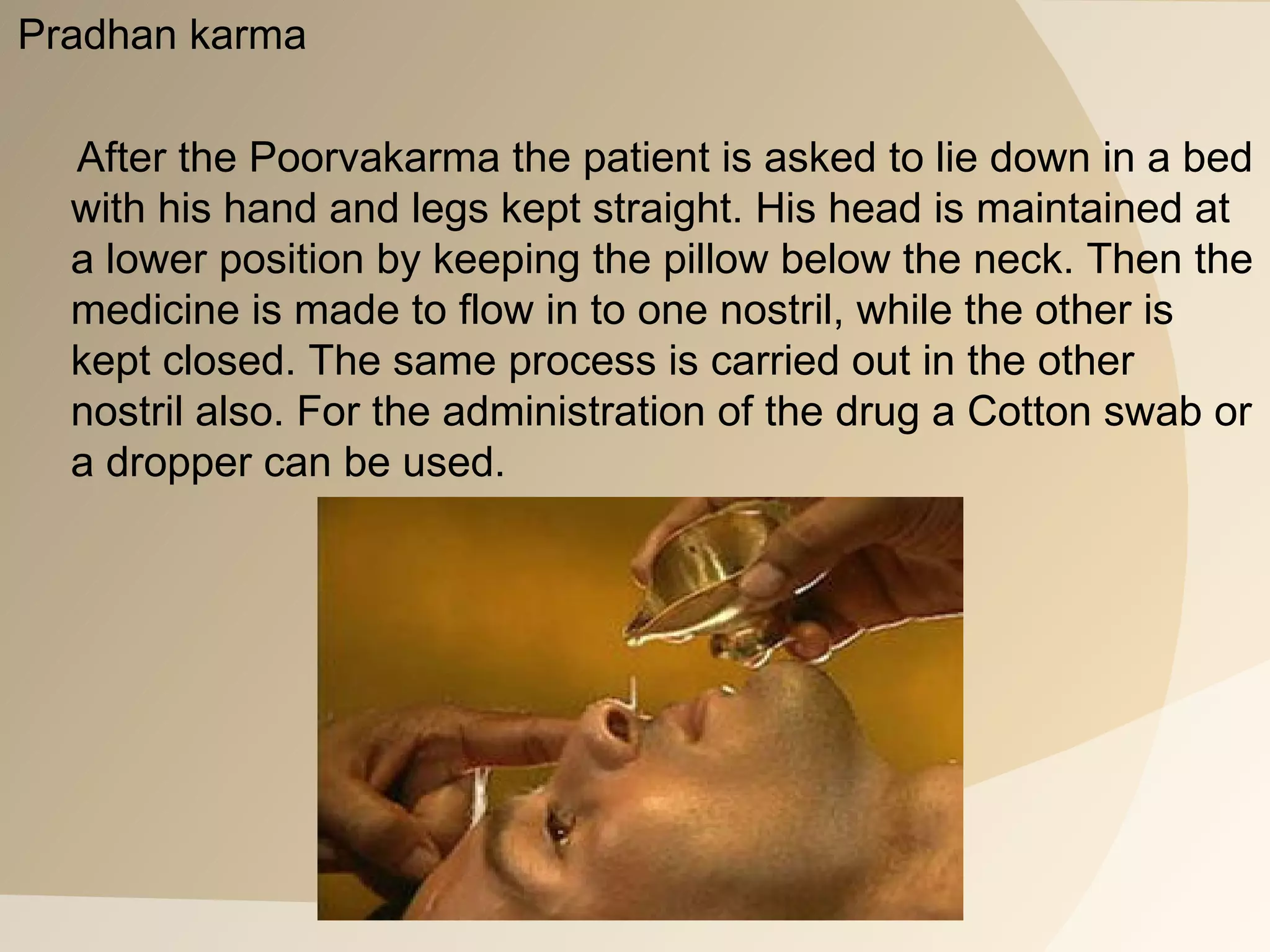
Today, we shift our focus from the eyes to the nose, another critical gateway to the head (Shiras). Our objective is to analyze the principles, types, and benefits of Pratimarsha Nasya, differentiating it from therapeutic Nasya Karma.
Pratimarsha Nasya is the form of nasal instillation specifically prescribed as a part of Dinacharya. A clear understanding of its unique properties, especially how it differs from the more intensive, treatment-oriented Nasya procedures used in Panchakarma, is fundamental for safe and effective clinical guidance. We will explore its principles, benefits, and indications, and connect them to both classical rationale and modern scientific understanding.
1. Situating Pratimarsha within Nasya Karma
The practice of administering medicine through the nasal passages, known as Nasya Karma, is a cornerstone of Ayurvedic therapy for the supraclavicular region (Urdhvajatru). This is based on the foundational principle articulated by Acharya Charaka: "Nasa hi shiraso dwaram"—the nose is the gateway to the head.
While Nasya is famously one of the five primary Panchakarma procedures, it encompasses a wide range of types and applications. A crucial classification, particularly for Swasthavritta, is based on the dosage (Matra). This is where the distinction between therapeutic Nasya and daily-use Nasya becomes clear.
Based on dosage, Snehana Nasya (oleation Nasya) is principally of two types:
- Marsha Nasya: A higher-dose, therapeutic procedure.
- Pratimarsha Nasya: A low-dose, daily maintenance procedure.
While both involve instilling medicated oil (Sneha), their purpose, procedure, and clinical context are fundamentally different.
2. Differentiating Pratimarsha and Marsha Nasya
Understanding the differences between Pratimarsha and Marsha Nasya is essential to avoid clinical errors and to correctly advise patients on daily self-care versus supervised therapy.
The following article provides a clear comparison. Pay special attention to the table that contrasts the two.
Conceptual study on Partimarsha Nasya - A Review Article
Please read the introduction and the sections that define and differentiate Marsha and Pratimarsha Nasya in the paper 'Conceptual study on Partimarsha Nasya' by Dr. Nidhi Gupta et al. This will lay a strong foundation for our discussion.
Read the 'INTRODUCTION', the section titled 'Pratimarsha Nasya', and carefully study 'Table 1: Difference between Marsha and Pratimarsha Nasya'. Focus on the contrasting points regarding type, dose, action, and required after-care.
Based on the article and classical principles, here is a synthesized comparison highlighting the key distinctions for clinical practice:
| Feature | Marsha Nasya (Therapeutic/Panchakarma) | Pratimarsha Nasya (Preventive/Dinacharya) |
|---|---|---|
| Primary Purpose | Shodhana (Purification), Brimhana (Nourishing) | Shamana (Palliative), Brimhana (Nourishing), gentle cleansing |
| Dosage (Matra) | Higher, variable dose: 6 (Hina), 8 (Madhyama), 10/12 (Uttama) Bindu | Fixed, low dose: 2 Bindu |
| Action Speed | Ashukari (Fast-acting) | Chirakari (Slow, long-lasting effect over time) |
| Procedure | Requires extensive Purvakarma (local Snehana/Swedana) and Paschatkarma (Dhoomapana, gargling, rest). Must be done under supervision. | Simple procedure, can be self-administered. No elaborate pre- or post-procedures required. |
| Restrictions (Parihara) | Strict dietary and lifestyle restrictions are essential post-procedure. | No restrictions or special care needed. |
| Complications (Vyapad) | Potential for complications if not performed correctly. | Considered free of complications (Nirvyapat). |
| Suitability | Indicated for strong patients (Balavan) capable of undergoing Shodhana. Restricted age group (e.g., 7-80 years). | Suitable for all ages (from birth to death), including the weak (Kshina), children (Bala), and elderly (Vriddha), and in all seasons. |
A Bindu is defined as the amount of liquid that drips down when the first two phalanges of the index finger are dipped into it and taken out. This is standardized to approximately 0.5 ml. Therefore, Pratimarsha Nasya is about 1 ml total, whereas Marsha Nasya can be 5 ml or more.
This distinction is critical: advocating for daily use of a Marsha dose would be inappropriate and potentially harmful, while using a Pratimarsha dose for acute Shodhana would be ineffective.
3. Principles, Benefits, and Application of Pratimarsha Nasya
Now, let's focus specifically on Pratimarsha Nasya as a Dinacharya practice. Its principle is to provide daily nourishment (Brimhana), lubrication (Snehana), and gentle cleansing to the nasal and sinus passages. This pacifies aggravated Vata (which causes dryness and degeneration) and helps clear subtle, daily accumulations of Kapha (which cause blockage and heaviness).
To delve deeper into its benefits, indications, and the specific timings for administration, the following resource is invaluable.
A Critical review on Pratimarsha Nasya
The article 'A Critical review on Pratimarsha Nasya' offers a detailed exploration of its benefits, indications, contraindications, and the specific times for its administration. This provides the granular detail needed for precise clinical recommendations.
Please read the sections titled 'Pratimarsha Nasya:', 'Dose of Pratimarsha Nasya-', 'Definition of Bindu-', 'Indications of Pratimarsha Nasya-', 'Contraindication of Pratimarsha Nasya -', and study 'Table No 3: Pratimarsha Nasya Kala' and 'Table No :4 Time of Nasya and Benefits'.
General Benefits and Indications
As you've read, regular practice of Pratimarsha Nasya yields extensive benefits for the entire Urdhvajatru region:
- Keeps the eyes, nose, and ears healthy.
- Strengthens the veins, joints, ligaments, and tendons of the head and neck.
- Prevents premature graying of hair (Palitya) and hair fall (Khalitya).
- Soothes the mind and relieves stress-induced headaches.
- Improves voice clarity and sense of smell.
- Promotes sound sleep.
It is indicated for almost everyone, especially those who are weak, lead a stressful life, or suffer from conditions related to Vata aggravation in the head.
Specific Times (Kala) of Administration
The classical texts brilliantly outline specific times during the day to perform Pratimarsha to achieve targeted benefits. This connects the practice directly to other activities of Dinacharya.
| Time of Administration (Kala) | Associated Benefit | Clinical Rationale |
|---|---|---|
| Talpothita (After waking up) | Clears accumulated Kapha, induces mental clarity (Manaprasada), relieves heaviness. | Removes phlegm that has pooled overnight in the sinuses and respiratory tract. |
| Prakshalita Danta (After brushing) | Strengthens teeth and gums (Danta Dridhata), promotes pleasant odour. | The oil's properties can support oral and periodontal health. |
| Vyayamottara (After exercise) | Relieves fatigue and stiffness. | Pacifies the Vata increased by physical exertion. |
| Bhojanottara (After meals) | Cleanses the channels (Srotoshuddhi), lightens the body. | Helps clear any Kapha aggravation related to digestion. |
| Divaswapnothita (After a day-sleep) | Prevents Kapha Vriddhi, removes heaviness, gives mental peace. | Counteracts the Kapha-increasing nature of sleeping during the day. |
| Sayam Kala (In the evening) | Promotes sound sleep (Nidra Sukhaprada), easy awakening. | Pacifies Vata aggravated by the day's activities, calming the nervous system. |
This time-specific approach allows you to create highly personalized and effective recommendations for your patients.
4. Mode of Action: A Classical and Modern Synthesis
The efficacy of Pratimarsha Nasya can be understood through both classical Ayurvedic principles and modern biomedical pathways, which aligns with your interest in an integrated perspective.
Classical Rationale
As discussed, the concept of "Nasa hi shiraso dwaram" is central. The administered Sneha reaches the Shringataka Marma, a vital point described as a junction of Siras (vessels/nerves) supplying the nose, eyes, ears, and tongue. By pacifying and nourishing this neuro-vascular junction, Nasya exerts its effect on the entire head.
Modern Scientific Correlation
The article "A Critical review on Pratimarsha Nasya" provides an excellent discussion on the modern mode of action. Let's summarize the key pathways:
- Vascular Pathway: The nasal mucosa is highly vascularized. Substances absorbed here enter the venous circulation, which communicates with the cavernous sinus—an intracranial venous plexus. This allows the drug to reach the brain while bypassing the first-pass metabolism of the liver, leading to higher bioavailability.
- Neurological Pathway: The olfactory nerves are direct extensions of the brain. The medicated oils can stimulate these nerves, which have connections to the limbic system and hypothalamus. This provides a direct route to influence the neuro-endocrine system, which governs mood, stress response, and sleep.
- Diffusion Pathway: The oil and its active herbal components are absorbed across the nasal mucosa. Lipophilic (fat-soluble) components readily pass through the cell membranes, nourishing the tissues directly.
This integrated view explains how a simple act of nasal oiling can have profound effects on stress, sleep, hormonal balance, and the health of all structures in the head and neck.
Test your understanding! (Clinical Case)
A 42-year-old female patient, a university professor, presents with chronic neck tension, dry eyes from screen use, difficulty falling asleep, and frequent episodes of waking up at night (Vata-predominant Nidranasha). Her sinuses feel dry, especially in an air-conditioned environment. She has no signs of acute infection.
How would you integrate Pratimarsha Nasya into her Dinacharya?
- Which oil would you recommend?
- Which administration times (Kala) would be most beneficial, and why?
- How would you explain the rationale to her, bridging classical and modern concepts?
Show answer
-
Recommended Oil: Anu Taila is an excellent choice as it is classically indicated for Pratimarsha and is Tridoshahara (balancing all three doshas), making it safe and effective for long-term use. Plain, warm sesame oil (Tila Taila) would also be a very good, simple starting point, given its potent Vata-pacifying properties.
-
Most Beneficial Kala:
- Sayam Kala (In the evening): This is the most crucial time for her. Administering it in the evening will directly pacify the Vata Dosha that has accumulated throughout her stressful day of teaching and computer work. This will help calm her nervous system, relieve neck tension, and promote deeper, more consistent sleep.
- Talpothita (After waking up): This would also be beneficial to lubricate the nasal passages, counteract the dryness from the previous night, and provide a sense of clarity and grounding for the day ahead.
-
Explanation to the Patient: "I recommend a simple practice called Pratimarsha Nasya, which is like daily nourishment for your nervous system through your nasal passages. Your symptoms of neck tension, sleep disturbance, and dry eyes are related to an imbalance of the Vata principle, which governs movement and the nervous system. By applying 2 drops of this medicated oil in each nostril in the evening, we can directly calm this imbalance. The nasal passages have a rich network of nerves and blood vessels with a direct connection to the brain. The oil is absorbed here, soothing the nerves and calming your mind, which will help you fall asleep more easily and stay asleep. Think of it as lubricating and relaxing your entire head and neck from the inside out."
Conclusion
Today, we have precisely defined Pratimarsha Nasya and distinguished it from therapeutic Marsha Nasya. This differentiation is a cornerstone of safe and effective Swasthavritta practice.
Key Takeaways:
- Pratimarsha Nasya is a low-dose (2 Bindu), safe, self-administered oleation technique for daily health maintenance (Dinacharya).
- It is fundamentally different from Marsha Nasya, which is a high-dose, supervised, therapeutic procedure with specific restrictions and potential complications.
- The benefits of Pratimarsha—including improved sleep, reduced stress, and enhanced sensory function—are achieved through its nourishing and Vata-pacifying properties.
- Administering Pratimarsha at specific times (Kala) allows for targeted clinical benefits, aligning with the body's daily rhythms.
- Its mode of action is robustly explained by both classical principles (Shringataka Marma) and modern neuro-vascular pathways, allowing for effective patient education.
Preview of the Next Lesson:
Having addressed the eyes and nose, we will continue our journey through the Urdhvajatru region by focusing on the oral cavity. In our next lesson, we will analyze the classical principles, methods, and benefits of Gandusha and Kavala for oral hygiene and systemic health. We will explore how these practices, commonly known as oil pulling, contribute not only to local health but to the well-being of the entire body.