Introduction
Welcome back! In our last lesson, we focused on the high-level task of designing integrated Yoga and Pranayama protocols for specific clinical conditions like anxiety and metabolic syndrome. You learned how to structure a therapeutic sequence by combining different practices.
As promised, today we will zoom in on the fundamental building blocks of those protocols. This lesson is dedicated to the learning outcome: Analyze the selection criteria for specific Vata-hara, Pitta-hara, and Kapha-hara Asanas and Pranayama techniques. We will systematically explore the why behind choosing a particular practice, moving from general principles to specific examples. This will equip you with a detailed "therapeutic palette" from which you can draw to personalize your prescriptions with greater precision, a key aspect of your goal to master the clinical application of Swasthavritta.
1. The Core Principle: Balancing Gunas with Yoga
The foundation for selecting any Ayurvedic intervention, including Yoga, is the Samanya-Vishesha Siddhanta (principle of similarity and dissimilarity). In simple terms, to reduce an aggravated Dosha, we must apply practices that have opposite qualities (Gunas).
- Vata Dosha Gunas: Ruksha (dry), Laghu (light), Shita (cold), Chala (mobile), Sukshma (subtle), Khara (rough).
- Pitta Dosha Gunas: Sasneha (oily), Tikshna (sharp/penetrating), Ushna (hot), Laghu (light), Drava (liquid).
- Kapha Dosha Gunas: Snigdha (oily), Guru (heavy), Shita (cold), Manda (slow), Sthira (stable), Shlakshna (smooth).
Therefore, our selection of Asanas and Pranayama will be guided by applying the opposing qualities to bring the system back to equilibrium (Samyavastha).
2. Selecting Doshahara Asanas
The physical practice of Asana directly influences the Annamaya Kosha (physical body) and has immediate effects on the Doshas. The style, pace, and duration of the practice are just as important as the specific postures chosen.
Vata-hara Asanas: Grounding, Warming, and Stabilizing
For a patient with Vata aggravation—presenting with anxiety, insomnia, constipation, or joint stiffness—the goal is to counteract the mobile, cold, and dry qualities of Vata.
- Core Principles:
- Pace: Slow, smooth, and mindful. Avoid fast or jerky movements.
- Focus: Stability and grounding. Connect with the earth.
- Environment: Practice in a warm, calm, and quiet space.
- Effort: Gentle and consistent, not forceful. The aim is to calm the nervous system, not exhaust it.
- Therapeutic Actions & Examples:
- Grounding Poses: Practices that emphasize connection to the floor help pacify Chala Guna. Examples: Balasana (Child's Pose), Marjaryasana-Bitilasana (Cat-Cow), and sitting postures like Vajrasana.
- Gentle Forward Bends: These are introspective and calm the nervous system. Examples: Paschimottanasana (Seated Forward Bend), Uttanasana (Standing Forward Bend) with bent knees to avoid strain.
- Supine Poses: Lying on the back is inherently stabilizing. Examples: Supta Virasana (Reclined Hero Pose) to work on the thighs and pelvis (a key Vata area), Apanasana (Knees-to-Chest Pose) to regulate Apana Vayu.
Pitta-hara Asanas: Cooling, Calming, and Surrendering
For a patient with Pitta imbalance—presenting with inflammation, acidity, skin rashes, or irritability—the goal is to cool the heat, calm the intensity, and release the tendency toward perfectionism.
- Core Principles:
- Pace: Moderate and relaxed. Avoid a competitive mindset.
- Focus: Creating space and releasing tension, especially in the mid-abdomen (Pitta's seat).
- Environment: Practice in a cool or well-ventilated space. Avoid practicing in direct, hot sun.
- Effort: Non-aggressive. Encourage an attitude of surrender in the postures.
- Therapeutic Actions & Examples:
- Cooling Sequences: Chandra Namaskar (Moon Salutation) is preferred over the more heating Surya Namaskar.
- Poses that Release Abdominal Tension: Gentle twists and forward bends help to calm Pachaka Pitta. Examples: Bhujangasana (Cobra Pose) performed gently to open the chest without compressing the neck, Dhanurasana (Bow Pose), and seated forward bends.
- Spacious Poses: Standing poses that open the hips and chest without being overly strenuous are beneficial. Example: Trikonasana (Triangle Pose).
Kapha-hara Asanas: Stimulating, Warming, and Mobilizing
For a patient with Kapha excess—presenting with lethargy, weight gain, congestion, or fluid retention—the goal is to counteract the heavy, cold, and static qualities of Kapha.
- Core Principles:
- Pace: Vigorous, dynamic, and flowing. Minimize time spent motionless between poses.
- Focus: Generating internal heat (Ushna), stimulating circulation, and reducing stagnation.
- Environment: Practice in a warm space to encourage perspiration.
- Effort: Challenging and disciplined. The goal is to build stamina and break through lethargy.
- Therapeutic Actions & Examples:
- Dynamic Sequences: Surya Namaskar (Sun Salutation), performed at a steady, brisk pace, is the quintessential Kapha-hara practice.
- Heating and Stimulating Poses: Standing poses, backbends, and inversions are excellent. Examples: Virabhadrasana (Warrior series), Ustrasana (Camel Pose), and Adho Mukha Svanasana (Downward-Facing Dog).
- Chest-Opening Poses: These help to clear Avalambaka Kapha from the lungs and heart area. Examples: Setu Bandhasana (Bridge Pose).
To consolidate this, the following image provides a helpful visual summary.
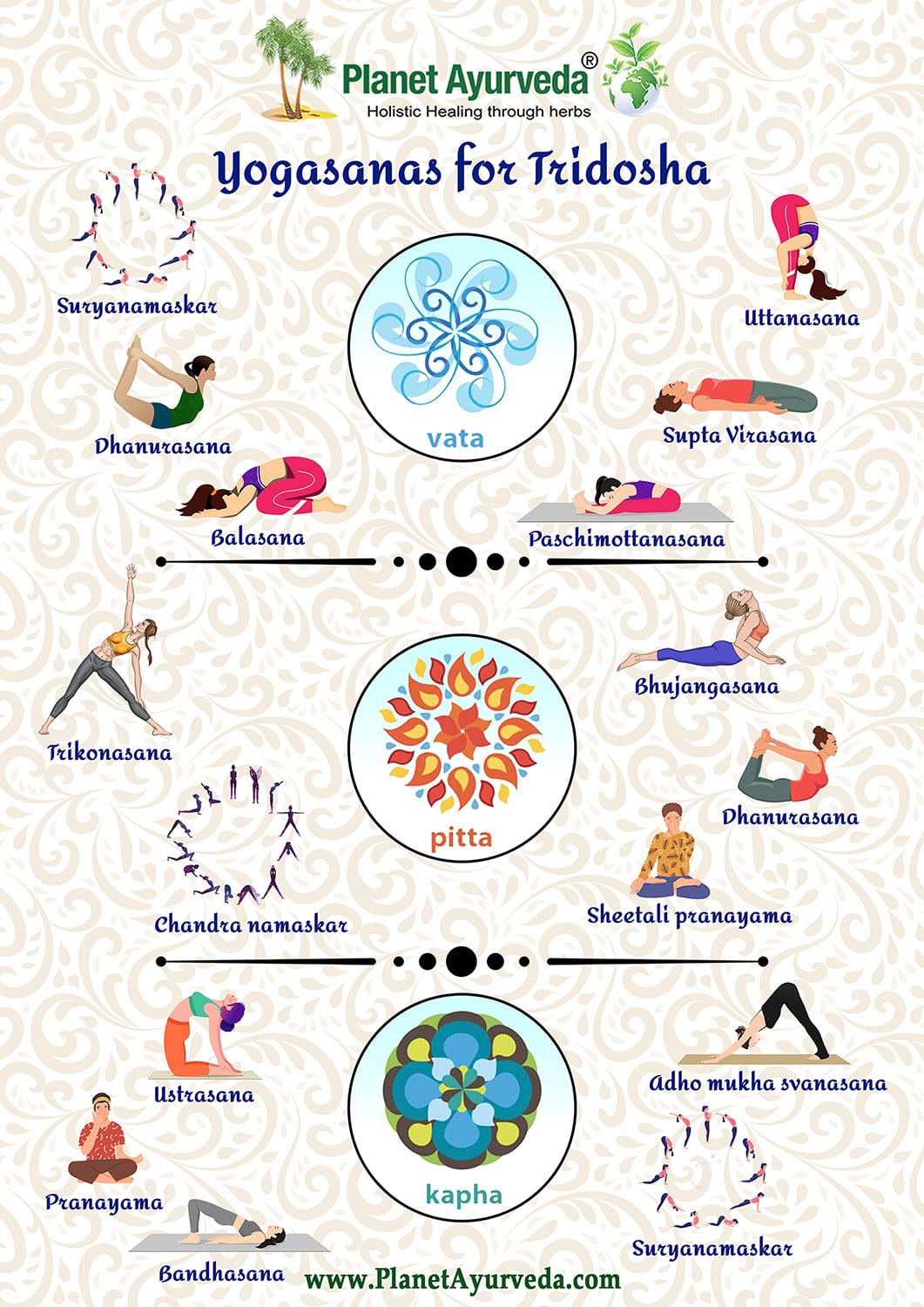
For a more detailed breakdown, please study the following resource. It methodically outlines the rationale and provides a comprehensive table of recommendations.
YOGA AS A PREVENTIVE HEALTH CARE ACCORDING ...
The article 'YOGA AS A PREVENTIVE HEALTH CARE...' provides an excellent framework for personalizing Yoga based on Prakriti. It directly addresses how to deduce practices based on the characteristics of each Dosha.
Please read the section 'Yoga according to physical, physiological, psychological/ emotional characteristics...', Table 5: 'Recommendation of Yoga according to dominance of Doshaja Prakriti', and the 'Balancing Vata/Pitta/Kapha' sections. Focus on how the authors connect the qualities of the Doshas to the specific recommendations regarding posture types, frequency, duration, and even psychological approach. Table 5 is a particularly valuable summary.
Test your understanding!
A 55-year-old patient (Vata-dominant age) with a Vata-Prakruti presents with osteoarthritis of the knees and reports feeling anxious and overwhelmed. They want to start Yoga. Based on the principles, which of these approaches is most appropriate and why?
A) A vigorous, fast-paced Vinyasa flow class to generate heat and improve circulation.
B) A slow, mindful practice focusing on seated and supine poses with long, gentle holds.
C) A hot yoga class to warm up the stiff joints.
Show answer
Approach B is the most appropriate. The patient's age and Vata-predominant condition call for a practice that is grounding, stabilizing, and calming (Sthira, Manda, Snigdha Gunas). A slow, mindful practice will soothe their anxiety and avoid aggravating the mobile (Chala) and rough (Khara) qualities of Vata, which could worsen joint pain and mental restlessness. Fast-paced (A) or intensely hot (C) classes would likely be over-stimulating and depleting for their constitution.
3. Selecting Doshahara Pranayama
Pranayama operates on a subtler level than Asana, directly influencing the Pranamaya Kosha (energy body). Improper practice can be more disruptive than an incorrect Asana, so careful selection is paramount.
A Deeper Concept: Prana, Tejas, and Ojas
Before selecting a technique, it's crucial to understand that Pranayama doesn't just affect the Doshas; it manipulates the three subtle essences:
- Prana (the vital life force, subtle aspect of Vata)
- Tejas (the inner radiance or fire of intelligence, subtle aspect of Pitta)
- Ojas (the ultimate essence of immunity and contentment, subtle aspect of Kapha)
A balanced practice increases all three proportionally. However, aggressive or improper Pranayama can increase Prana (drying) and Tejas (heating) at the expense of Ojas, leading to burnout, emotional instability, and depletion. This is why a strong foundation of Ojas (built through proper diet, rest, and lifestyle) is a prerequisite for advanced practice.
To understand this critical concept in more detail, please review the following text.
The blog post 'Pranayama, Yoga, and Ayurveda' from the Ayurvedic Institute explains the potential dangers of faulty practice by detailing its effect on the subtle essences.
Please read the section 'Imbalances in the Subtle Body Caused by Faulty Pranayama Practice'. Focus on understanding how rising Prana and Tejas can deplete Ojas and the resulting symptoms. This explains the 'why' behind the need for careful selection.
With this in mind, let's categorize the primary Pranayama techniques.
Vata-hara Pranayama: Balancing and Calming
- Principle: Soothe the nervous system, promote regularity, and provide warmth without over-stimulation.
- Examples:
- Nadi Shodhana (Alternate Nostril Breathing): This is the quintessential Vata-pacifying Pranayama. It balances the Ida (lunar/cooling) and Pingala (solar/heating) nadis, bringing profound equilibrium to the entire nervous system.
- Ujjayi (Victorious Breath): A gentle, warming breath that creates a soothing sound, helping to focus the mind and calm the Chala Guna of Vata.
- Bhramari (Humming Bee Breath): Excellent for calming a racing mind, but should be done gently.
Pitta-hara Pranayama: Cooling and Soothing
- Principle: Release heat from the system, calm irritability, and soothe intensity.
- Examples:
- Shitali (Cooling Breath - rolled tongue): Directly cools the body and blood, pacifying Pitta's heat. Highly effective for anger, acidity, and hot flashes.
- Sitkari (Hissing Breath - flat tongue): Similar in effect to Shitali, used by those who cannot roll their tongue.
- Chandra Bhedana (Lunar Breath): Inhalation through the left nostril (Ida Nadi) and exhalation through the right. This activates the cooling, parasympathetic nervous system.
Kapha-hara Pranayama: Stimulating and Clearing
- Principle: Generate heat, clear congestion from the respiratory tract (Pranavaha Srotas), and energize a sluggish metabolism (Mandagni).
- Examples:
- Bhastrika (Bellows Breath): A powerful, rapid breathing technique that strongly increases heat and metabolic rate. It forcefully expels Kapha.
- Kapalabhati (Skull Shining Breath): Technically a Kriya (cleansing action), it involves forceful exhalations that are heating, clearing, and stimulating to Agni.
- Surya Bhedana (Solar Breath): Inhalation through the right nostril (Pingala Nadi) and exhalation through the left. This activates the heating, sympathetic nervous system, directly countering Kapha's cold quality.
The following resource provides a detailed analysis of these techniques and their specific Doshic effects.
Now, let's dive deep into the specifics. The article 'Pranayama, Yoga, and Ayurveda' contains a section that meticulously breaks down each major Pranayama technique from an Ayurvedic perspective.
Please read the section titled 'Types of Pranayama and Their Effects from an Ayurvedic Perspective'. For each Pranayama listed (Ujjayi, Surya Bhedana, Nadi-shodhana, etc.), note its primary action (heating/cooling), which Doshas it pacifies, and which it might aggravate. This is your core reference guide for Pranayama selection.
Test your understanding!
A patient with a Kapha constitution complains of morning grogginess, sinus congestion, and a slow metabolism. Which Pranayama would be most specifically indicated for their morning routine, and which would be strongly contraindicated?
Show answer
Indicated: Bhastrika or Kapalabhati. Both are heating, stimulating, and clearing. They would directly address the patient's grogginess (Manda Guna), congestion (Kleda), and slow metabolism (Mandagni). Surya Bhedana would also be an excellent choice.
Contraindicated: Shitali or Sitkari. These are cooling (Shita Guna) and would only increase the cold, heavy qualities of Kapha, potentially worsening the congestion and lethargy.
Conclusion
In this lesson, you have analyzed the core criteria for selecting Yoga and Pranayama techniques based on Ayurvedic principles. By understanding the interplay of Gunas, you can now move beyond generic prescriptions and begin to artfully apply these practices to balance the specific Doshic needs of an individual.
Key Takeaways:
- The selection of Asanas and Pranayama is guided by the principle of applying opposite qualities (Gunas) to pacify an aggravated Dosha.
- Vata-hara practices are slow, grounding, and warming (e.g., Paschimottanasana, Nadi Shodhana).
- Pitta-hara practices are cooling, calming, and non-competitive (e.g., Chandra Namaskar, Shitali Pranayama).
- Kapha-hara practices are dynamic, stimulating, and heating (e.g., Surya Namaskar, Bhastrika Pranayama).
- Pranayama selection requires extra care due to its powerful effects on the subtle energies of Prana, Tejas, and Ojas.
Preview of the Next Lesson:
Now that you have learned how to structure a protocol (last lesson) and how to select the specific ingredients for it (this lesson), the next logical step is integration. In our next session, we will "Integrate a simple Yoga and Rasayana regimen into a comprehensive Dinacharya plan for a patient." We will explore how to weave these therapeutic practices seamlessly into a patient's daily routine for sustained, long-term health benefits.