Introduction
Welcome back. In our last two lessons, you learned the foundational principles for selecting individual Yoga Asanas and Pranayama techniques based on their specific effects on the Doshas and Manas. You can now analyze a posture or breathing technique and determine its suitability for pacifying Vata, Pitta, or Kapha.
Today, we transition from selecting individual components to composing a complete therapeutic prescription. The learning outcome for this lesson is to design integrated daily Yoga and Pranayama protocols for specific clinical case studies, using anxiety and metabolic syndrome as our working examples. This session is highly practical and case-based, directly aligning with your goal of mastering the clinical application of Swasthavritta. We will synthesize the principles you've learned into structured, coherent daily routines that you can adapt for your patients.
1. Principles of Structuring a Daily Yoga Protocol
Designing a yoga protocol is not just about picking a few beneficial Asanas and Pranayamas. The sequence and flow are critical for maximizing therapeutic effect and ensuring safety. A well-structured daily practice generally follows a logical progression that moves from gross to subtle, preparing the body and mind for deeper work.
A standard therapeutic sequence includes:
- Shithilikarana / Loosening Practices (e.g., Pawanmuktasana series Part 1): Gentle mobilization of all major joints. This warms up the body, removes minor blockages in energy flow, and prepares the joints for more dynamic movements. It is particularly important for pacifying Vata and releasing stiffness.
- Dynamic Sequences (e.g., Surya Namaskar): These sequences link breath with movement, generate heat (Ushna), improve circulation, and enhance cardiovascular function. The choice and speed of the sequence can be modified to suit the Dosha (e.g., slow and mindful for Vata/Pitta, more vigorous for Kapha).
- Asanas (Static Postures): This is the core of the physical practice where postures are held for a specific duration. The selection of Asanas is entirely dependent on the therapeutic goal—for example, twists for digestion, forward bends for calming the mind, or backbends for invigoration.
- Pranayama (Breath Regulation): After the body has been prepared and purified through Asana, it is still and ready for the subtler work of Pranayama. At this stage, the mind is more capable of focusing, and the effects of Pranayama on the Pranamaya Kosha are more profound.
- Pratyahara & Dharana (e.g., Shavasana, Yoga Nidra, Meditation): The practice concludes with deep relaxation or meditation. This allows the physiological and pranic effects of the practice to be fully integrated. It is essential for calming the nervous system and cultivating Sattva.
This framework is our template. Now, let's see how to populate it based on specific clinical conditions.
2. Case Study 1: Protocol for Mixed Anxiety and Depression (Chittodwega / Vishada)
Let's begin by analyzing a real-world case. We will then use our principles to build a comprehensive daily protocol.
Ayurvedic Analysis of the Case
First, let's examine a published case report that aligns with our learning objective.
Multimodal Ayurveda and Yoga intervention in mixed...
The article 'Multimodal Ayurveda and Yoga intervention in mixed...' details the case of a 40-year-old police officer with symptoms of stress, anxiety, and depression. This provides a perfect clinical scenario for our first protocol design.
Please read the sections titled 'PATIENT INFORMATION', 'CLINICAL FINDINGS', 'THERAPEUTIC INTERVENTION', and the portion of the 'DISCUSSION' that begins 'Yoga in the form of Pranayama...'. As you read, focus on: The patient's key symptoms (e.g., lack of concentration, anger, sleep disturbances). The Ayurvedic assessment: Kapha-Pitta Sharirika Prakriti, Raja-Tamasa Manasika Prakriti, and the predominant Doshic features of his Vikruti. The specific Yoga intervention prescribed (Naadi shuddhi pranayama) and the rationale provided for its use.
From the case, we can deduce the following Samprapti (pathogenesis):
- Vata Dushti: Manifests as lack of concentration, nervousness, and sleep disturbances (Anidra). The Chala Guna of Vata creates mental restlessness.
- Pitta Dushti: Presents as anger outbursts and an agitated feeling, driven by the Ushna and Tikshna Gunas of Pitta.
- Kapha Dushti: Appears as lethargy, malaise, and depressive thoughts (Tamas).
- Manasika Guna Involvement: The condition is dominated by Rajas (agitation, anger) and Tamas (lethargy, low confidence), with a deficiency of Sattva.
The primary therapeutic goal (Chikitsa Sutra) is therefore Tridosha Shamana (with a focus on Vata and Pitta), reduction of Rajas and Tamas, and enhancement of Sattva.
Designing the Integrated Protocol
The case report wisely prescribed a simple, high-impact intervention: Nadi Shuddhi Pranayama. For a patient with a demanding job and time constraints, starting with a single, powerful practice ensures better compliance.
Building on that, here is a more comprehensive daily protocol you could design for such a patient, explaining the rationale for each component.
| Component | Practices (Duration) | Ayurvedic Rationale |
|---|---|---|
| Shithilikarana (Loosening) | Gentle Neck, Shoulder, Wrist, and Ankle Rotations (5 mins) | Releases physical tension held in the joints due to stress (Vata aggravation). Promotes flow of Prana and prepares the body gently. |
| Asanas (Grounding & Calming) | 1. Marjaryasana-Bitilasana (Cat-Cow Pose) - 10 rounds 2. Shashankasana (Child's Pose) - 1 min hold 3. Paschimottanasana (Seated Forward Bend) - 1 min hold (10-15 mins) |
These are primarily Vata-Pitta Shamaka. The gentle spinal movement of Cat-Cow soothes the nervous system. The forward-bending and introverted nature of Shashankasana and Paschimottanasana calms the mind, reduces Rajas, and encourages introspection (Pratyahara). |
| Pranayama (Mind-Calming) | 1. Bhramari Pranayama (Humming Bee Breath) - 5-7 rounds 2. Nadi Shodhana Pranayama (Alternate Nostril Breathing) - 10-15 rounds (10 mins) |
Bhramari provides an immediate calming effect on the mind via Nada (sound), directly pacifying agitated Pitta and Rajas. This prepares the mind for the deeper, balancing effect of Nadi Shodhana, which harmonizes the entire nervous system, pacifies Vata, and enhances Sattva. |
| Relaxation (Integration) | Shavasana (Corpse Pose) with breath awareness (10 mins) | The most critical practice for pacifying Vata. It allows the nervous system to shift into a parasympathetic state, integrating the benefits of the entire practice and cultivating deep rest. |
This protocol is designed to be calming, grounding, and balancing, directly addressing the root Doshic and Manasika imbalances of anxiety and mental distress.
Test your understanding!
A patient complains of high stress and being easily angered (Pitta aggravation). You prescribe the protocol above. Which practice would you emphasize they should never skip, even on a busy day, to manage their anger? Why?
Show answer
For managing anger and irritability (Pitta/Rajas), Bhramari Pranayama would be the most crucial practice to emphasize. Its immediate calming effect on the mind through sound vibration (Nada) and its ability to soothe the nervous system makes it a potent and quick intervention for acute feelings of agitation and anger. While the whole sequence is important, Bhramari acts as an immediate "fire extinguisher" for Pitta-driven emotional states.
3. Case Study 2: Protocol for Metabolic Syndrome
Now, let's tackle a condition rooted in metabolic dysfunction. Metabolic Syndrome is a cluster of conditions—increased blood pressure, high blood sugar, excess body fat around the waist, and abnormal cholesterol or triglyceride levels. In Ayurveda, this falls under the umbrella of Santarpanottha Vyadhis (diseases of over-nutrition), with clear links to Sthaulya (obesity) and Prameha (diabetic conditions).
Ayurvedic Analysis of the Condition
- Doshas: It's a classic Kapha-pradhana Tridoshaja condition.
- Kapha Dushti: Leads to increased Meda Dhatu (adipose tissue), lethargy, and blockage of channels (Srotorodha).
- Pitta Dushti: Disturbed Pachaka Pitta and Dhatvagni lead to impaired metabolism and inflammation.
- Vata Dushti: The blockage by excess Kapha and Meda obstructs the normal flow of Vata (Avarana), affecting various systemic functions.
- Agni: The core issue is Mandagni (sluggish digestive fire) at the central level (Jatharagni) and impaired metabolism at the tissue level (Dhatvagni).
- Ama: Poor digestion leads to the formation of Ama (metabolic toxins), which further clogs the channels.
The Chikitsa Sutra is Kapha-Medohara (to reduce Kapha and fat), Agnideepana (to stimulate fire/metabolism), Srotoshodhana (to clear the channels), and Vatanulomana (to regulate Vata).
Analyzing an Integrated Protocol
Let's examine a yoga protocol that has been successfully used in a case of Metabolic Syndrome.
Integrated Yoga and Naturopathy module in management of ...
The case report 'Integrated Yoga and Naturopathy module in management of Metabolic Syndrome' provides a detailed daily yoga protocol. This is an excellent example of a stimulating and metabolically-active practice.
Please study Table 1: 'Integrated Yoga Naturopathy (IYN) protocol'. Focus entirely on the 'Integrative yoga protocol for everyday' section. Pay close attention to the specific Asanas and Pranayamas chosen and the overall energetic feel of the sequence.
Rationale of the Protocol from an Ayurvedic Perspective
The protocol you just reviewed is expertly designed to counter the pathology of Metabolic Syndrome. Let's break down why.
| Component | Practices (from the case report) | Ayurvedic Rationale |
|---|---|---|
| Dynamic Sequence | Surya Namaskar | Agnideepana & Kapha-hara. This dynamic, heating sequence is perfect for stimulating metabolism, improving circulation, and reducing the heavy, cold qualities of Kapha. |
| Asanas (Stimulating & Twisting) | Ardha Chakrasana, Padahastasana, Ardhakati Chakrasana, Vakrasana, Navasana, Parivrtta Trikonasana | Agnideepana & Srotoshodhana. This selection focuses on: • Twists (Vakrasana, Parivrtta Trikonasana): These "wring out" the abdominal organs, stimulating Pachaka Pitta, pancreatic function (Kledaka Kapha), and aiding in Ama Pachana (digestion of toxins). • Core Work (Navasana): Strengthens the abdomen, stimulating Samana Vayu and Jatharagni. |
| Pranayama & Kriya (Heating & Purifying) | Kapalabhati, Surya Anuloma Viloma Pranayama | Kapha-hara & Agnideepana. • Kapalabhati: A powerful shatkarma that is intensely heating and purifying. It expels excess Kapha from the respiratory system and strongly stimulates Agni. • Surya Anuloma Viloma: This is a specific variation of alternate nostril breathing that emphasizes inhalation through the right nostril (Surya Nadi / Pingala), which is heating and stimulating to the metabolism. This is a precise choice to counter Mandagni. |
| Relaxation | Deep Relaxation Technique (DRT) | Vata Shamana. Even in a stimulating practice, relaxation is crucial. A vigorous, heating practice can potentially aggravate Vata. The concluding relaxation phase ensures the system is balanced and prevents Vata-related side effects like strain or burnout. |
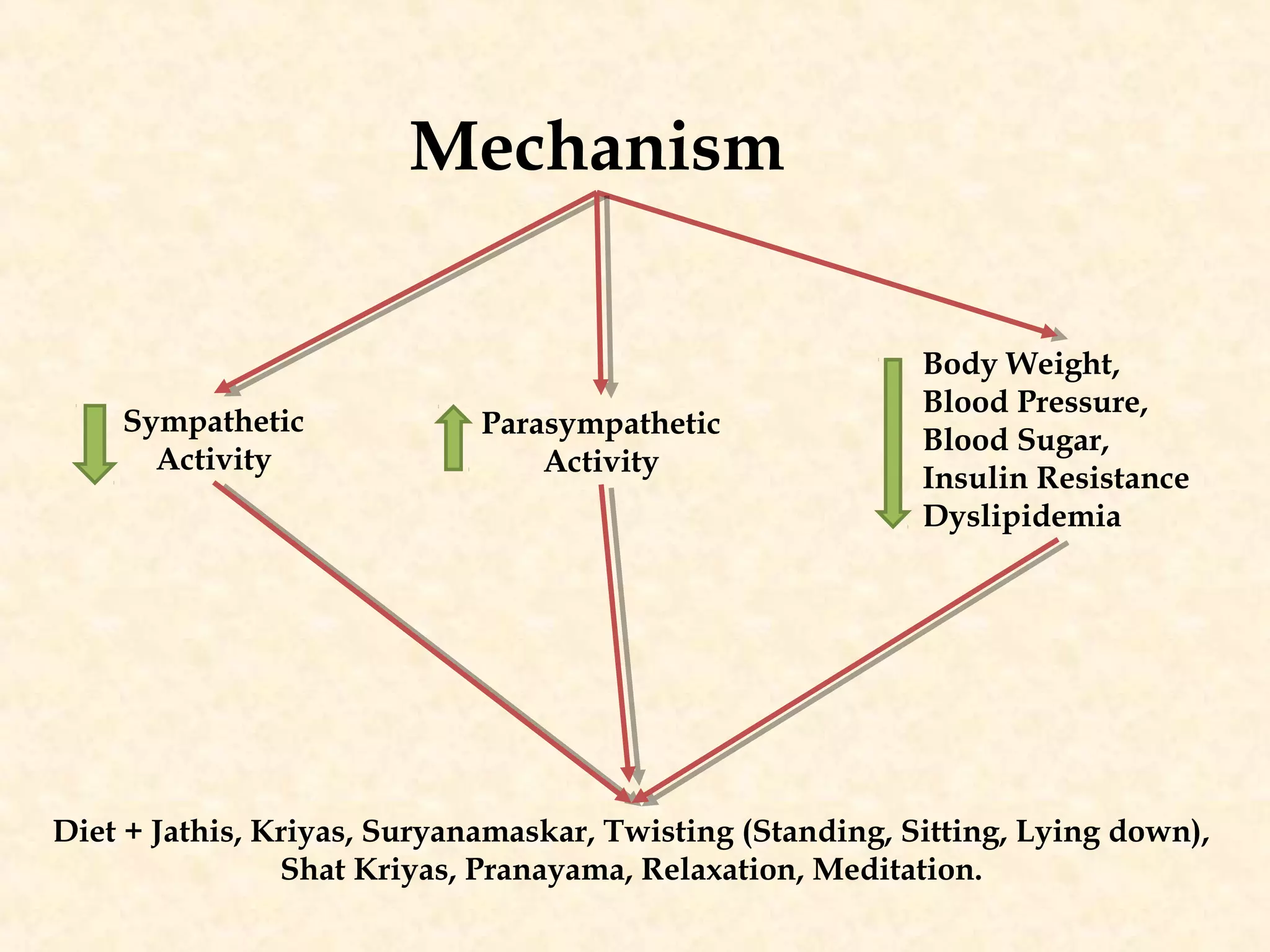
This protocol effectively translates the Chikitsa Sutra into a physical practice. The modern physiological explanation aligns perfectly with this.
Conclusion
In this lesson, you have learned to move beyond theory and design structured, integrated Yoga and Pranayama protocols for specific clinical conditions. By anchoring your design in a clear Ayurvedic analysis (Samprapti) and a logical sequence, you can create powerful, personalized therapeutic interventions.
Key Takeaways:
- An integrated yoga protocol follows a specific sequence: Loosening → Dynamic practice → Static Asanas → Pranayama → Relaxation.
- The selection of practices for a protocol is dictated by the Chikitsa Sutra derived from a Doshic analysis of the case.
- Protocols for anxiety-like conditions (Vata-Pitta dominant) should be calming, grounding, and introverted, using practices like Nadi Shodhana, Bhramari, and forward bends.
- Protocols for metabolic syndrome (Kapha dominant) should be heating, stimulating, and purifying, using practices like Surya Namaskar, Kapalabhati, and abdominal twists.
- The final relaxation phase is non-negotiable in any protocol to ensure proper integration and to pacify Vata.
Preview of the Next Lesson:
Having applied your knowledge to design protocols for two specific conditions, we will now take a step back to broaden your therapeutic arsenal. In our next lesson, we will "Analyze the selection criteria for specific Vata-hara, Pitta-hara, and Kapha-hara Asanas and Pranayama techniques." We will systematically categorize a wider range of practices, creating a comprehensive reference library that you can draw upon for any clinical scenario.