Welcome to the final lesson in our module on observational study designs. In our previous lessons, we explored cross-sectional, cohort, and case-control studies individually. You learned how each one is structured, what it measures, and its primary purpose. Now, it's time to bring all that knowledge together.
This lesson focuses on comparing these three designs side-by-side. Your goal is to understand their relative strengths and limitations so you can critically evaluate epidemiological research and appreciate why a researcher might choose one design over another. This is akin to choosing the right data structure in computer science; the optimal choice depends on the specific problem, constraints, and desired outcomes.
The Core Difference: Direction and Time
The most fundamental way to distinguish between these study designs is by their relationship with time—what epidemiologists call temporality. This refers to whether the study design allows us to establish that an exposure occurred before an outcome. This is a crucial first step in trying to infer a causal relationship.
The following diagram provides a clear visual summary of how these designs are oriented in time.

Let's break down what this image shows:
- Cross-sectional studies are a "snapshot" in the present. They assess both exposure and outcome at the same single point in time. Because of this, they cannot determine which came first.
- Case-control studies are retrospective. They start in the present by identifying people with the outcome (cases) and without it (controls), then look backward into the past to assess prior exposures.
- Cohort studies are typically prospective. They start in the present by identifying an exposed and a non-exposed group, then follow them forward into the future to see who develops the outcome. (As you learned, they can also be retrospective, but they still follow the same logical direction from exposure to outcome).
The following video offers a quick and memorable way to think about this temporal distinction.
Study Design - Case-control study, Cross-sectional study, Cohort study (Prospective, Retrospective)
This clip from Medicosis Perfectionalis frames the three designs in terms of the question they ask about time.
Watch the segment from the beginning. The key idea is the association of each study with a time frame: Cross-sectional: "What is happening right now?" (Prevalence) Case-control: "What happened in the past?" (Odds Ratio) Prospective Cohort: "What is going to happen in the future?" (Relative Risk)
A Detailed Comparison of Trade-offs
Choosing a study design involves a series of trade-offs between what is ideal and what is practical. A researcher must consider the nature of the disease, the exposure, available time, and budget.
The following reading provides a comprehensive table that compares these three observational designs across a range of important characteristics. This table is the central reference point for this lesson.
Study Designs – Epidemiology - Pressbooks at Virginia Tech
This chapter from an epidemiology textbook provides detailed descriptions and an excellent comparative table.
Your main focus should be Figure 3.3, the large table comparing the five observational designs. You can find this table right at the beginning of the section titled "Study Designs". For now, concentrate on the columns for Cross-sectional, Case-control, and Cohort studies. As you study the table, try to answer these questions for each design: Is it better for rare diseases or rare exposures? What is the primary measure of association it can calculate? What are its biggest advantages and disadvantages? To add more context, you can also quickly review the short descriptions of cross-sectional, case-control, and cohort studies that follow the table.
Let's distill the most critical points from that table into a direct comparison.
When is each design the best choice?
- Cross-sectional: Best for determining the prevalence of a condition in a population. Think of it as a census or survey. It's excellent for public health planning and generating hypotheses.
- Example: A health department wants to know the percentage of adults in a city who have undiagnosed high blood pressure.
- Case-control: The go-to design for studying rare diseases or outcomes with long latency periods. Because you start by finding the few people who already have the disease, it's incredibly efficient.
- Example: Investigating potential environmental risk factors for a rare type of brain cancer. A cohort study would be impractical, as you'd have to follow millions of people for years to find enough cases.
- Cohort: The best observational design for studying rare exposures and for clearly establishing a temporal sequence. You can also study multiple outcomes from a single exposure.
- Example: Following a group of uranium miners (a rare exposure) to see if they develop various types of cancer (multiple outcomes) compared to a group of non-miners.
What are the biggest strengths and weaknesses?
| Study Design | Key Strengths | Key Limitations |
|---|---|---|
| Cross-sectional | • Fast and inexpensive • Good for assessing population health needs • Can study multiple exposures & outcomes |
• Cannot establish temporality (cause and effect) • Inefficient for rare diseases |
| Case-control | • Excellent for rare diseases • Relatively quick and inexpensive • Can examine many potential exposures |
• Prone to recall bias and selection bias • Inefficient for rare exposures • Cannot directly calculate incidence or risk |
| Cohort | • Strongest for inferring causality (clear temporality) • Excellent for rare exposures • Can study multiple outcomes • Can directly calculate incidence and risk |
• Very expensive and time-consuming • Inefficient for rare diseases • Loss to follow-up can bias results |
To reinforce these pros and cons, let's watch one more summary video.
Epidemiological Studies: A Beginners guide
This guide from "Let's Learn Public Health" provides concise summaries of the advantages and disadvantages of each design.
You can watch the sections that review each design: Cross-sectional studies Case-control studies Cohort studies Pay attention to how the strengths of one design often correspond to the weaknesses of another.
The Hierarchy of Evidence vs. Practicality
Given these trade-offs, epidemiologists often talk about a "hierarchy of evidence" for inferring causality. In this hierarchy, some designs provide stronger evidence than others.
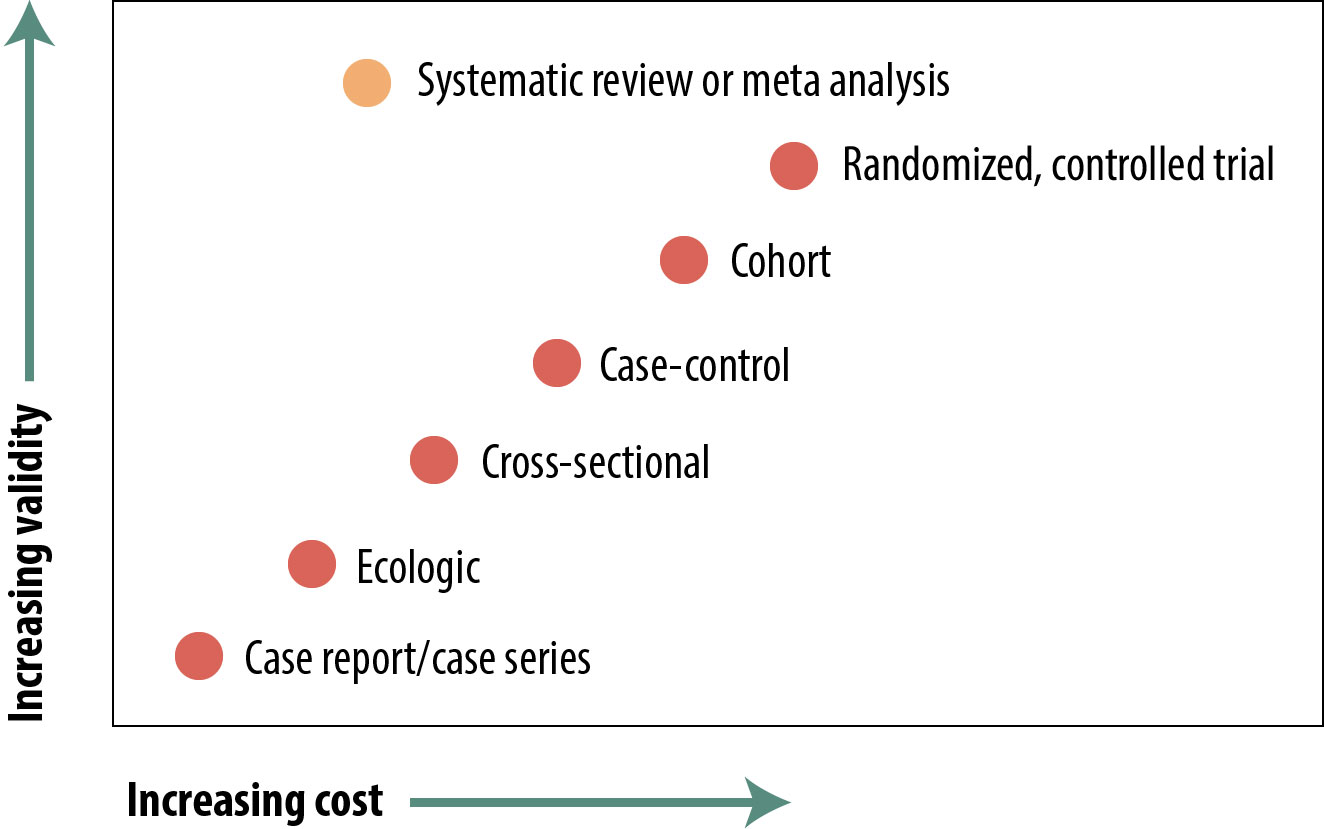
As you can see, cohort studies are placed higher on the "increasing validity" axis than case-control studies, which are in turn higher than cross-sectional studies. This is primarily because of their ability to establish temporality.
However, notice the x-axis: "Increasing cost." The designs that provide stronger evidence are also generally more expensive and complex to execute. This illustrates the central dilemma in study design: the choice is always a balance between scientific rigor and practical constraints. You might want the strong evidence of a cohort study, but if your disease is rare and your budget is small, a case-control study is the far more sensible, and often only feasible, option.
To see how these different approaches play out on the same research topic, consider the following example.
Study Designs – Epidemiology - Pressbooks at Virginia Tech
Let's return to the "Study Designs" chapter to see a practical example of how a research question could be tackled with two different designs.
Read the section under the heading "Example: Hospital-acquired infections". Notice how the cohort study starts with the surgery type (exposure) and looks for infections, while the case-control study starts with the infections (outcome) and looks for the associated surgery type. This highlights their fundamentally different logic.
Conclusion
You have now completed your overview of the three major observational study designs. The ability to compare and contrast them is essential for any work in data science related to health outcomes.
Here are the key takeaways from our comparison:
- Temporality is Key: Cohort studies are the strongest observationally because they establish a clear time sequence from exposure to outcome. Case-control studies look backward, and cross-sectional studies are a snapshot in time.
- No "Best" Design: The ideal design depends on the research question. For rare diseases, choose case-control. For rare exposures, choose cohort. To measure prevalence, choose cross-sectional.
- Trade-offs are Everything: There is a fundamental trade-off between the strength of evidence a design provides and its cost, time, and logistical complexity. A well-designed case-control study is often more valuable than a poorly executed cohort study.
In this lesson and the previous ones, we've repeatedly mentioned concepts like "selection bias" and "recall bias." While we have a general sense of what these are, our next lesson will formalize this topic. We will dive into the different types of systematic errors, or biases, that can threaten the validity of an epidemiological study and learn how to identify them.